

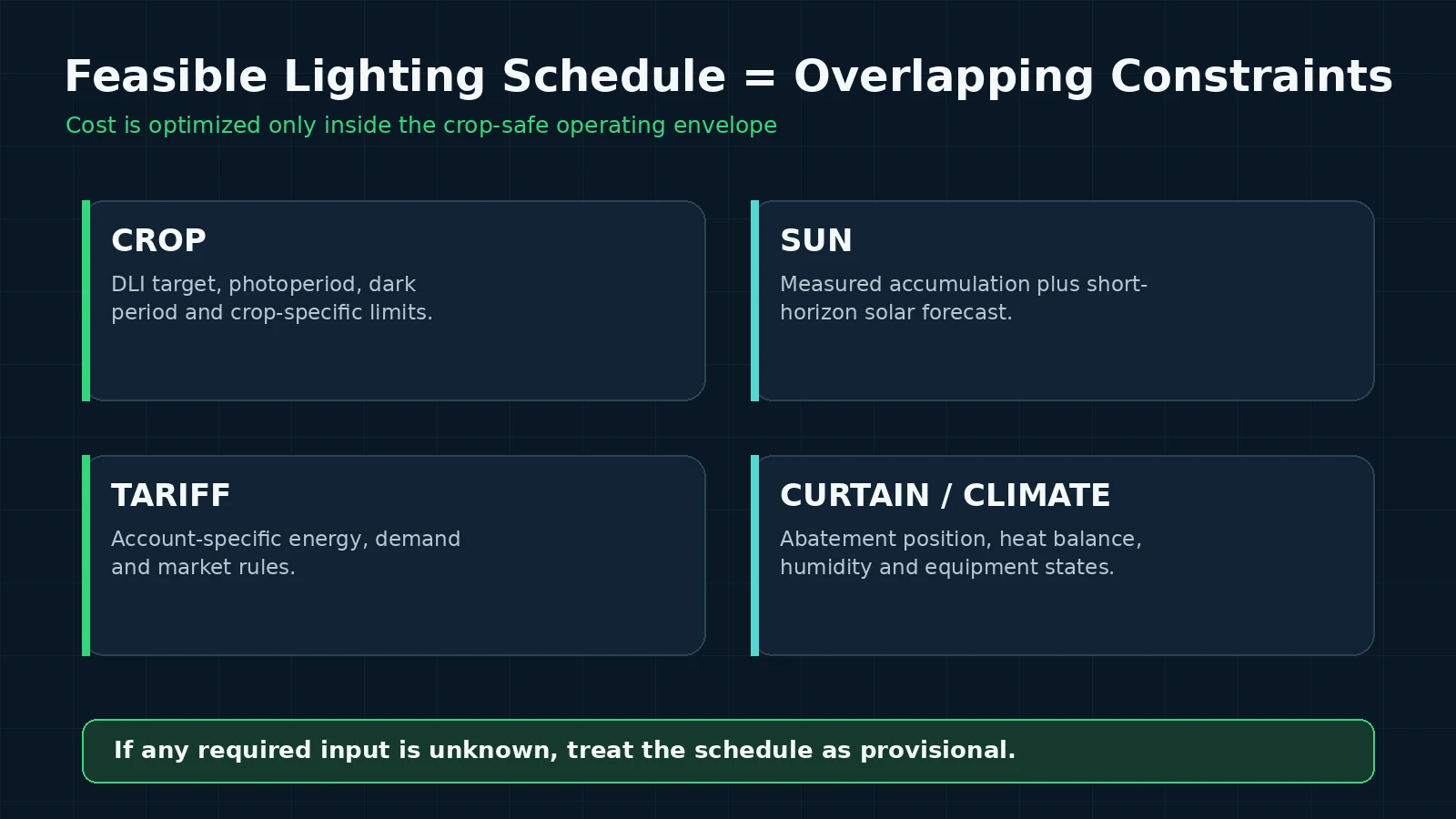
Greenhouse lighting schedule optimization is a constrained control problem, not simply “run lights off-peak.” The schedule must first satisfy crop DLI, photoperiod and dark-period requirements, then respect curtain permissions, climate capacity, electrical demand and the customer’s actual tariff. Use measured photon accumulation and short-horizon forecasts to update the remaining DLI, apply fail-safe limits, and verify the result against crop-level light and whole-site interval data.
Key Takeaways
- Confirm the utility account, rate class, effective date and billing determinants before modelling TOU or demand cost.
- Optimize the remaining daily photon requirement, not a fixed number of clock hours.
- Curtain position, humidity, heat balance and local light-abatement rules can make a low-price interval infeasible.
- Demand cost depends on the tariff’s interval and the whole-site coincident load, not fixture wattage alone.
- Commission sensors, zones, ramps, interlocks, manual override and data retention before relying on automated savings.
The cheapest electricity interval is not automatically the best time to light a greenhouse. A crop still needs an acceptable daily photon dose and photoperiod. A blackout or energy curtain may have deployment rules. Lighting can add sensible and radiant heat when the climate system is already constrained. The facility’s highest metered interval may occur outside a published time-of-use window.
A useful greenhouse lighting schedule optimization method therefore builds a feasible operating envelope first and minimizes cost second. It extends MarsEVOL’s DLI lighting control methodology without taking ownership of the broader tariff or electrical-design intents.
What Should a Greenhouse Lighting Schedule Optimize?
The objective may include energy cost, demand cost, peak contribution, crop-light consistency or a weighted combination. Write the objective explicitly and keep biological and legal requirements as constraints rather than soft assumptions. If the grower cannot miss the crop DLI or shorten the dark period, the optimizer must not trade those requirements away to produce a lower modelled bill.
For Ontario projects, the Ontario Energy Board’s public TOU and ultra-low-overnight pages apply to residential and small-business utility customers. A commercial greenhouse may instead have a distributor tariff, retail contract, market exposure, Global Adjustment treatment or demand billing that differs materially. As verified on 11 October 2026, the correct first step remains the current account schedule and distributor documentation—not a residential rate screenshot.
Which Inputs and Constraints Are Required?
Crop and lighting constraints
Record daily target, acceptable range, photoperiod, dark period, maximum canopy PPFD, stage, zone and response to interruptions. Keep crop values traceable to trials or authoritative evidence. The PPFD vs DLI guide explains why a daily total and an instantaneous ceiling are separate constraints.
Measured light and forecast
Use crop-level photon accumulation with sensor-quality flags. Add a short-horizon solar forecast if it improves decisions, but keep the controller able to recover from forecast error. An optimizer that assumes perfect sunlight will under-deliver on a cloudier day unless it retains a feasible catch-up window.
Account-specific electricity rules
Extract energy charges by period, demand calculation, billing interval, ratchets or peaks, fixed charges and any program rules that affect controllable load. The IESO Peak Tracker can inform eligible Ontario ICI customers about system peak risk, but eligibility and Global Adjustment treatment must be confirmed for the account. Use the broader greenhouse electricity tariffs guide for bill interpretation.
Curtain, climate and operating permissions
Translate current local light-abatement requirements and curtain hardware into explicit states. Also constrain lighting by indoor temperature, humidity, condensation risk, equipment availability, labour and maintenance windows. Read the greenhouse light-pollution checklist; local legal text and amendments always control.
6 Steps for Greenhouse Lighting Schedule Optimization
1. Start each day with a feasible photon and time budget
Load the crop target, permitted lighting window, zone limits, current tariff and curtain schedule. Validate sensor health and clock synchronization. If a required input is unavailable, fall back to a documented conservative mode rather than continuing an unbounded optimization.
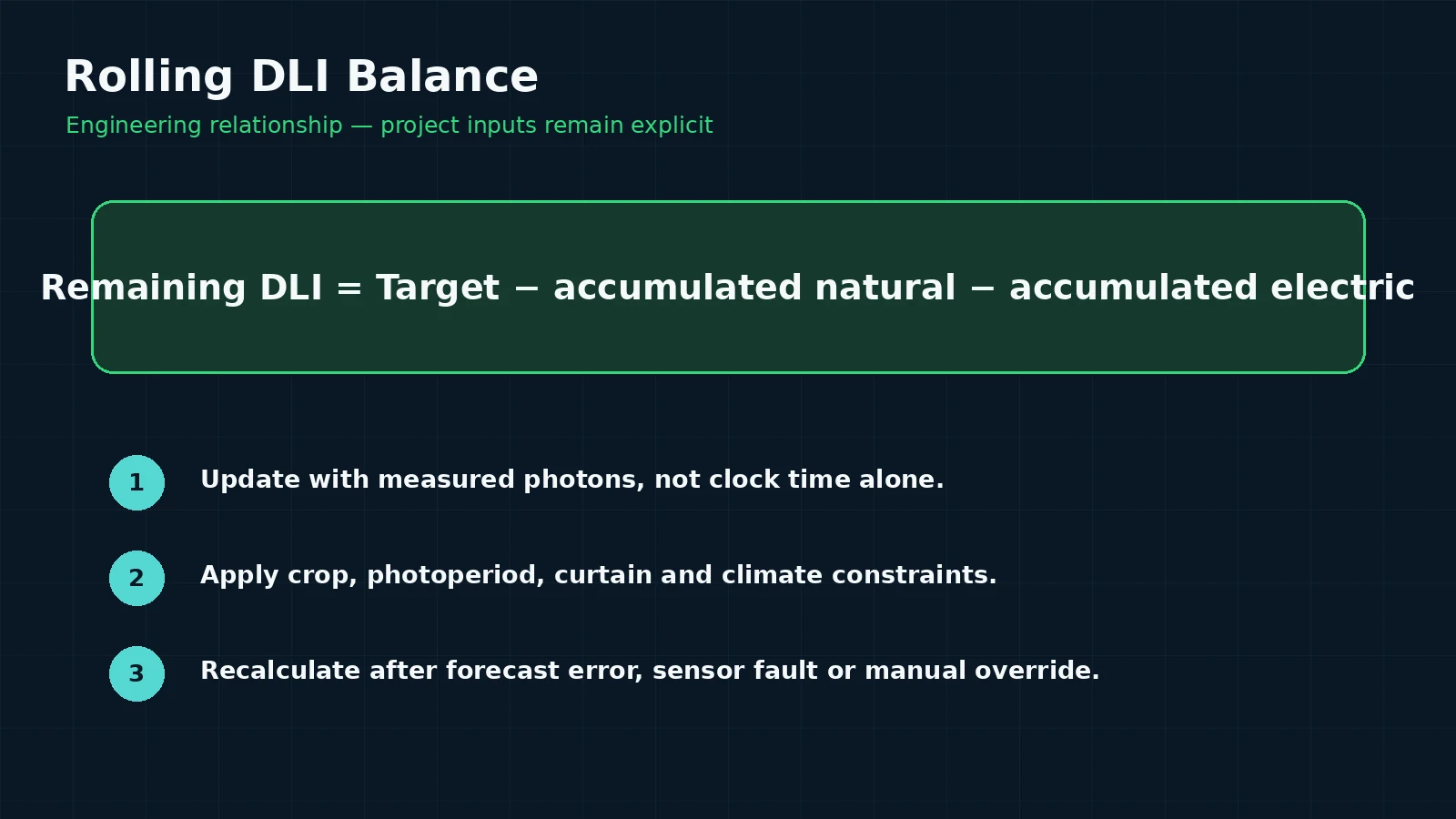
2. Update the remaining DLI from measurements
Engineering relationship
Remaining DLI = max(0, target DLI − accumulated natural DLI − accumulated electric DLI)
Recalculate through the day using quality-checked crop-level data. Keep natural and electric contributions separately auditable.
3. Forecast only across the controllable horizon
Estimate natural light and non-lighting site load for the next control horizon. Longer forecasts can support planning, but near-term commands should be refreshed as measured conditions diverge. Retain enough future capacity to meet the target if sunlight underperforms.
4. Enumerate feasible light states
For each zone and interval, apply dimming limits, ramp rate, minimum on/off state, crop ceiling, remaining photoperiod, curtain permission, climate capacity and electrical limit. Remove infeasible options before comparing cost.
5. Compare whole-site cost, not only lamp energy
Calculate the incremental bill effect under the actual tariff. Lighting may reduce energy cost by shifting intervals yet create a higher monthly demand if it overlaps another load. Conversely, dimming during a brief site peak may be valuable even if the energy price is unchanged. The decision must use whole-site interval data.
6. Command, measure and reconcile
Send the bounded setpoint, confirm device response and update measured accumulation. Log the reason for every override or fallback. At day end, reconcile delivered DLI, energy, demand, curtain state, alarms and missed constraints.
A Hypothetical Scheduling Decision
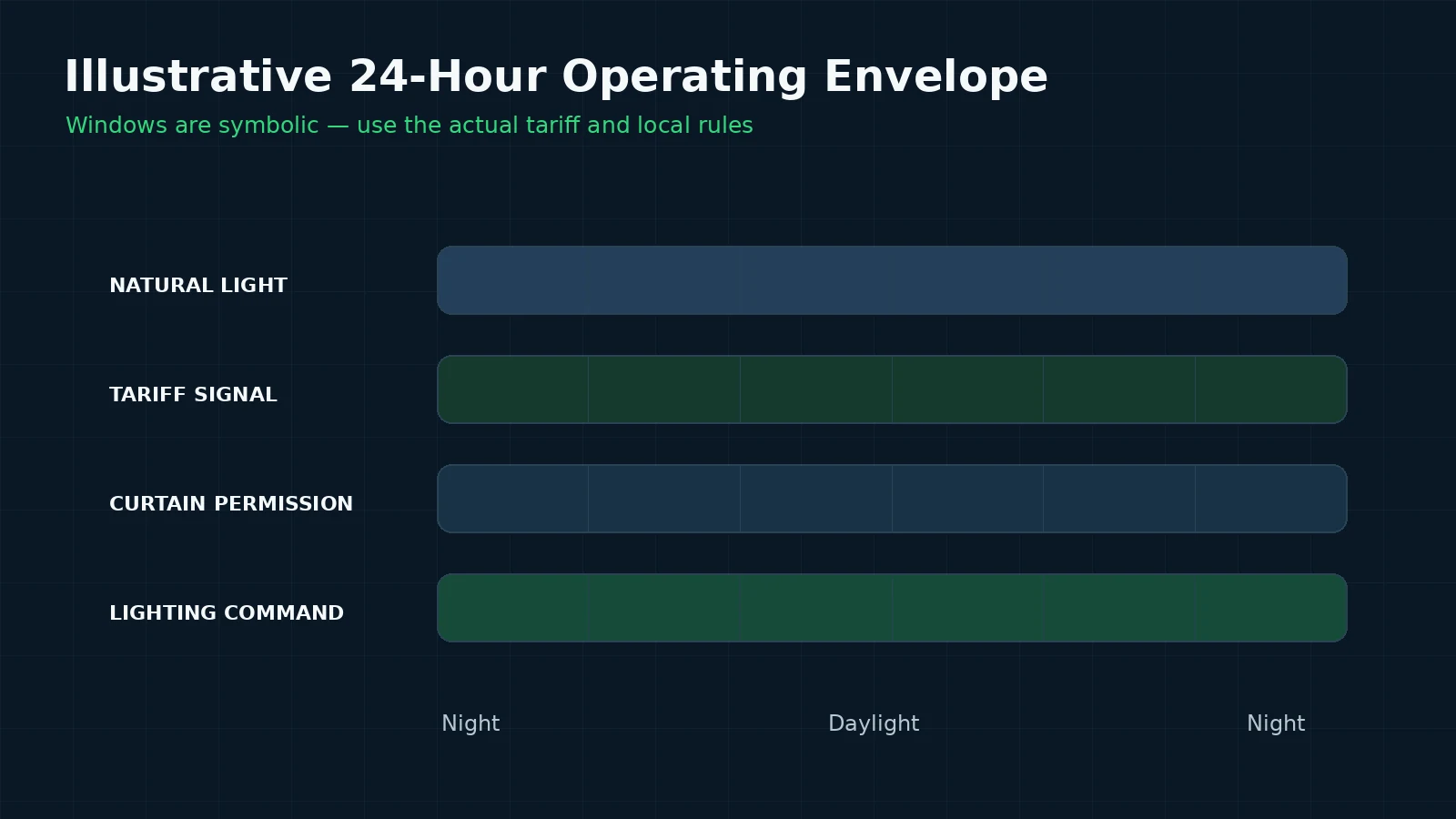
Assume a zone has a verified remaining DLI requirement and two feasible lighting windows. Window A has a lower energy rate but overlaps the facility’s irrigation and heating peak. Window B has a higher energy rate but lower whole-site demand and a more stable curtain state. The correct decision cannot be made from TOU alone.
| Check | Window A | Window B | Decision input |
|---|---|---|---|
| Crop DLI capacity | Feasible | Feasible | Measured remaining photons |
| Energy period | Lower example | Higher example | Current account tariff |
| Whole-site load | High overlap | Lower overlap | Interval meter/forecast |
| Curtain state | Transition risk | Stable permitted state | Current local rule and equipment |
| Climate capacity | Constrained | Available | Greenhouse controller |
This table intentionally contains no rates or promised savings. The inputs must be replaced with current project data. A transparent optimizer should show why a window was selected and which constraint would change the decision.
What Control and Fail-Safe Design Is Needed?
Align lighting zones with crop and curtain zones. Use a common time source across the greenhouse controller, meters and data historian. Set permissible output bounds and ramp rates. Confirm that a communications loss, sensor fault or curtain-position mismatch moves the system to an approved state.
Manual override should require an authorized operator, reason and expiry. Do not let an override silently persist into the next tariff or abatement window. The greenhouse lighting control system guide covers 0–10 V zoning and commissioning boundaries; product-specific capabilities must be confirmed in the final submittal.
For demand management, aggregate the commanded lighting load with other controllable and non-controllable loads. Circuit-level metering helps diagnose zones, but the utility billing point defines the actual site peak. Coordinate with the greenhouse lighting electrical design guide before relying on a maximum-load constraint.
How Should an Optimized Schedule Be Verified?
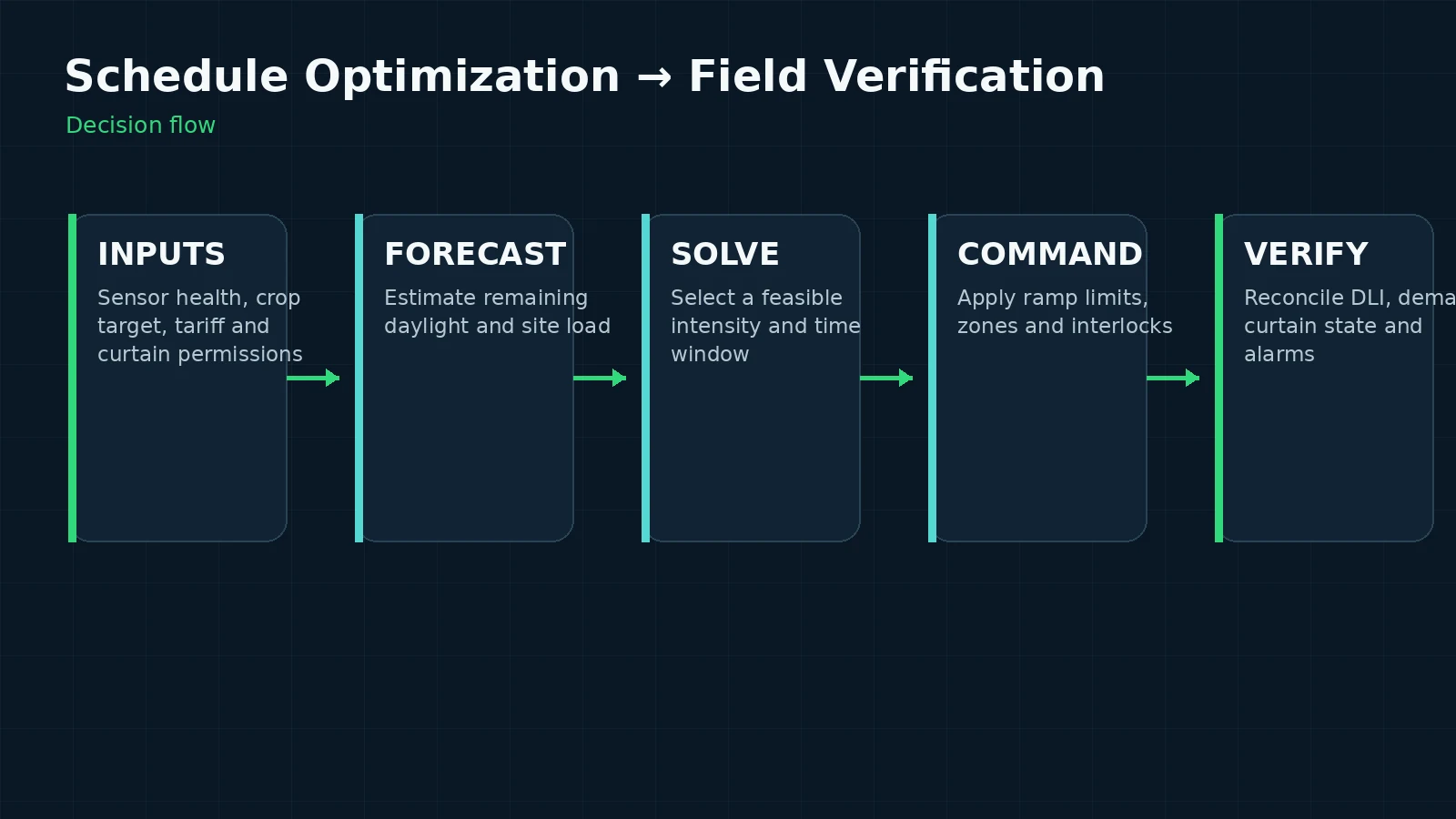
Commission in stages. First verify sensor calibration, placement and time alignment. Then test each lighting zone at defined outputs, confirm curtain permissives and exercise faults. Next run a representative day and reconcile crop-level DLI with controller accumulation. Finally compare whole-site interval demand and bill calculations over a long enough period to include relevant production and weather variability.
Use an acceptance table with required evidence: command, measured output, accumulated DLI, curtain position, alarm state and meter interval. A lower modelled cost is not acceptance if the crop target or safety logic was missed.
Common Schedule Optimization Mistakes
Using residential TOU rates for a commercial greenhouse
Rate class and account treatment may differ. Obtain the current utility bill and tariff.
Optimizing lamp kWh but ignoring demand
The bill may depend on the whole-site coincident peak and a defined interval. Model the billing determinant that actually applies.
Assuming a perfect solar forecast
Maintain catch-up capacity and refresh the plan with measured photons.
Treating curtains as a binary afterthought
Roof, sidewall and endwall states, travel time, gaps, alarms and local requirements must be translated into control permissions.
Claiming savings before baseline agreement
Define production, weather, tariff and baseline schedule. Report measured outcomes with uncertainty rather than a guaranteed percentage.
FAQ
Should greenhouse lights always run during off-peak hours?
No. Off-peak operation must still satisfy crop, curtain, climate, electrical and whole-site demand constraints.
Can DLI control eliminate a fixed schedule?
It can make output responsive, but the controller still needs permitted hours, photoperiod and fail-safe boundaries.
How often should the schedule recalculate?
Choose an interval consistent with sensor quality, dimming response, forecast value and control stability. Faster is not automatically better.
Can fixture wattage predict the demand charge?
No. Demand billing uses the account’s tariff rule and whole-site metered interval. Lighting matters through its coincidence with other loads.
What happens if a PAR sensor fails?
Enter a documented fallback with alarms and bounded output. Do not continue unconstrained optimization from invalid data.
Conclusion
Schedule optimization is valuable when it stays inside a verified operating envelope. Start with crop DLI and photoperiod, add measured sunlight, apply the actual tariff and whole-site load, translate curtain and climate states into permissions, then command and reconcile. That sequence can improve operational decisions without converting a forecast, rate table or optimization model into an unsupported crop or savings promise.
Build a Project-Specific Lighting Plan
Share crop targets, permitted hours, recent interval data, the current utility tariff, curtain requirements, zone list, electrical limits and control interfaces. MarsEVOL can help define a lighting schedule and preliminary control plan for project review.
Explore More MarsEVOL Resources
Build an auditable baseline before testing schedule changes.
Review tariffs, rebates and local-rule source pathways.
References
- Ontario Energy Board. Electricity rates. Official scope and pricing-plan information; verified 11 October 2026.
- Independent Electricity System Operator. Peak Tracker. Ontario system-demand and ICI peak information; verified 11 October 2026.
- van Iersel, M. W., and Gianino, D. An Adaptive Control Approach for LED Lights Can Reduce the Energy Costs of Supplemental Lighting in Greenhouses. HortScience (2017).
- Afzali, S., et al. Development and Implementation of an IoT-Enabled Optimal and Predictive Lighting Control System in Greenhouses. Plants (2021).
- Government of Ontario. Effect of greenhouse light-abatement curtains. Official Ontario research summary; verified 11 October 2026.