
The most useful greenhouse lighting resources connect your project location to the responsible rebate administrator, electricity supplier, permit authority and product verification database. Use this directory to find those sources, confirm the rules for your exact installation, and save dated evidence before procurement. Incentive availability, electricity charges and local requirements must be checked separately.
A lighting proposal can look attractive until the purchasing sequence disqualifies an incentive, a demand charge changes the bill, or a local curtain requirement changes operation. These are practical questions to resolve alongside the crop and design decisions in our greenhouse supplemental lighting guide.
Scope: commercial greenhouse projects in the United States and Canada, with regional examples. Sources checked: September 27, 2026. This page is a research route, not an eligibility determination or a live rate feed. DSIRE is a university-operated directory; DLC is a product qualification organization. Their listings serve different purposes from government rules and utility approvals.
Key Takeaways
- Identify the site, serving utility and project type before choosing a program or tariff.
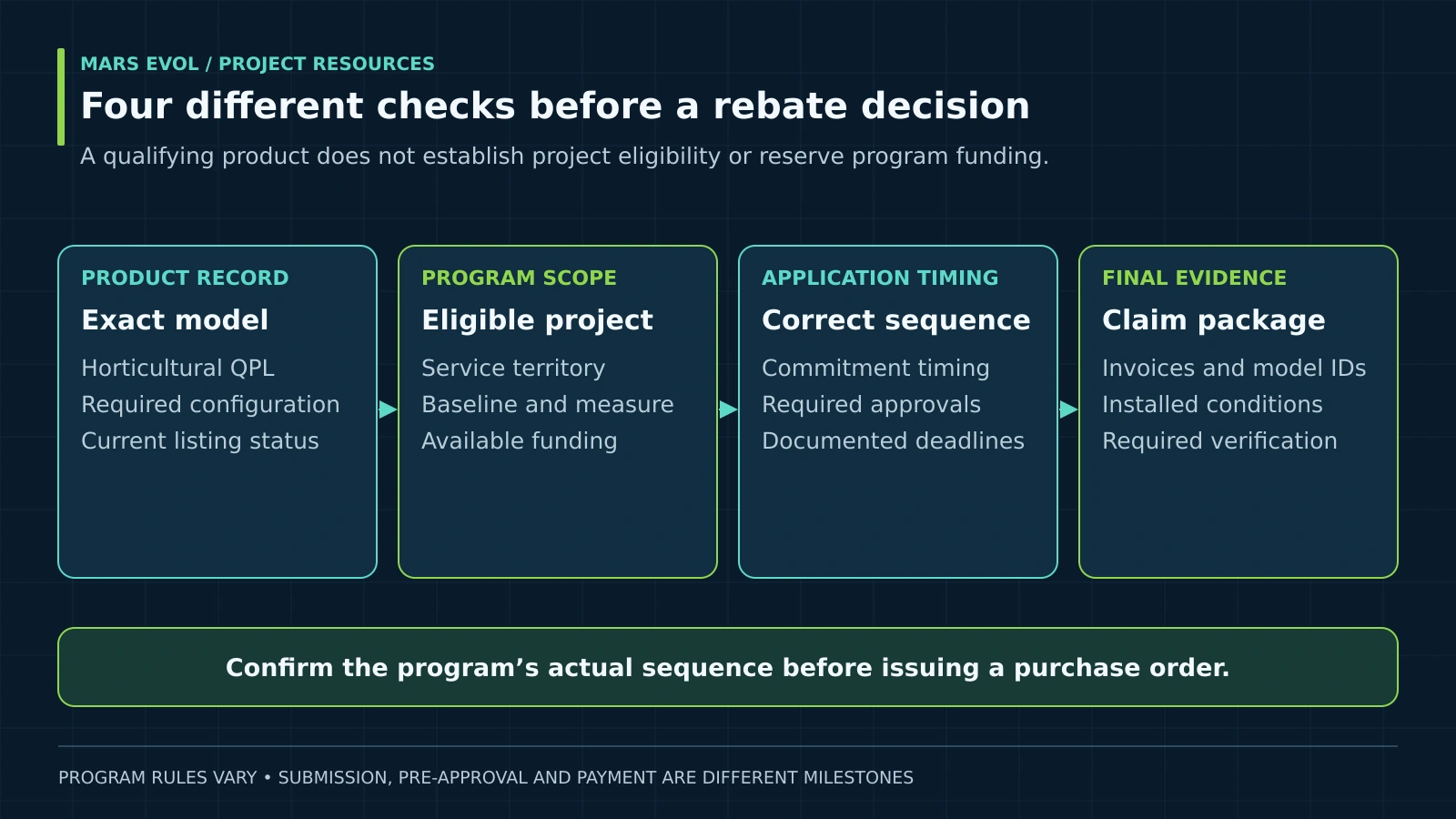
- Check application timing before signing a contract or placing an equipment order.
- Model energy and billed demand separately; regional averages are only benchmarks.
- Verify the exact fixture, local requirements and dated supporting documents.
How should you use these greenhouse lighting resources?
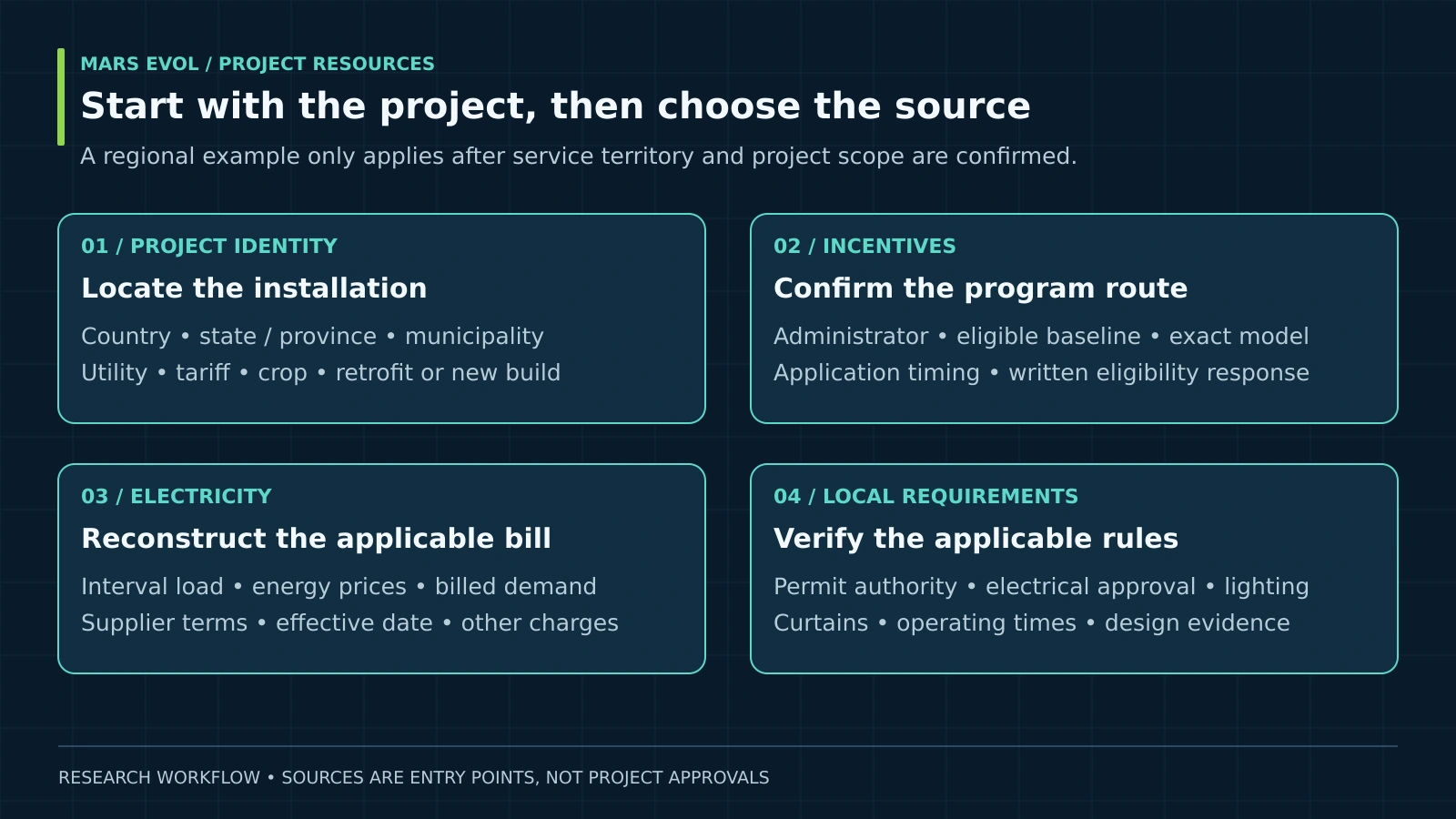
Build a short project brief first, then use the directories to locate the organization responsible for each decision. Record the postal or ZIP code, utility, tariff name, crop, illuminated area, existing lighting and proposed operating schedule. State whether the work is a retrofit, an expansion or new construction.
Keep the energy baseline explicit. Replacing HPS while maintaining the agreed crop-light target is a different case from adding lighting to an unlit greenhouse. Our LED versus HPS comparison explains why the lighting and heat boundaries matter. Ask the program administrator which baseline it accepts before preparing savings claims.
Where should you check greenhouse lighting rebates?
Start with a regional directory, then confirm eligibility with the administrator that will review and pay the claim. The four resources below are useful starting points; none promises funding for every greenhouse or lighting model.
| Resource and region | What to check | What to retain |
|---|---|---|
| DSIRE — United States | Search incentives by state or ZIP code; follow the program’s own website. | Administrator, service territory and current program link. |
| USDA REAP — United States | Applicant and project eligibility, application notices, audit requirements and state contacts. | Current notice and a project-specific response from the state office. |
| Save on Energy — Ontario | Retrofit horticultural lighting and controls, application sequence and accepted measures. | Applicable requirements, submitted agreement and pre-approval conditions. |
| BC Hydro — British Columbia | Business upgrade, energy management and new-construction routes for eligible customers. | Confirmed program route, baseline and required approval timing. |
Ontario timing matters. Save on Energy’s Retrofit FAQ requires application submission and acceptance of the Participant Agreement before a binding commitment, such as issuing a purchase order. Starting after submission but before pre-approval can still put the incentive at risk. Do not substitute “before installation” for the actual purchasing rule.
The REAP page states that grant applications are not currently being accepted. Its general loan notice must also be read with the separate CEA and biodigester pause letter, which extends the relevant loan-guarantee pause through December 31, 2026, unless superseded by further guidance. The FAQ excludes certain traditional greenhouse operations. Ask USDA to classify your specific project; neither a blanket “open” nor “all greenhouses excluded” statement is reliable.
For every program, ask about eligible costs, funding availability, incentive stacking, completion deadlines and post-installation evidence. Save the written answer. A supplier’s estimate is useful for planning, but the administrator’s decision controls the application.
Which electricity sources should shape the budget?
Use the tariff and supply arrangement that apply to the actual account. Use public price statistics to test assumptions and trends, not to replace a bill calculation.
| Resource and region | Use it for | Keep this distinction |
|---|---|---|
| EIA electricity data — United States | State and sector price trends; downloadable historical data. | Average retail prices are not your site’s marginal lighting cost. |
| PG&E tariffs — California service area | Electric schedules, eligibility provisions, time periods and effective dates. | Select the applicable agricultural or business schedule and supply arrangement. |
| BC Hydro Electric Tariff — service territory | Rate schedules, demand provisions and service terms. | The approved tariff governs; confirm the site’s rate class. |
| IESO Global Adjustment — Ontario | How GA treatment differs by customer class and billing arrangement. | A wholesale energy price alone does not represent the delivered bill. |
For Ontario, establish the account’s GA treatment: Class A, non-RPP Class B, or Regulated Price Plan billing. GA is already included in RPP rates, so adding it again would double count that component. Confirm the actual treatment with the local distribution company.
Collect interval consumption, seasonal schedules, energy prices, demand rules, fixed charges and supply-contract terms. Some demand provisions can preserve a charge based on earlier peaks. When prices change, update the effective-date assumption and rerun the model. The greenhouse lighting cost calculator guide develops the full project calculation.
Worked example: equal energy, different demand impact
Assume a constant 100 kW lighting load runs 12 hours daily for 30 days. Use a hypothetical flat energy price of US$0.12/kWh and one demand charge of US$15/kW per month. Assume no demand ratchet. These are teaching assumptions, not quoted tariffs.
Energy = 100 kW × 12 h/day × 30 days = 36,000 kWh
Energy charge = 36,000 kWh × US$0.12/kWh = US$4,320
Modeled increment = energy charge + incremental billed demand × demand rate
If lighting increases billed demand by 100 kW in Case A, the modeled increment is US$5,820. If a different whole-site operating profile limits that increase to 40 kW in Case B, it is US$4,920. The US$900 difference exists only under those assumptions. Fixed charges, other demand components, adjustments and taxes are excluded.
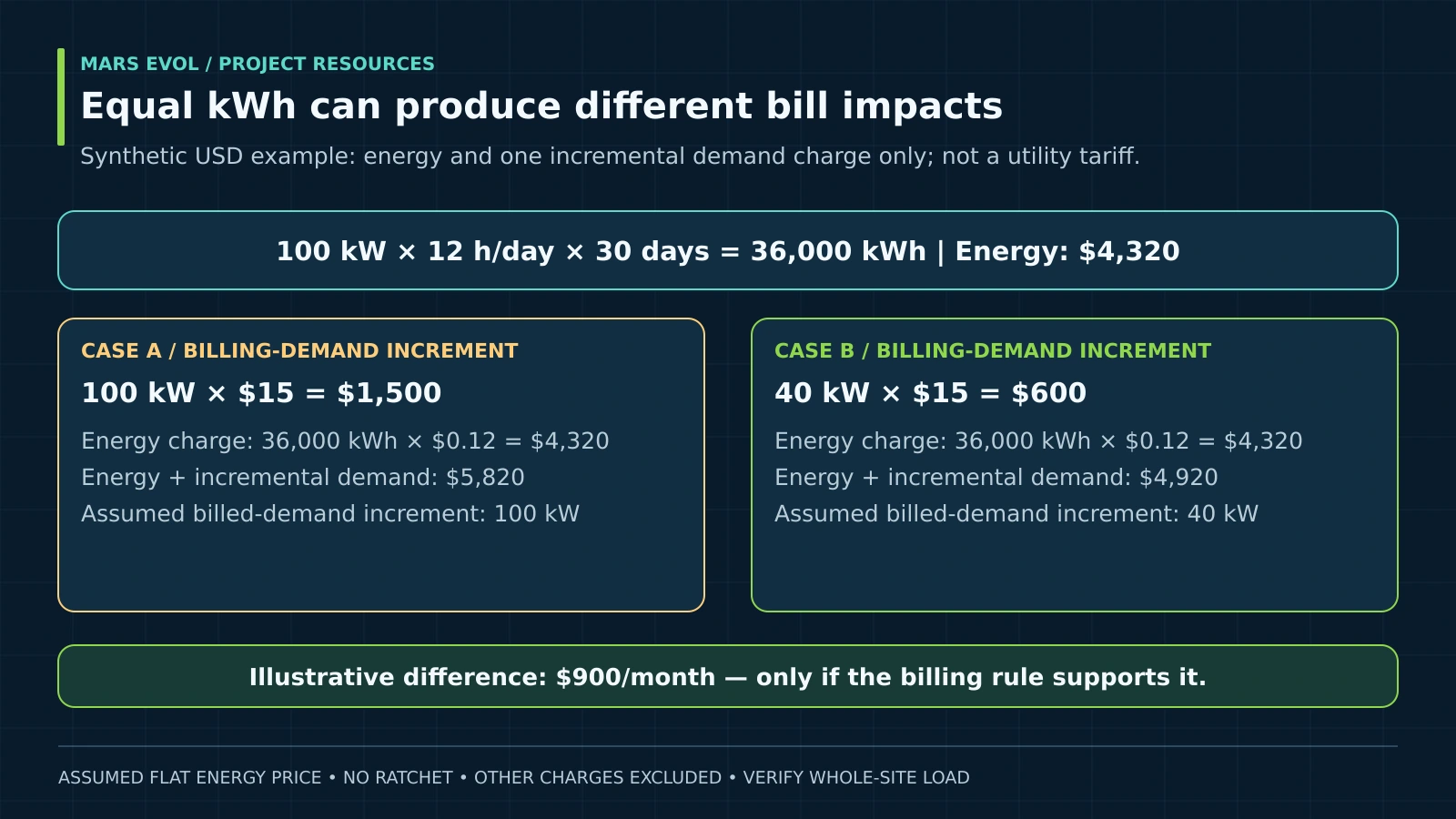
The 40 kW value must come from a whole-site interval comparison under the tariff’s billing method; it cannot be inferred from fixture nameplate power. Moving lighting hours may leave the billed peak unchanged. Any schedule change must also respect the crop’s light target, photoperiod, climate limits and local rules. Use DLI lighting control to assess the crop-light side of that decision.
Where do local rules and product checks belong?
Check them before the design and equipment order are fixed. The applicable permit authority, electrical authority and program administrator may require different evidence.
| Resource | What it helps establish | Scope limit |
|---|---|---|
| California Energy Commission — CEH FAQs | Energy Code provisions for horticultural lighting, controls and project alterations. | Confirm the applicable edition, project scope and permit interpretation. |
| Leamington — greenhouse light abatement | Municipal requirements affecting curtains and lighting operation. | This is a local example, not a Canada-wide rule. |
| DLC — Horticultural QPL | Exact model and configuration in the relevant qualification database. | A listing alone does not approve a rebate or installation. |
| OSHA — NRTL Program | Recognized laboratories, their scope and certification marks. | Laboratory recognition is not an individual fixture certificate. |
| Ontario ESA — approval marks | Recognized Canadian product approval and field-evaluation markings. | A component mark does not approve the complete luminaire. |
California’s CEH guidance addresses new spaces and specified changes to existing installations. Ask the authority having jurisdiction which provisions apply to the actual project rather than copying one efficacy threshold into every specification. Leamington illustrates another design issue: curtain operation and light containment may need to be coordinated with climate control.
For product verification, match the full model identifier, voltage, configuration and intended environment to the relevant listing or certification record. Ask for supporting documents when the sales description is broader than the evidence. The electrical planning guide covers the information to coordinate with the project’s qualified electrical designer.
How do you keep the resource set useful?
Maintain a small evidence register with a named owner. A working link is not enough: the linked document must support the decision you are making.
- At feasibility: identify the program, tariff and local authority; record unresolved eligibility questions.
- Before commitment: recheck application timing, funding, exact model and approved scope.
- Before installation: confirm permits, design revisions and control requirements.
- At handover and claim: retain invoices, settings, verification results and submission deadlines.
Record the official URL, document edition, effective date, date checked, relevant clause, saved evidence and person responsible. During operation, review electricity bills monthly and revisit assumptions when a tariff, program or design changes. These are recommended review practices, not a universal compliance timetable.
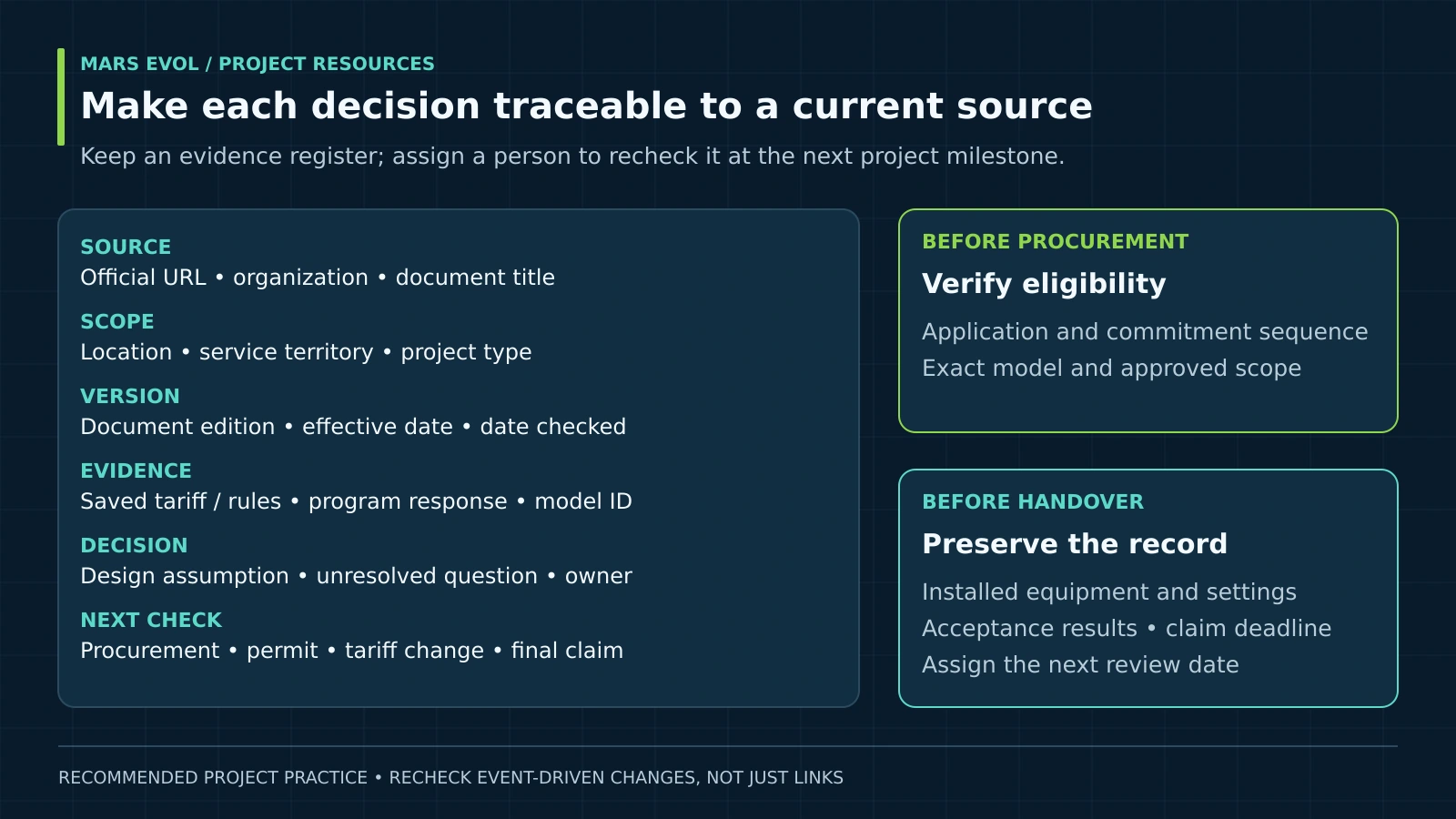
Connect the evidence register to the commissioning and handover record. That makes it easier to show what was actually installed and which assumptions were accepted, instead of reconstructing the project when a reviewer asks for evidence.
Common mistakes that weaken a project decision
- Ordering too early: an application deadline may precede the purchase commitment.
- Using the wrong tariff: residential prices or statewide averages may misrepresent commercial demand charges.
- Equating qualification with approval: product listing, electrical acceptance and rebate eligibility answer different questions.
- Copying another region’s rules: a nearby greenhouse may have a different utility, permit scope or municipal requirement.
- Keeping an undated estimate: an old screenshot cannot establish the current funding window or rate.
FAQs about greenhouse lighting resources
Is there one website that confirms everything?
No. Use a directory to find programs, the serving utility for account-specific rates, the relevant authority for local requirements and the appropriate database for product evidence. Keep their decisions separate in the project record.
Does a DLC-listed grow light automatically receive a rebate?
No. Confirm the exact listing and the selected program’s requirements, then establish project eligibility, timing and documentation. A product-level qualification does not reserve funds or approve a particular installation.
Can I apply after placing the order?
Check before ordering. Some programs treat a purchase order or signed contract as a binding commitment. Ontario’s Retrofit FAQ specifies application and agreement requirements before that point. Other programs may use different milestones.
Should I follow daily electricity prices?
Only if those prices affect the account’s charges or contract. Start with the actual tariff and bill components. A market-price dashboard is useful context, but it cannot show every demand, delivery or adjustment charge.
How often should these sources be rechecked?
Recheck at procurement, permit submission, design changes and the final claim. Review rate assumptions when new schedules take effect. Assign a responsible person; this article’s verification date does not mean that linked pages are monitored automatically.
The MarsEVOL Perspective
Useful greenhouse lighting resources turn broad claims into specific questions for a proposal. Request the proposed model’s power, photon-output data, controls and supporting qualification documents. For a SOLIFY PRO proposal, verify the exact offered configuration rather than assuming every variant carries the same listing. Budget the project both with and without an unapproved incentive.
Conclusion
Use this directory to connect location, funding, electricity charges and local requirements before procurement. The durable practice is simple: identify the responsible source, verify the project’s scope, preserve dated evidence and revisit the decision when its assumptions change.
Build a lighting proposal around your project conditions
Share the project location, serving utility, crop, existing lighting, proposed schedule and retrofit or new-build scope. Include known program or permit requirements so the proposal can address the right technical questions.
Explore More MarsEVOL Resources
Compare technical assumptions, operating conditions and supporting evidence before selecting a system.
Keep inspection, cleaning and performance records useful throughout operation.
References
Official and first-party sources checked September 27, 2026. Live pages may change; confirm the version applicable to your project.
- N.C. Clean Energy Technology Center, NC State University. DSIRE. Live incentive and policy directory; accessed 2026.
- USDA Rural Development. Rural Energy for America Program. Live program guidance and application notice; accessed 2026.
- USDA Rural Development. Continued pause on CEA and biodigester projects. 2026 administrative letter and FAQs; accessed 2026.
- IESO / Save on Energy. Frequently Asked Retrofit Questions. Live program requirements guidance; accessed 2026.
- BC Hydro. Programs and incentives. Live business program directory; accessed 2026.
- U.S. Energy Information Administration. Electricity Data. Live electricity statistics and download index; accessed 2026.
- Pacific Gas and Electric Company. Tariffs. Current schedules, rules and historical information; accessed 2026.
- BC Hydro. Electric Tariff. Current tariff and approved-version guidance; accessed 2026.
- Independent Electricity System Operator. Global Adjustment. Live Ontario billing guidance; accessed 2026.
- California Energy Commission. 2025 Controlled Environment Horticulture FAQs. 2025 Energy Code support resource; accessed 2026.
- Municipality of Leamington. Legal Services: Greenhouse Light Abatement. By-law 41-22 guidance and official by-law link; accessed 2026.
- DesignLights Consortium. Qualified Products Lists: Horticultural Lighting. Live product qualification directory; accessed 2026.
- U.S. Occupational Safety and Health Administration. Nationally Recognized Testing Laboratory Program. Live laboratory recognition guidance; accessed 2026.
- Electrical Safety Authority, Ontario. Search for an Approval Mark. Live recognized marks and component limitations; accessed 2026.