
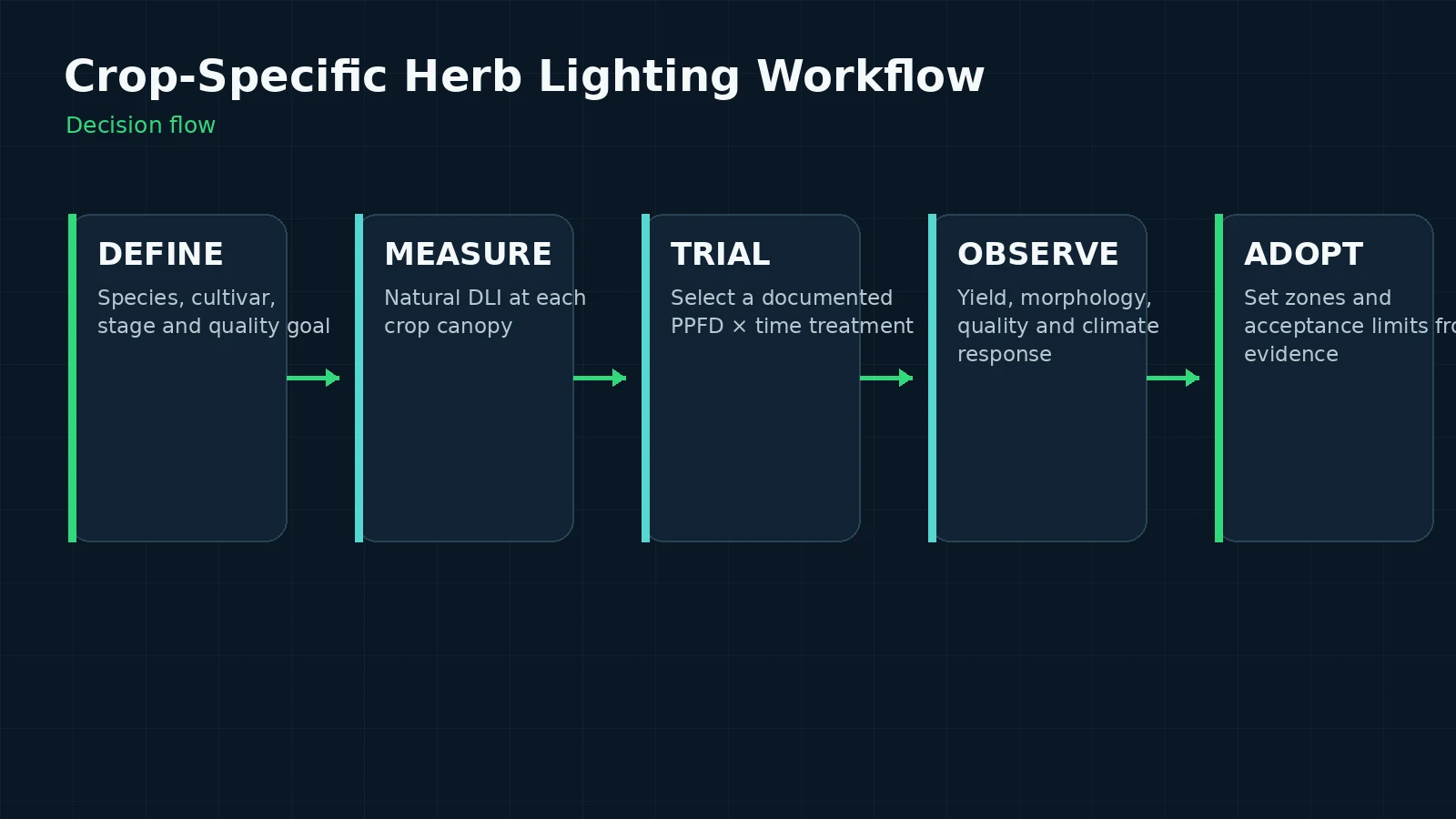
Herb greenhouse lighting should not use one universal DLI or PPFD recipe for basil, cilantro and fenugreek. Define the species, cultivar, crop stage, density and harvest objective; measure natural DLI at each canopy; choose a documented trial range; and evaluate fresh mass, morphology, quality and days to harvest under the same climate conditions. A shared lighting system is reasonable only when zones or an explicitly tested compromise keep every crop inside its acceptable operating envelope.
Key Takeaways
- Basil has useful controlled-environment evidence, but published treatments remain cultivar-, stage- and system-specific.
- Cilantro lighting must be interpreted with temperature, bolting, canopy closure and harvest timing.
- Fenugreek grown for microgreens, shoots or mature leaves is not one production target; start with a measured trial where crop-specific evidence is limited.
- Equal DLI does not guarantee equal morphology when intensity, photoperiod, spectrum or temperature differs.
- Use separate control zones when crop windows do not overlap, and verify the actual canopy distribution after installation.
Herbs are often grouped commercially because they share benches, channels or harvest workflows. Their lighting decisions are not automatically interchangeable. Species, cultivar, propagation history, crop age, plant density and marketable quality can change the response to the same photon dose. A robust herb greenhouse lighting plan therefore starts with the crop objective, not a copied fixture setpoint.
This article is an application layer within MarsEVOL’s greenhouse supplemental lighting framework. It does not replace crop trials or claim a universal recipe for three biologically different herbs.
Why Do Basil, Cilantro and Fenugreek Need Separate Light Plans?
DLI describes daily photon quantity, but plants also experience intensity, duration, spectrum, temperature and timing. A 2024 basil study held DLI constant while varying intensity and photoperiod and still observed differences in growth and phytochemical responses. That result is a useful warning: matching one daily number does not prove that two schedules are biologically equivalent.
Production objectives differ too. Basil may be sold as a large-leaf bunch, living plant or processed ingredient. Cilantro may be harvested before bolting for leaf quality. Fenugreek may be grown as a microgreen, tender shoot or mature leaf crop. Each objective changes the stage, density, height and quality criteria used to judge a lighting treatment.
How Should Each Herb Be Framed?
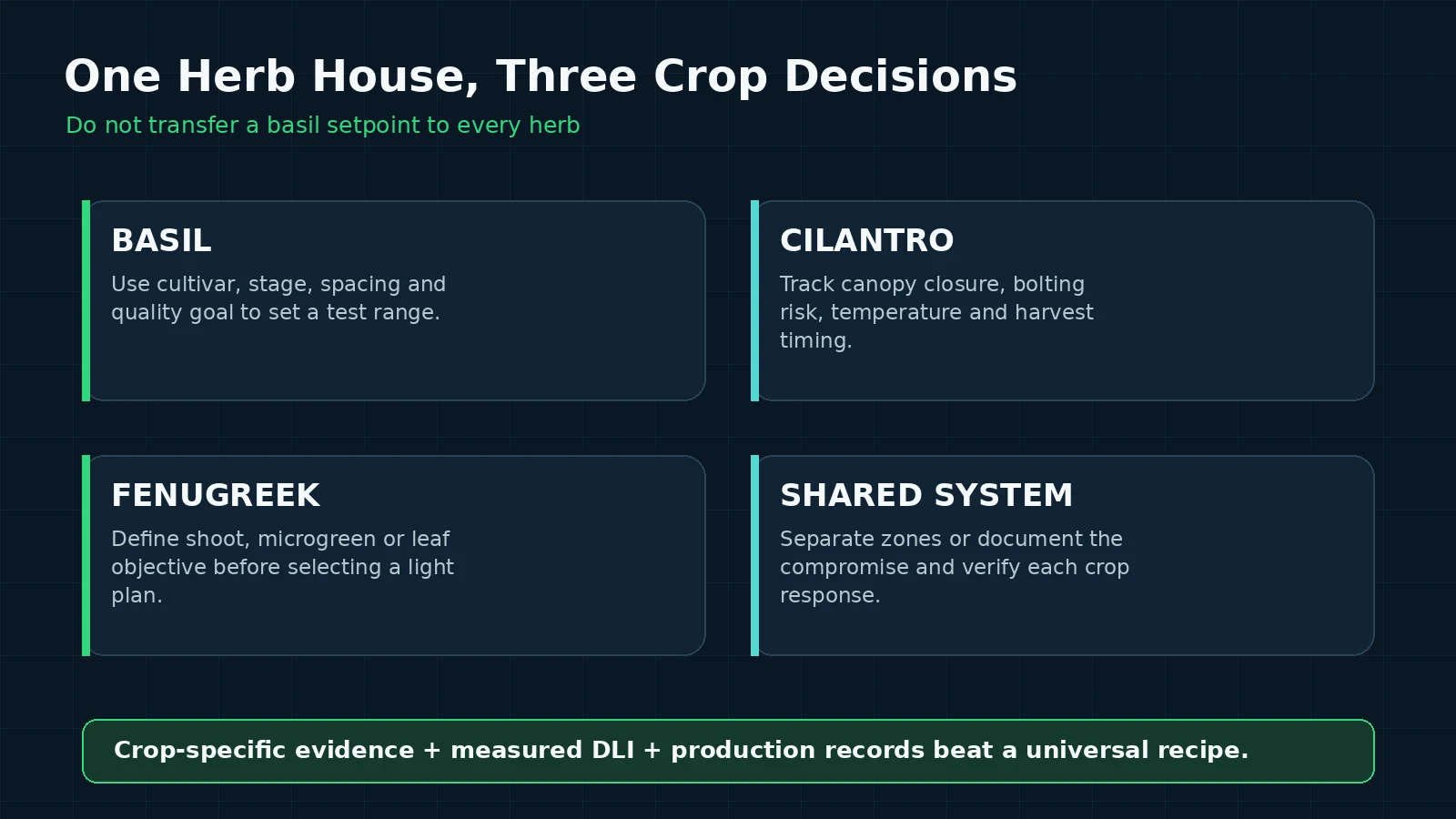
Basil: use evidence, then narrow it to the actual cultivar and system
Basil has a growing research base. Michigan State University Extension has reported greenhouse culinary-herb work comparing light environments, and peer-reviewed studies have tested DLI, intensity, duration and spectrum. These sources can define a sensible test range, but the result still depends on cultivar, stage, CO₂, temperature, nutrition and harvest metric. Do not present a single paper’s best treatment as a guaranteed commercial optimum.
Cilantro: integrate light with temperature and bolting management
Cilantro is a cool-season crop whose market value depends on leaf quality and harvest timing. Penn State Extension’s crop guidance emphasizes its production characteristics; a greenhouse lighting test should record temperature and bolting alongside photons. More light may accelerate biomass accumulation, but the commercial result is unacceptable if climate or photoperiod drives premature reproductive development.
Fenugreek: define the product before defining the light target
“Fenugreek” can describe different harvested products. A dense microgreen tray and a mature leaf crop have different canopies, cycle lengths and quality metrics. Where greenhouse DLI evidence for the exact production format is limited, use conservative engineering: measure the baseline, create a small controlled range, record response and scale only after the crop window is demonstrated.
7 Essential Herb Greenhouse Lighting Planning Checks
1. Name the crop, cultivar, stage and harvest specification
Record whether the decision concerns propagation, finishing, regrowth after cutting or a complete crop cycle. Define marketable height, leaf size, color, aroma, fresh mass, shelf-life or other relevant acceptance measures.
2. Measure natural DLI at each crop canopy
Bench height, plant height, hanging baskets, structural shade and neighboring crops can create different light environments in one compartment. Place calibrated sensors or conduct a mapped campaign at the real canopy plane. Use the method in the PAR sensor placement guide.
3. Separate daily photon quantity from intensity and duration
Engineering relationship
DLI (mol·m⁻²·d⁻¹) = average PPFD (µmol·m⁻²·s⁻¹) × light hours × 0.0036
This conversion is valid for the stated average and time window. Two treatments with the same DLI can still differ in morphology or quality because intensity and duration are biological variables.
4. Keep spectrum claims inside the evidence
Do not assume a color ratio will improve aroma, yield or appearance across all herbs. If spectrum is adjustable, state the actual channel output and test objective. If it is fixed, characterize the luminaire using appropriate official documentation and evaluate the crop response under the full greenhouse spectrum.
5. Coordinate temperature, humidity, irrigation and CO₂
Lighting changes leaf energy balance and crop demand. A comparison is hard to interpret if one zone also differs in root temperature, vapour-pressure conditions or irrigation timing. Log climate with the light treatment and avoid claiming causation from photons alone.
6. Decide whether crops can share a control zone
A shared zone is an engineering compromise. Define the overlap among acceptable DLI, photoperiod, schedule and canopy PPFD for every crop. If no practical overlap exists, separate the zones, crop cycles or compartments rather than forcing one setpoint.
7. Define verification before procurement
Specify measurement grid, canopy plane, electric-only test condition, allowable dimming state and acceptance metrics. See the PPFD uniformity guide and greenhouse lighting commissioning guide for a field-ready boundary.
How Can a Grower Run a Useful Herb Lighting Trial?
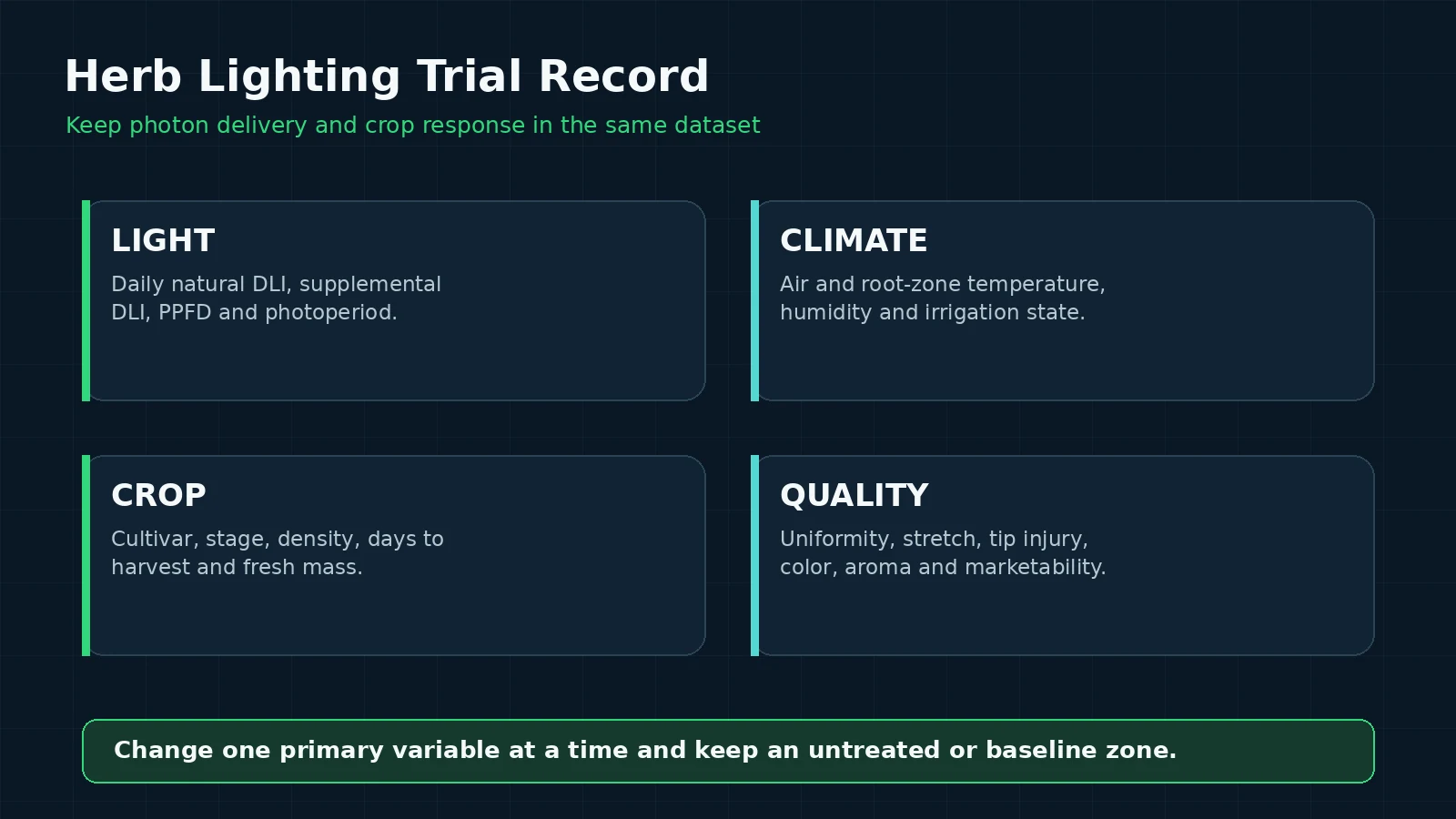
Start small enough to control confounding variables but large enough to represent commercial density and edge effects. Use at least a baseline and one proposed treatment. Randomize or replicate where practical. Keep the fixture geometry, nutrition and climate comparable, and change one primary light variable at a time.
| Record | Minimum useful fields | Why it matters |
|---|---|---|
| Crop identity | Species, cultivar, lot, stage, density | Prevents results being generalized to a different crop |
| Photon delivery | Natural DLI, electric DLI, PPFD map, hours | Separates daily quantity from distribution and timing |
| Climate | Air/root temperature, humidity, irrigation, CO₂ state | Exposes important confounding variables |
| Production | Days, fresh mass, marketable fraction, labour | Connects biology to commercial performance |
| Quality | Height, stretch, color, injury, aroma or shelf life | Prevents yield alone from defining success |
Use a pre-written acceptance rule. For example, the treatment may need to improve marketable fresh mass without exceeding an agreed height, bolting incidence or quality threshold. The point is not to manufacture a positive result. It is to decide what evidence would justify adoption.
How Should the Lighting System Support Mixed Herbs?
Build the layout around planted benches or channels, not gross room area. Model mounting height, fixture-to-canopy distance and obstructions. A crop mix with different heights may require separate measurement planes or operating states. The greenhouse lighting layout guide shows how geometry affects distribution.
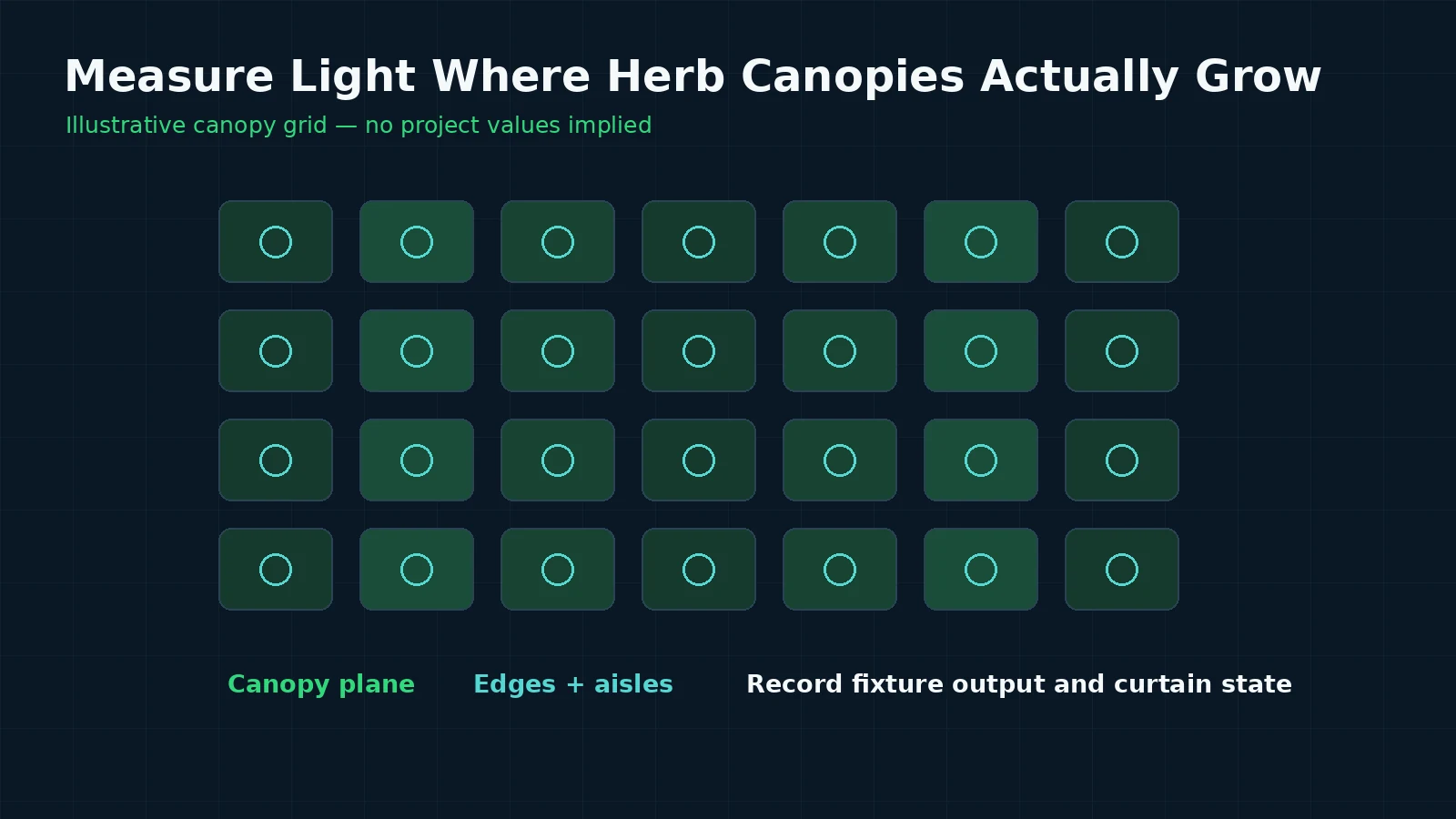
Controls should align with real crop zones. A useful zone schedule identifies crop, stage, target accumulation, maximum or minimum output, permitted hours and sensor inputs. If benches change crops frequently, make the recipe assignment explicit and keep a revision log. For implementation, use the greenhouse lighting control system guide and DLI control guide.
From the MarsEVOL perspective, fixture efficacy is only one selection input. The proposal must connect the crop trial to a buildable layout, available electrical service, control zones, dimming method and a field-verification procedure. No product parameter should be inferred if it is not present in the final approved submittal.
Common Herb Lighting Mistakes
Using a basil result for cilantro or fenugreek
Crop identity is not a minor variable. Use the paper to inform a test, not to erase species differences.
Reporting PPFD without daily duration
An instantaneous value cannot describe daily photon delivery. Record intensity, hours and natural-light contribution.
Changing light and climate together
A hotter or drier treatment may change growth independently. Log and control climate or state the limitation.
Measuring only the centre of the bench
Edges, aisles and zone boundaries can determine the marketable fraction. Use an agreed grid and include minimum values.
Scaling before the quality response is known
Yield can improve while morphology, aroma or shelf life becomes unacceptable. Define the full market specification first.
FAQ
What DLI should I use for basil?
Use cultivar- and stage-relevant research to choose a trial range, then verify under your climate and market specification. Published values are treatments, not universal guarantees.
Can cilantro and basil share one lighting zone?
Only if a documented operating window satisfies both crops. Otherwise separate controls, schedules or production areas.
Does fenugreek need the same light as other microgreens?
Do not assume so. Product stage, density, cycle length and quality objective must match the evidence; run a measured trial when exact data is limited.
Is equal DLI enough for an equal crop response?
No. Intensity, photoperiod, spectrum and climate can alter morphology and secondary metabolism even when daily photons are equal.
How large should a trial be?
Large enough to include normal density and edge effects, with replication where practical, but small enough to maintain comparable climate and operations.
Conclusion
Good herb greenhouse lighting is crop-specific and evidence-led. Define what basil, cilantro or fenugreek product is being sold, measure the actual canopy light, choose a documented treatment range, record climate and quality, and adopt only the operating window supported by the trial. Then translate that window into zones, geometry, power, controls and commissioning.
Build a Project-Specific Lighting Plan
Send the crop and cultivar list, production stages, bench dimensions, canopy heights, winter DLI records, harvest specifications and control constraints. MarsEVOL can prepare a preliminary layout and zoning plan for review.
Explore More MarsEVOL Resources
Connect the herb trial to a documented winter natural-light deficit.
Use photon balance as a feasibility check before photometric layout.
References
- Michigan State University Extension. Increasing Daily Light Integral Increases Culinary Herb Growth. Official Extension publication; verified 11 October 2026.
- Penn State Extension. Cilantro, a Unique Culinary Herb. Official crop guidance; verified 11 October 2026.
- BMC Plant Biology. Growth, phytochemical, and phytohormonal responses of basil to different light durations and intensities under constant DLI (2024).
- HortScience / PubMed. Modeling purple basil, sage, spearmint, and sweet basil responses to DLI and mean daily temperature (2023).
- ASABE. ANSI/ASABE S640: Quantities and Units of Electromagnetic Radiation for Plants.