
An engineering guide to research greenhouse bench controls, independently managed light recipes, accurate measurements and reproducible crop trials. Begin by identifying measured conditions, allowed variability and the people authorized to approve changes; do not mistake a design number for a field result.
Key Takeaways
- Use the scientific experimental treatment, not a cable circuit, as the starting definition of independence.
- Document fixture configuration, measurement plane, control settings and daylight assumptions.
- Separate design calculations, actual readings and crop-response evidence.
- Set explicit acceptance methods and operating responsibilities before purchase.
- Keep traceable records and revisions as the greenhouse configuration changes.
research bench lighting controls require more than an appropriate spectrum and a set of identical light fixtures. Researchers, growers and integrators must agree what the plant actually experiences, how it is measured and what can change without compromising the study. This guide explains the responsibilities, engineering inputs and tests that connect a commercial greenhouse lighting package to a defensible trial.
It complements the existing supplemental lighting engineering, greenhouse lighting design inputs and greenhouse bench layout resources. The focus is narrower than general luminaire selection or a whole-building PPFD map. All technical decisions below remain project-specific; no universal crop recipe, performance guarantee or unverified search-volume figure is implied.
Why bench-level control deserves its own design
A greenhouse bench is an experimental unit only when the research plan defines what is being compared and how unwanted variability is controlled. A single roof bay may contain several crop species or weed treatments, different sowing dates, and distinct light-response questions. Treating every luminaire on one electrical circuit as one experiment can erase these distinctions. Good research bench lighting controls begin by separating the scientific treatment boundary from the wiring boundary and the operator’s screen. Those boundaries may overlap, but they are not synonyms.
Before choosing a dimming controller, ask the principal investigator which variables are intentionally varied: supplemental PPFD, daily light integral, photoperiod, spectral treatment, or a fixed reference condition. Identify biological replicates, controls, randomization and experimental blocks. Then specify what independence is required for each group. If a controller can address individual fixtures but an aisle receives uncontrolled spillover from adjacent groups, the study does not achieve independent light delivery merely because the software shows separate channels. Provide a short, dimensioned treatment matrix that researchers and installation technicians can read together.
Define a bench-and-treatment inventory
Start with an asset schedule rather than a generic promise of independent dimming. Record the measured length and width of every planted bench, height above floor, likely mature canopy elevation, crop or treatment name, and electrical outlet or distribution location. Record what structures can carry suspension loads and where irrigation, shade screens, ventilation and crop support systems may interfere with the chosen light geometry. Include research access needs: technicians should not have to move a sensor or unplug a shared fixture every time they sample plants.
Each bench should have a stable ID independent of its seasonal crop assignment. Build a relation between bench ID, experimental treatment ID, luminaire group, driver and circuit. State whether independent control means separate setpoint, separate photoperiod or physical light isolation; those are different requirements. For preliminary proposals, distinguish confirmed dimensions from assumptions. Where the investigator has given only a nominal PPFD target and a bench plan, do not treat that as sufficient evidence to select the exact number of fixtures. The light distribution and target measurement height remain open engineering inputs.
Separate electrical circuits from controllable groups
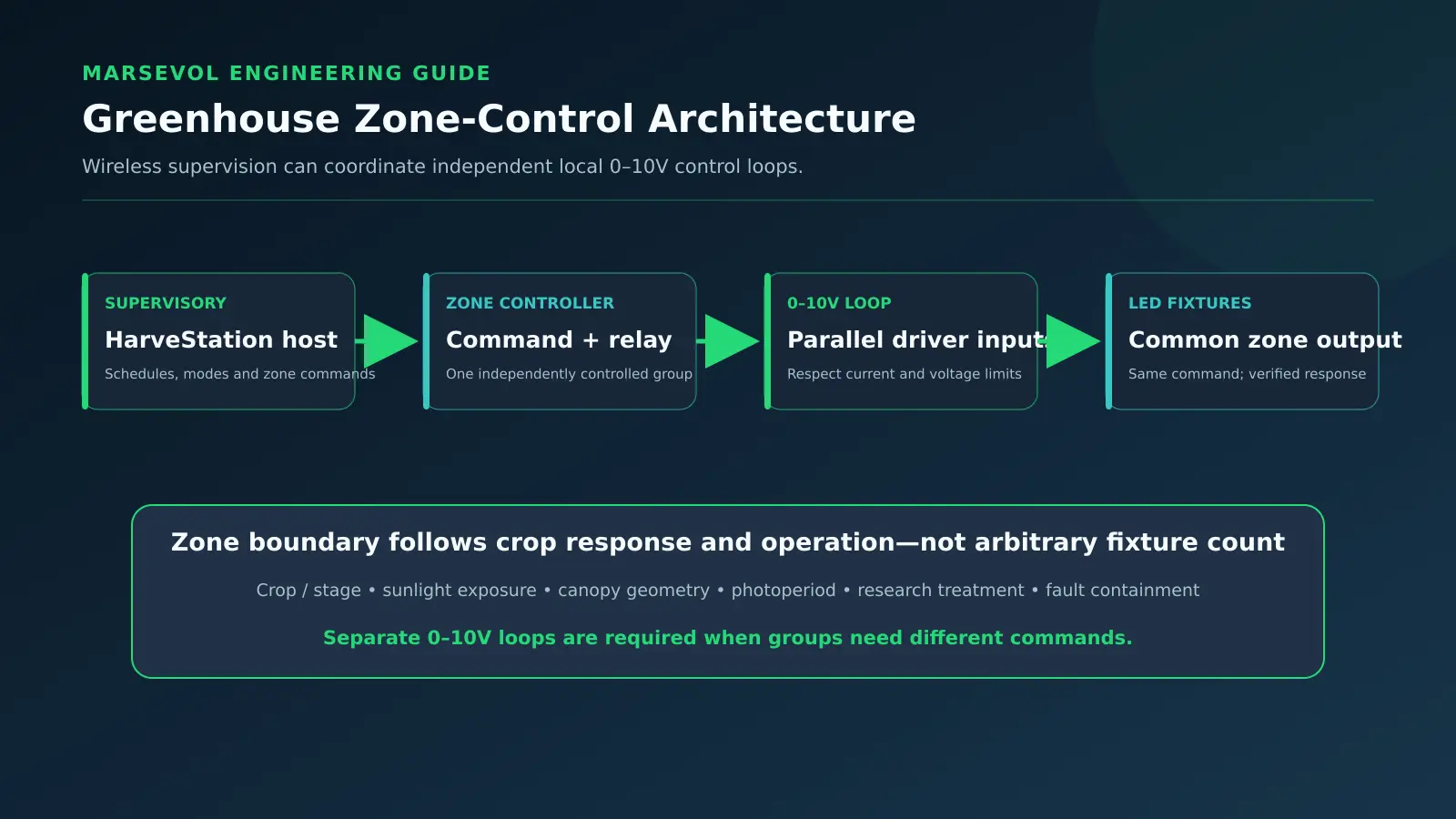
A power circuit protects and supplies equipment. A control group receives operating commands. They may be arranged differently, subject to electrical code, driver capabilities and the supplier’s interface design. A controller that announces multiple zones does not prove that each connected fixture can follow an independent profile. Check how a dimming command is addressed, whether the driver supports true shutoff, and whether its response remains stable at low output. Verify circuit grouping before cables are installed.
For every group, document device model, address, output capability, expected fixture count, connected load, sensor assignment and failure behavior. Determine whether the system uses analog dimming, digital addressing or a gateway. With analog 0–10 V, the actual minimum level, off function and isolation need confirmation from device data and witnessed tests; a screen reading of fifty percent is not necessarily half the PPF. A research plan should also state who is authorized to alter recipes, how overrides are logged, and how settings are restored after a power interruption.
Translate science into testable recipes
A recipe needs units, a location and a time basis. A useful record includes treatment PPFD range at a defined canopy plane, cumulative target DLI when appropriate, permitted photoperiod, spectral assumptions, lamp height, control interval and crop stage. A nominal design value should never be presented as an installed measurement. In supplemental greenhouses, incoming daylight creates a moving background that may differ between positions because of roof structures, glazing, curtains and local shadows. Explicitly say whether the experiment is electric-only or daylight-plus-electric.
When comparing treatments, keep the other major variables as stable as the experimental design requires. Similar DLI totals do not automatically mean similar photobiology if instantaneous intensity or day length differs. If the study relies on a fixed supplemental PPFD over a limited time, log the actual measured values and environmental conditions rather than only the daily controller target. If treatments intentionally vary day length, make the dark interval and start/stop timing observable. Save recipe revisions with the study record so a later crop response can be linked to the actual settings in effect.
Design the photon measurement plane
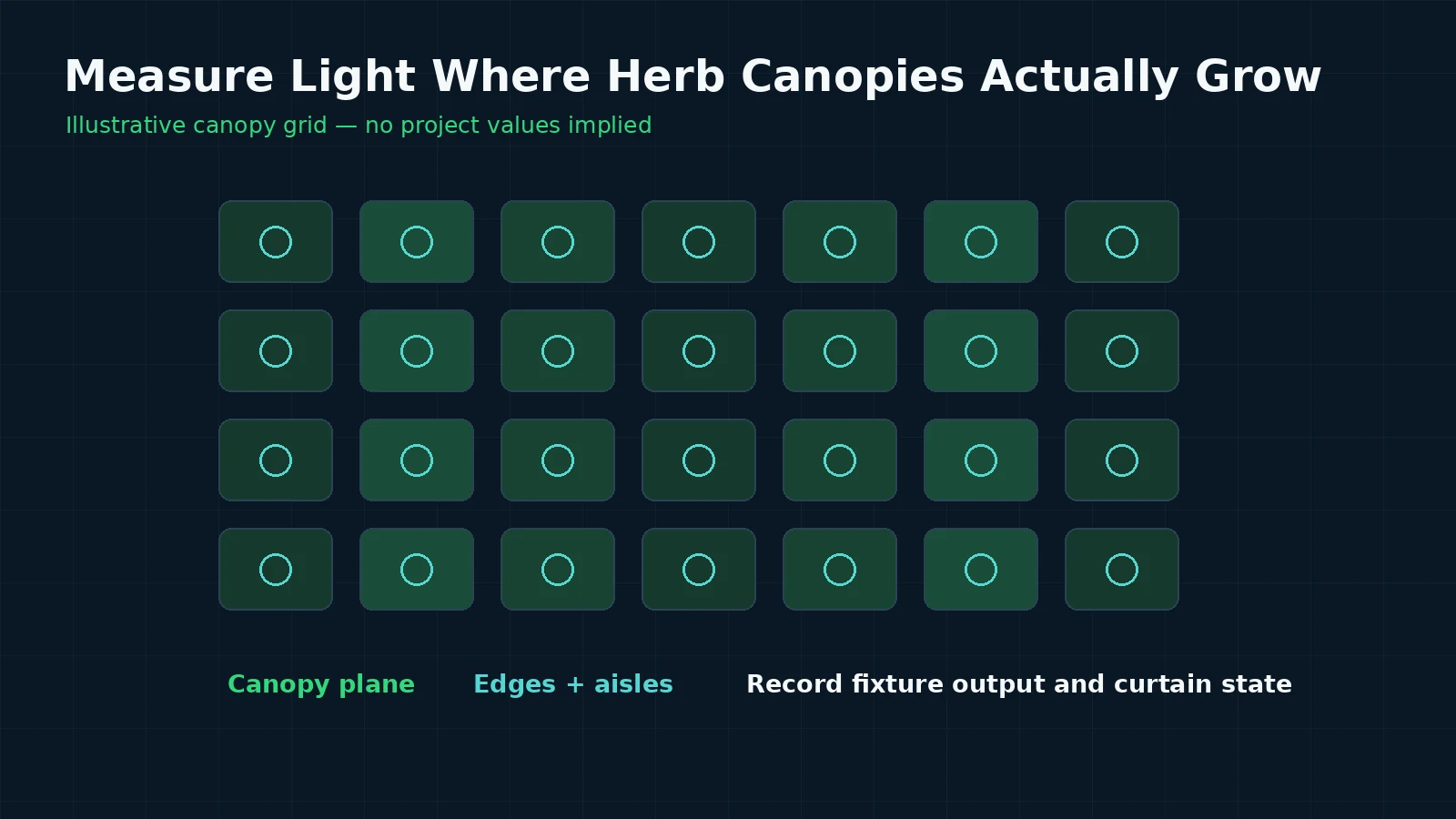
The experiment’s measurement plane belongs to the crop treatment, not to the room drawing. Agree on canopy height before simulation and then document how that height changes during crop development. For seedling trials the relevant plane may move substantially over a short period. For tiered or raised benches, a floor-level map is not a substitute. Use a calibrated PAR quantum sensor suitable for the expected spectrum, and record calibration or service information so sensor differences are not mistaken for biological effects.
Map a repeatable grid on every representative bench, including perimeter positions where intensity or neighbor spill may differ. Record the fixture drive state, time, curtain state and ambient light condition. If the investigator expects a fixed supplemental contribution, either measure under suitable conditions or follow a documented ambient subtraction method. A single reading directly below the center fixture cannot establish treatment uniformity. Averages, minima, spatial variation and measurement uncertainty should be reported separately; none of these values should be invented from the fixture nameplate.
Control cross-light and experimental contamination
Bench experiments can fail even when every controller channel responds correctly. Photons do not stop at software-defined zone borders. Adjacent suspended fixtures may contribute meaningful PPFD across a walkway or treatment edge, depending on optics, mounting, spacing and geometry. Build a test where one treatment group operates while its neighbor is off, then reverse the states in a safe controlled sequence. The purpose is not to generate a universally acceptable spillover percentage, but to measure whether the neighbor contribution is small enough for the study’s declared comparison.
Treatment independence also has a procedural dimension. Sensor relocation, accidental overrides, shared timers and incorrectly labeled fixtures can contaminate the data. Place bench IDs on both electrical schedules and the researcher’s recipe matrix. If shielding or mounting adjustments are contemplated, check ventilation, cleaning, structural loads and possible plant shading before installing them. Some experiments will require physical separation, whereas others can document residual cross-light as a covariate. The acceptance criteria must be agreed before the treatment starts, not after the team sees an inconvenient distribution map.
Build a fail-safe and audit trail
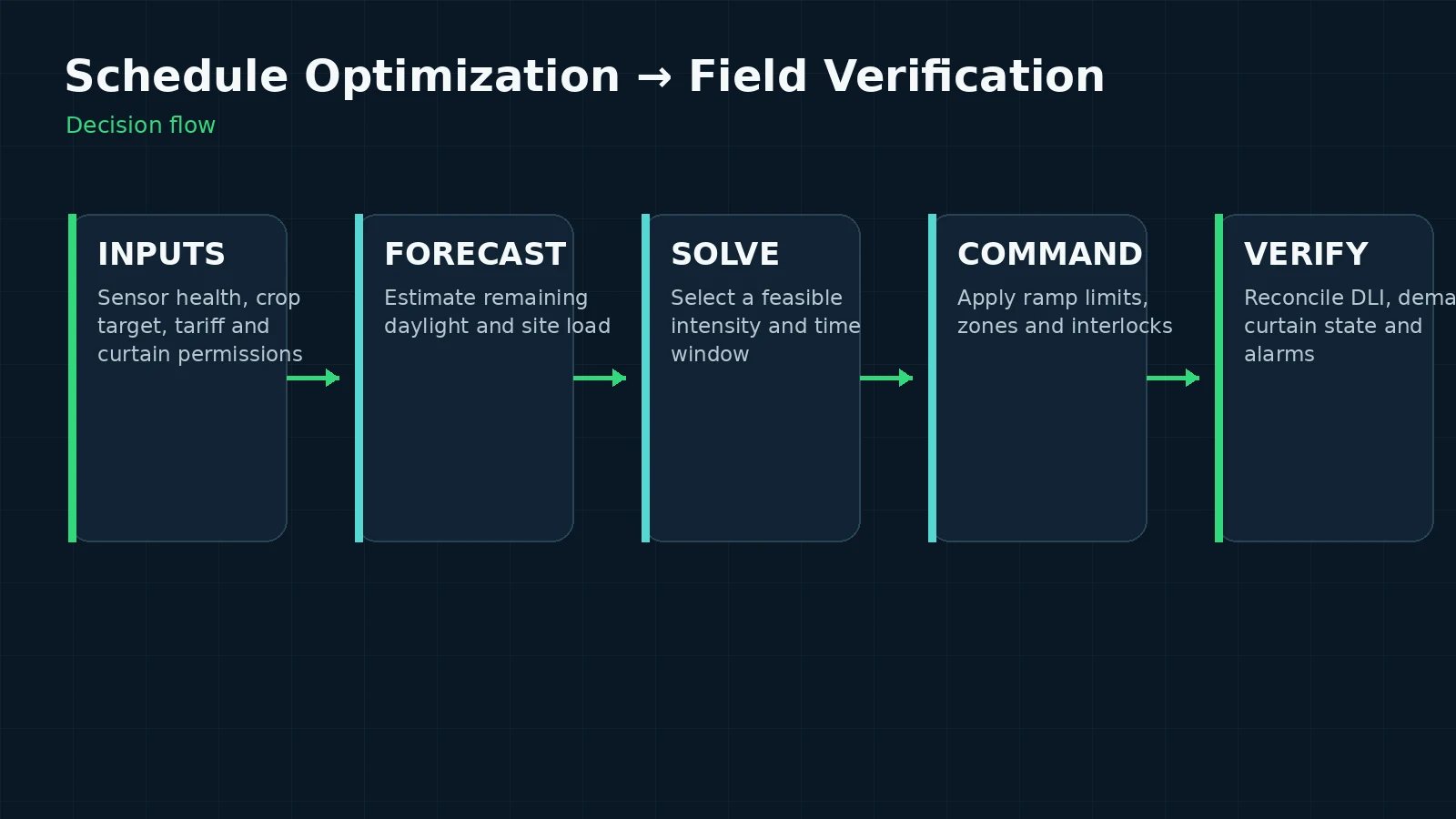
Research continuity can depend on a controller recovering correctly after a brief outage. Write explicit responses for communication loss, missing sensor input, manually overridden channels and controller clock reset. A safe fallback may be the last approved lighting program or a bounded time schedule, but it cannot be assumed without understanding the study and equipment. Operators must know when a system silently departed from a planned recipe and what date range of data may be affected.
Retain a change log containing user or role, treatment ID, requested level, actual feedback when available, timestamp and the reason for any override. Protect recipe editing accounts and avoid uncontrolled remote writes. When sensors are calibrated or moved, retain both the old and new positions. In a multi-season facility, versioned recipes prevent researchers from using a previous study’s configuration for a new crop simply because its name was convenient. A simple weekly exception report can be more useful than a complex dashboard without traceability.
Acceptance and procurement boundaries
The supplier submission should include a dimensioned bench map, fixture schedule, driver data, grouped power and communications diagrams, sensor method, sample grid and one-page treatment matrix. Define the operations and maintenance handover before ordering. If the project is a pilot, specify which readings would justify scaling from one bench to several, and what physical conditions must remain comparable. A controller demonstration in an office or a luminous greenhouse photograph is not evidence of field repeatability.
At acceptance, commission one group at a time. Confirm the mapping between screen commands and actual fixtures; test low, medium and high permitted levels; record measured PPFD for representative benches and verify cross-group independence. Then confirm alarm behavior, power recovery, recipe change control and exportable records. Keep the signed results with the as-built documents. This baseline supports later scientific questions and makes a new experimental setup easier to diagnose without changing the research hypothesis after the equipment has been installed.
Calculation and evidence boundaries
This equation is an integration example, not a universal crop target. When output varies through the day, calculate the time series integral. Record whether readings include daylight and which canopy plane they represent.
Common mistakes
Common errors include copying fixture quantities from a greenhouse of different height, comparing bench-center readings while excluding the edges, assuming a percent dimming command represents measured photons, or confusing a grower’s crop objective with a verified installation output. Another mistake is to report a scientific treatment as perfectly independent without measuring neighbor spillover and the natural-light background. Correct these problems in the design and acceptance plan rather than with unsupported marketing claims.
Data provenance matters as much as arithmetic. Keep names and units stable; retain the equipment and instrument identification; and link the timing of control changes to the timing of biological sampling. For broader commissioning context, use PPFD field mapping, lighting schedule optimization and PPFD proposal validation. The same procedure can later help troubleshoot a pilot bench before scaling a commercial array.
FAQ
Does every research bench require a separate controller?
Not necessarily. Separate logical groups can share hardware when independently addressable channels, power interfaces and fault behavior satisfy the study requirements. Verify limits against actual equipment.
Is a target PPFD enough to quote research bench lighting?
No. A nominal target lacks canopy geometry, spectral assumptions, fixture output distribution, photoperiod and permitted variation. Provide those inputs or clearly label the proposal preliminary.
Can we use outdoor solar measurements as bench DLI?
Not directly. Greenhouse glazing, frame shading, curtain states and canopy position affect delivered photons. Use a measured canopy baseline or documented transmission and uncertainty.
Is 0–10 V dimming inherently repeatable?
No. Device-specific response, driver minimums, wiring and sensor verification determine the actual output. Measure the fixture response at selected operating levels.
Why does cross-light matter if the beds are separated by aisles?
Aisles are not optical barriers. Neighboring fixture emissions can reach adjacent crop plots. Test the influence experimentally or model and verify it at the chosen measurement plane.
How can the team preserve a trial when equipment fails?
Specify safe fallback behavior, alarm ownership, backup settings and a log that lets researchers identify potentially invalid observations after an interruption.
Conclusion
Research-grade bench lighting depends on a defensible relationship between a scientific treatment, a controllable fixture group and measured photons at the crop. The most valuable deliverable is an independently verifiable, documented system rather than a count of channels on a dashboard.
Build a Project-Specific Lighting Plan
Share the bench plan, treatment matrix, canopy heights, permitted photoperiod, approximate natural-light conditions and required independence between experimental groups.
Explore More MarsEVOL Resources
The existing layout guide defines core geometry and fixture-to-canopy considerations.
Use the established measurement method when building a treatment-specific grid.
References
- Cornell Controlled Environment Agriculture. Cornell Controlled Environment Agriculture — official resources. Research and educational resources on greenhouse production systems.
- Michigan State University Floriculture. Michigan State University Floriculture — official resources. Extension and greenhouse production research resources.
- Illuminating Engineering Society. Illuminating Engineering Society — official resources. Professional lighting measurement and standards resources.