
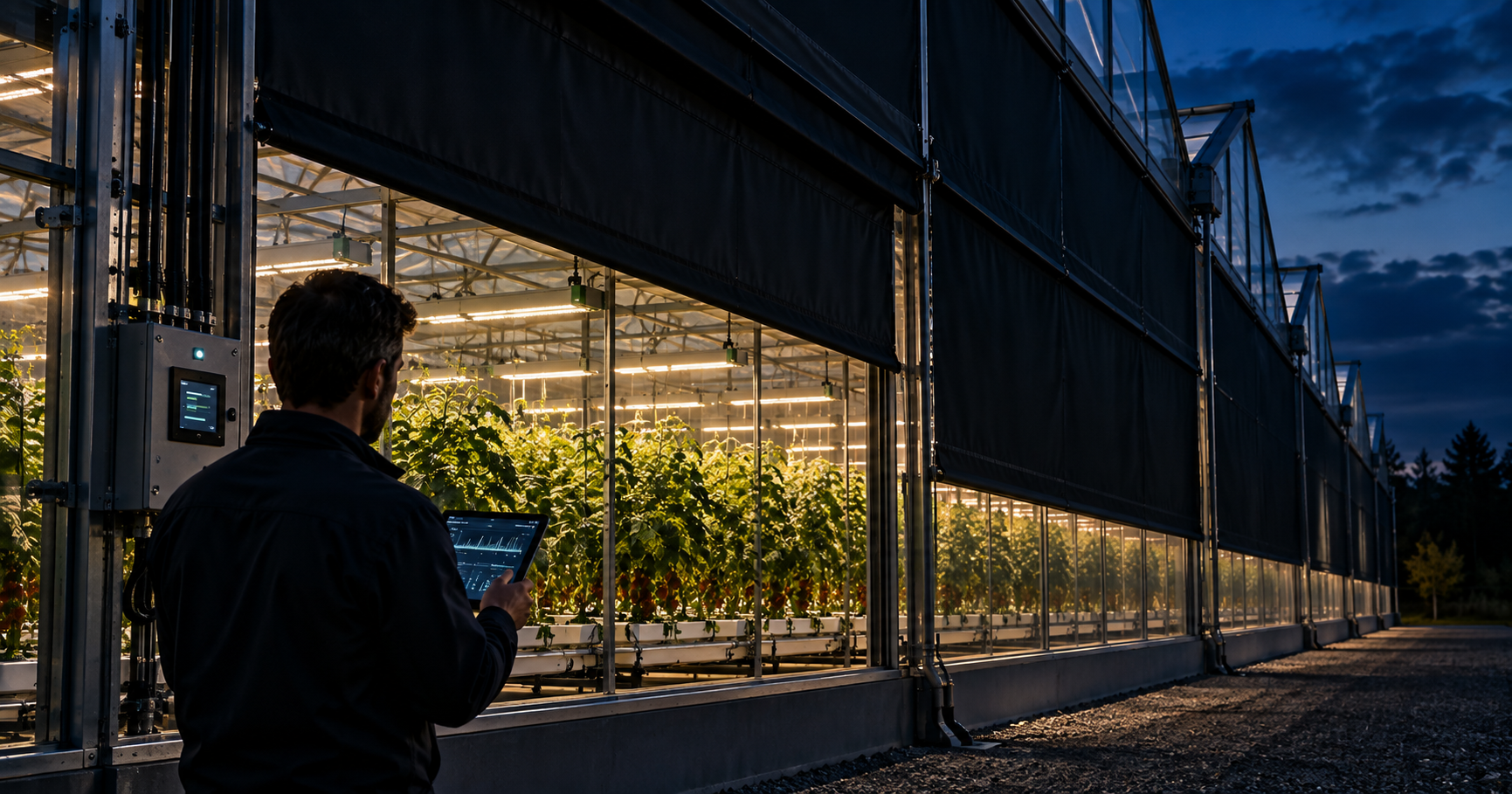
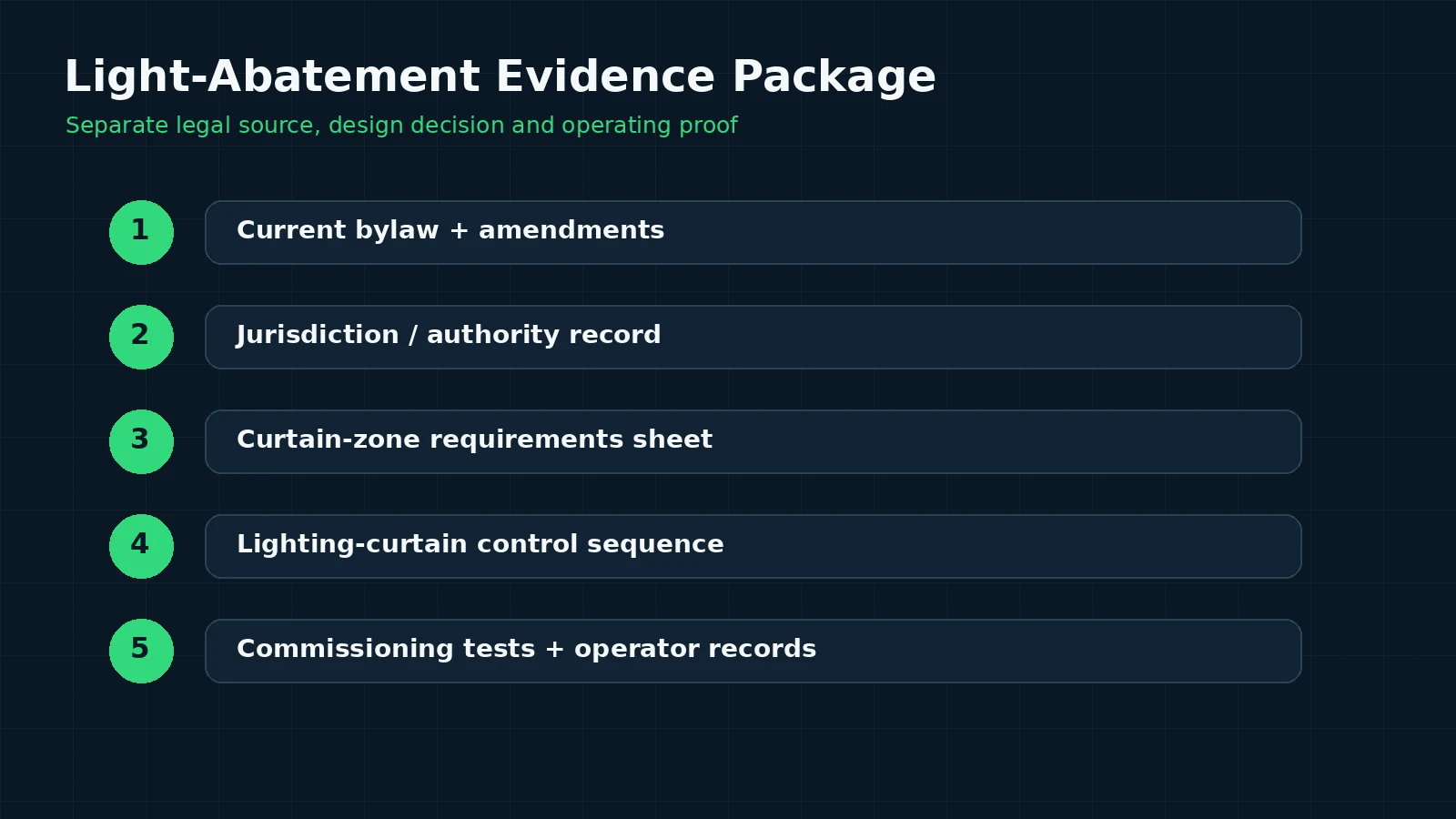
Greenhouse light pollution rules are local. Identify the property jurisdiction, retrieve the current bylaw and amendments, then extract the exact sidewall, endwall, roof-curtain, operating-hour and exception provisions that apply. Treat climate-control tactics as engineering methods, not legal exemptions, and configure lighting and curtain controls from the verified local requirements.
Commercial greenhouse operators increasingly need to coordinate supplemental lighting with local light-abatement rules. The difficult part is not finding a generic “dark-sky” rule; it is proving which authority governs the site, which version is current and how the text applies to the proposed greenhouse. This checklist focuses on greenhouse light pollution regulations and the design information a grower, integrator or controls team should capture before procurement and commissioning.
If you are still identifying official local sources, begin with the Greenhouse Lighting Resources hub. This article goes deeper into the compliance workflow.
Verified October 2, 2026: Leamington, Ontario is used below as a current municipal example. The municipality states that Greenhouse Light Abatement By-law 41-22 is actively enforced, and an official January 13, 2026 mayoral decision confirms that By-law 06-26 amended 41-22. Always retrieve the latest official text and amendments rather than relying on an older PDF saved in a project folder.
Key Takeaways
- Treat light-abatement requirements as jurisdiction-specific project inputs, not a universal greenhouse standard.
- Separate sidewall, endwall and roof/ceiling curtain rules because the same bylaw can treat them differently.
- Record operating windows, seasonal provisions, permitted gaps and exceptions exactly as written in the current local text.
- Ontario technical guidance can help manage heat and humidity under curtains, but it does not create legal permission to ignore a municipal rule.
- Translate the verified requirements into control states, alarms, operator instructions and commissioning evidence.
How do you identify the greenhouse light pollution rule that actually applies?
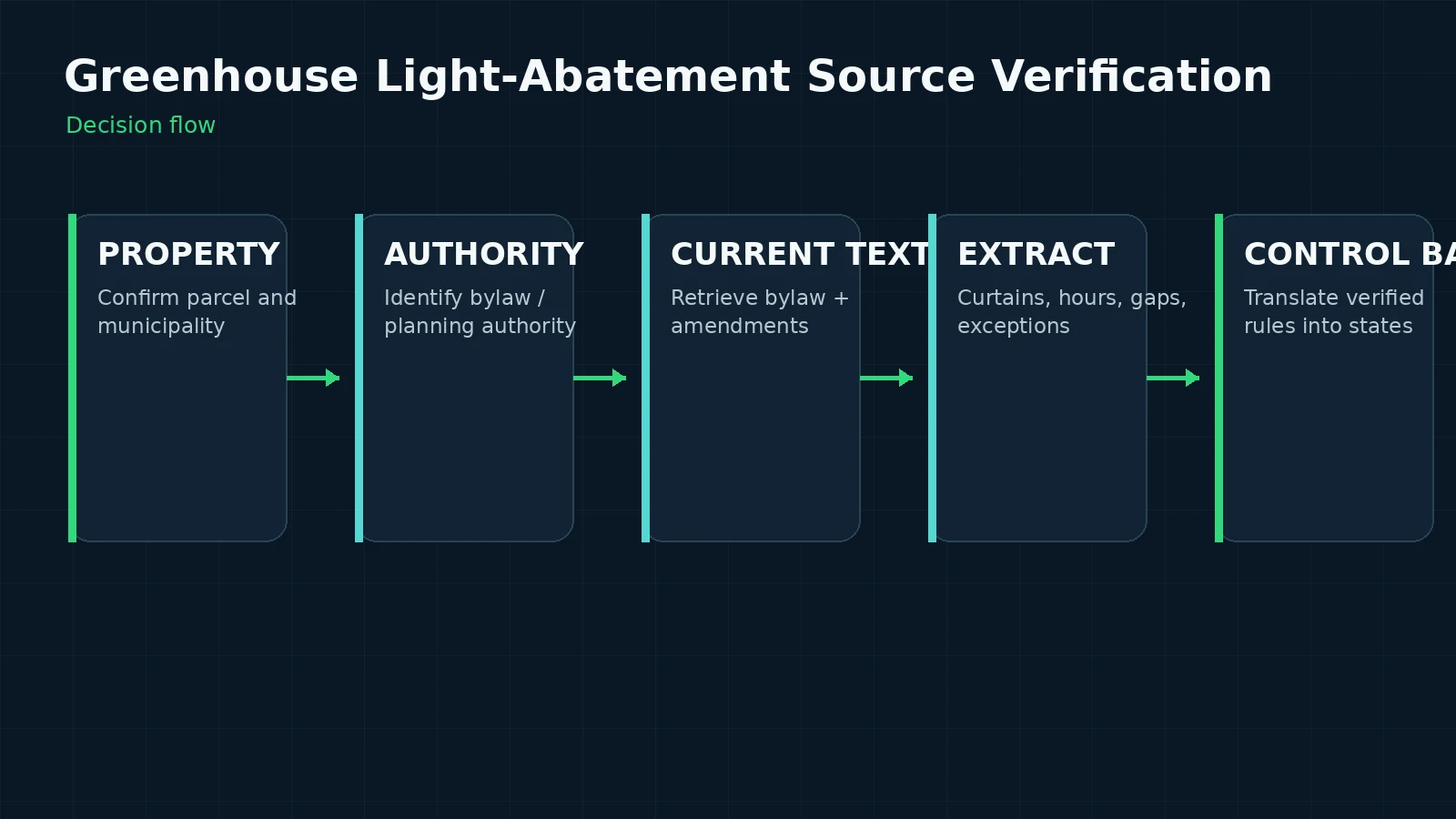
Start with the property, not the lighting product. Record the municipal or county jurisdiction, planning authority, building authority and any other local body named in permits or development approvals. Search the official municipal legal or bylaw portal, then save the current bylaw, amendments, definitions and effective dates that apply to the project.
Do not assume a neighboring municipality has the same rule. Greenhouse-light controls can be implemented through a dedicated bylaw, zoning or planning conditions, development agreements, nuisance provisions or other local instruments. The compliance route must be established for the actual parcel.
Leamington provides a useful example of why version control matters. The municipality’s current enforcement information describes curtain obligations for greenhouse owners, and its legal-services page notes that 41-22 replaced an earlier bylaw. On January 13, 2026, the municipality approved By-law 06-26 amending 41-22. A project team relying only on a 2022 copy can therefore miss later changes.
Create a short source register for the project:
| Check | Record | Owner |
|---|---|---|
| Property jurisdiction | Municipality / authority and service address | Project manager |
| Current legal text | Bylaw / amendment numbers and effective dates | Permitting / legal review |
| Applicability | Definitions, greenhouse type and relevant conditions | Project manager |
| Curtain requirement | Side, end and roof/ceiling provisions separately | Greenhouse designer |
| Operating window | Hours, season, holidays, gaps and exceptions | Controls integrator |
| Evidence | Required records plus recommended commissioning evidence | Commissioning lead |
Why should sidewall, endwall and roof curtains be extracted separately?
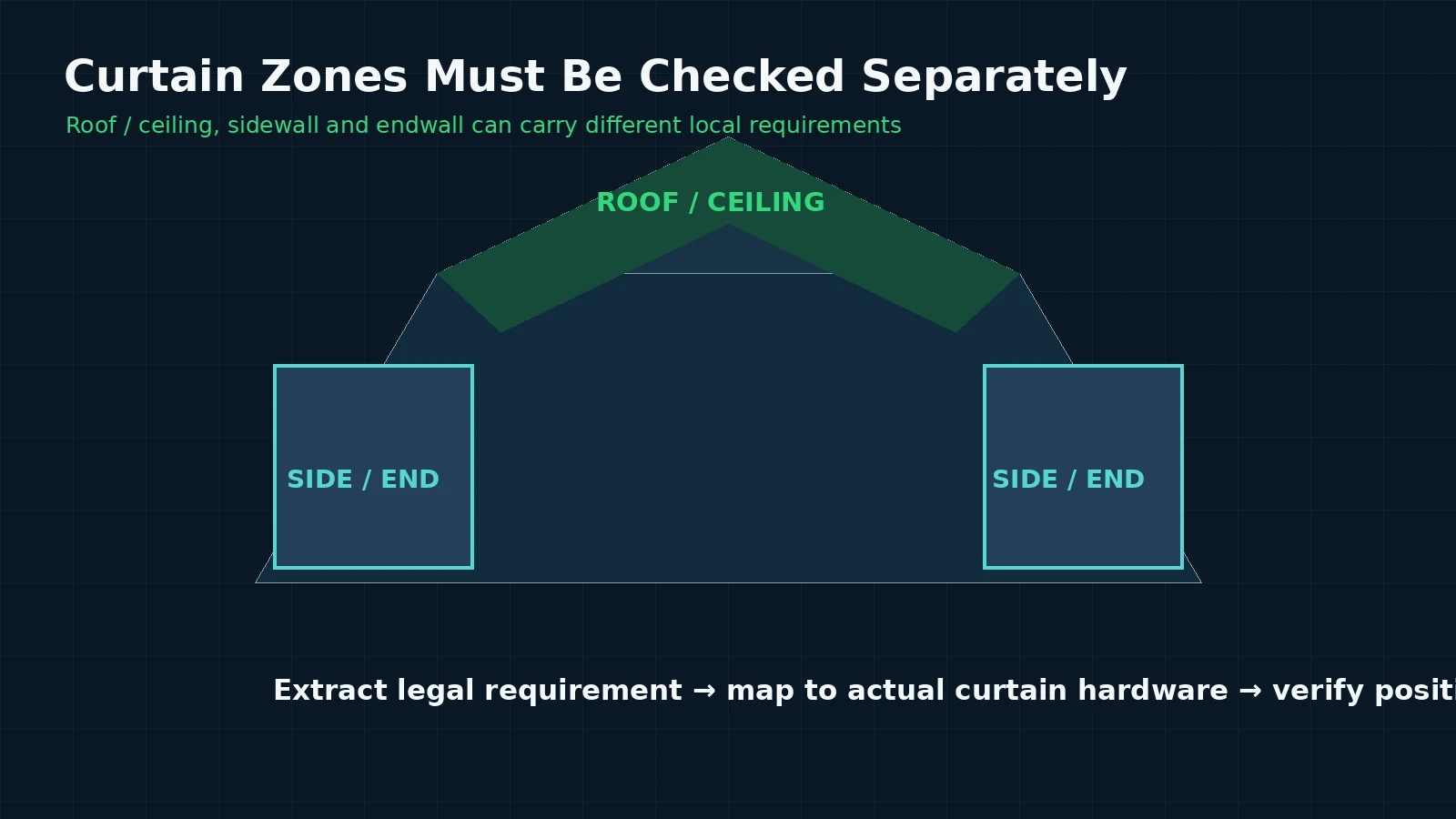
Different surfaces control different escape paths. A project specification that simply says “provide blackout curtains” can hide important differences in location, transmission requirement, deployment state and control logic. Build a requirement matrix by envelope zone.
Leamington’s current municipal information says greenhouse owners must install and maintain sidewall, endwall and ceiling curtains that block 99 percent of light. That is a local requirement, not a universal North American rule. The municipal framework also provides an Alternative Compliance Plan route for certain unique operations. Whether a specific project qualifies for such a route is a municipal decision, not a supplier assumption.
For engineering purposes, record curtain manufacturer, material/light-blocking performance, coverage area, drive mechanism, position feedback, failure state and maintenance access. The legal text may define only part of this list; the remaining items are design recommendations needed to make the system controllable and verifiable.
How should operating hours, seasonal rules and permitted gaps be handled?
Copy them directly from the current official text into a project requirements sheet. Do not type them from memory, from a marketing article or from another municipality. Record the time zone, start and end dates if seasonal, weekday or holiday treatment, curtain closure percentage if specified, permitted gaps if specified, and any expressly written exception or alternative-compliance provision.
Keep the legal requirement separate from the control implementation. For example, the control system may need an astronomical clock, a fixed local schedule, curtain-position feedback or a manual override process. Those are engineering choices used to comply with the rule; they should not be confused with the legal text itself.
The Greenhouse Lighting Control System guide explains how lighting zones, dimming and supervisory logic can be structured. Where a project also uses DLI-based control, the DLI Lighting Control guide helps define how natural light and supplemental-light decisions interact.
How do light-abatement curtains affect greenhouse climate?
Closing high-opacity curtains changes more than visible light. Ontario’s official technical guidance notes that fully deployed light-abatement curtains can reduce light emissions by more than 99 percent depending on the curtain model, while also affecting air temperature, humidity and vertical stratification. That can change ventilation and dehumidification requirements during a lighting period.
The same Ontario guidance discusses engineering methods such as curtain gapping, through-curtain fans and scheduling some lighting before sunrise to reduce the time curtains need to remain fully closed compared with an after-sunset strategy. Those methods are useful climate-management concepts, but they do not override a municipal bylaw. A legal permission for a gap or an operating condition must come from the applicable rule or authority.
Therefore, treat the curtain and lighting schedule as a coordinated state. Before moving supplemental light into a new time window, check crop photoperiod, DLI, temperature, relative humidity, condensation risk, ventilation capacity and the local light-abatement requirement. The Greenhouse Supplemental Lighting pillar provides the broader crop-light planning context.
What control states and evidence should the project define?
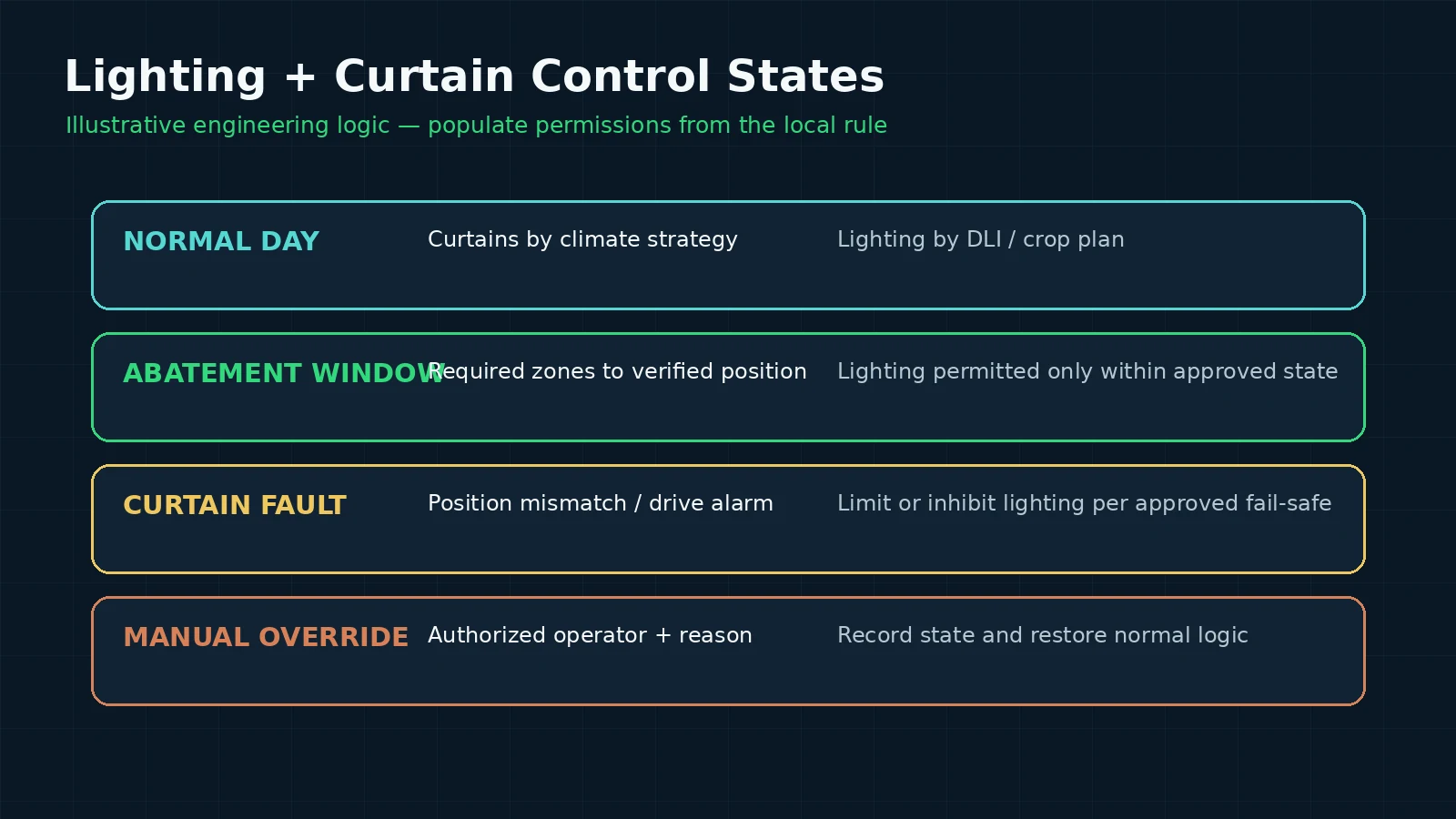
A robust project converts the verified local rule into explicit operating states. A simple state table can define whether lights may be off, dimmed or at the approved operating level; whether each curtain zone must be closed; and what happens if the required curtain position is not confirmed.
Recommended control and commissioning requirements include:
- local-time synchronization and documented schedule source;
- separate commands and position feedback for roof, sidewall and endwall curtain zones where required;
- a permissive that prevents or limits lighting when the required curtain state is not confirmed;
- clear operator override authority and a recorded reason for any override;
- alarms for curtain drive faults, position mismatch or schedule failure;
- event history showing lighting state, curtain state and alarm/override events;
- commissioning tests performed at the relevant operating conditions;
- a periodic review when the municipality changes its bylaw or the greenhouse changes lighting or curtain equipment.
These items are engineering recommendations unless the local law specifically mandates them. The legal obligation and the project-control method should be labeled separately in the design basis.
What should you confirm with the local authority before procurement?
When wording is unclear, resolve it before the curtain and lighting control architecture is frozen. A concise authority question list can include:
- Which bylaw, amendments and planning conditions currently apply to this parcel?
- How does the rule define the greenhouse or operation covered by the requirement?
- Are sidewall, endwall and roof/ceiling curtain provisions different?
- What operating windows, seasonal periods, closure percentages or expressly permitted gaps apply?
- Is an Alternative Compliance Plan or comparable process available, and what approval is required before relying on it?
- What inspection, documentation or complaint-response evidence should be retained?
- Does an expansion, fixture change, curtain replacement or control-system modification trigger a new review?
Keep the written answer with the design basis. This is particularly important when a project schedule crosses an amendment date or when older municipal guidance remains online alongside a newer bylaw.
Common mistakes in greenhouse light-abatement planning
- Copying another municipality’s rule: a local bylaw is not a regional greenhouse standard.
- Reading only the original bylaw: amendments can change the current requirement.
- Combining all curtain surfaces: roof, side and end walls may have different operating provisions.
- Treating climate guidance as a legal exception: gapping or ventilation methods need a legal basis where the bylaw restricts curtain position.
- Leaving controls until commissioning: the curtain permissive and fault response may affect electrical, control and operating design.
- Assuming a supplier claim proves compliance: compliance depends on the installed system, local rule and actual operation.
- Failing to document the rule version: a later operator may not know which requirements the control sequence was designed to satisfy.
FAQs About Greenhouse Light Pollution Regulations
Are greenhouse blackout curtains required everywhere?
No. Requirements are local. Some jurisdictions use dedicated greenhouse-light bylaws, while others may use planning or development controls. Verify the site authority and current legal text.
Does a 99 percent light-blocking curtain guarantee compliance?
No. Material performance is only one part of the installed system. The local rule may also address coverage, operating times, permitted openings, maintenance or alternative compliance.
Can I open curtains for humidity control?
Only to the extent allowed by the applicable rule or approved plan. Ontario technical guidance describes climate-management techniques, but engineering guidance does not itself authorize a legal exception.
Should lighting shut off if a required curtain fails?
That is a strong engineering fail-safe to evaluate, but the exact response should be based on the local requirement, crop risk and approved operating philosophy. Document the chosen permissive and manual-override process.
Do I need to log curtain and lighting states?
Unless the local rule explicitly requires logs, treat event recording as a recommended verification tool. It can support commissioning, troubleshooting and response to a complaint or inspection.
When should the compliance review be repeated?
Recheck before procurement, before commissioning and whenever the local rule, greenhouse envelope, lighting system, curtain system or control sequence materially changes.
The MarsEVOL Perspective
Light-abatement requirements should be integrated into the lighting design basis from the beginning. A useful proposal defines the lighting zones, intended operating windows, curtain interfaces and control permissives clearly enough that the grower can compare them with the current local rule. The Greenhouse Lighting Layout guide covers fixture geometry and canopy planning, while the Greenhouse Lighting Commissioning guide provides a framework for acceptance checks after installation.
For projects with local restrictions, MarsEVOL recommends adding a dedicated “light-abatement interface” section to the lighting proposal rather than burying curtain assumptions in a general controls note.
Conclusion
Greenhouse light pollution compliance begins with source verification. Identify the authority, capture the current bylaw and amendments, separate curtain zones, map the real operating windows and distinguish legal requirements from engineering recommendations. Then configure controls and commissioning tests around those verified inputs. That process is more durable than relying on a generic nighttime rule or a curtain-product claim.
Request a Free Lighting Plan
Share your greenhouse location, crop, proposed lighting hours, mounting conditions, curtain system and any current municipal requirements. MarsEVOL can help structure the lighting layout and controls around the verified project constraints.
Explore More MarsEVOL Resources
Find official incentive, tariff, legal and project-planning sources by jurisdiction.
Translate lighting, sensor and curtain interfaces into a practical zone-and-control architecture.
References
Official sources checked October 2, 2026. Local legal requirements can change; retrieve the current municipal text before procurement or commissioning.
- Municipality of Leamington. Greenhouse Light Abatement. Current enforcement and compliance information for By-law 41-22.
- Municipality of Leamington. Legal Services / Municipal By-laws. Official access point for current local legal information.
- Municipality of Leamington. Mayoral Direction MD-01-2026. January 13, 2026 approval record identifying By-law 06-26 as an amendment to By-law 41-22.
- Ontario Ministry of Agriculture, Food and Agribusiness. Effect of Greenhouse Light Abatement Curtains. Technical guidance on light reduction and greenhouse climate impacts.
- Government of Ontario. Reducing Nighttime Light Emissions from Greenhouses. Technical resource; not a substitute for the current municipal bylaw.