
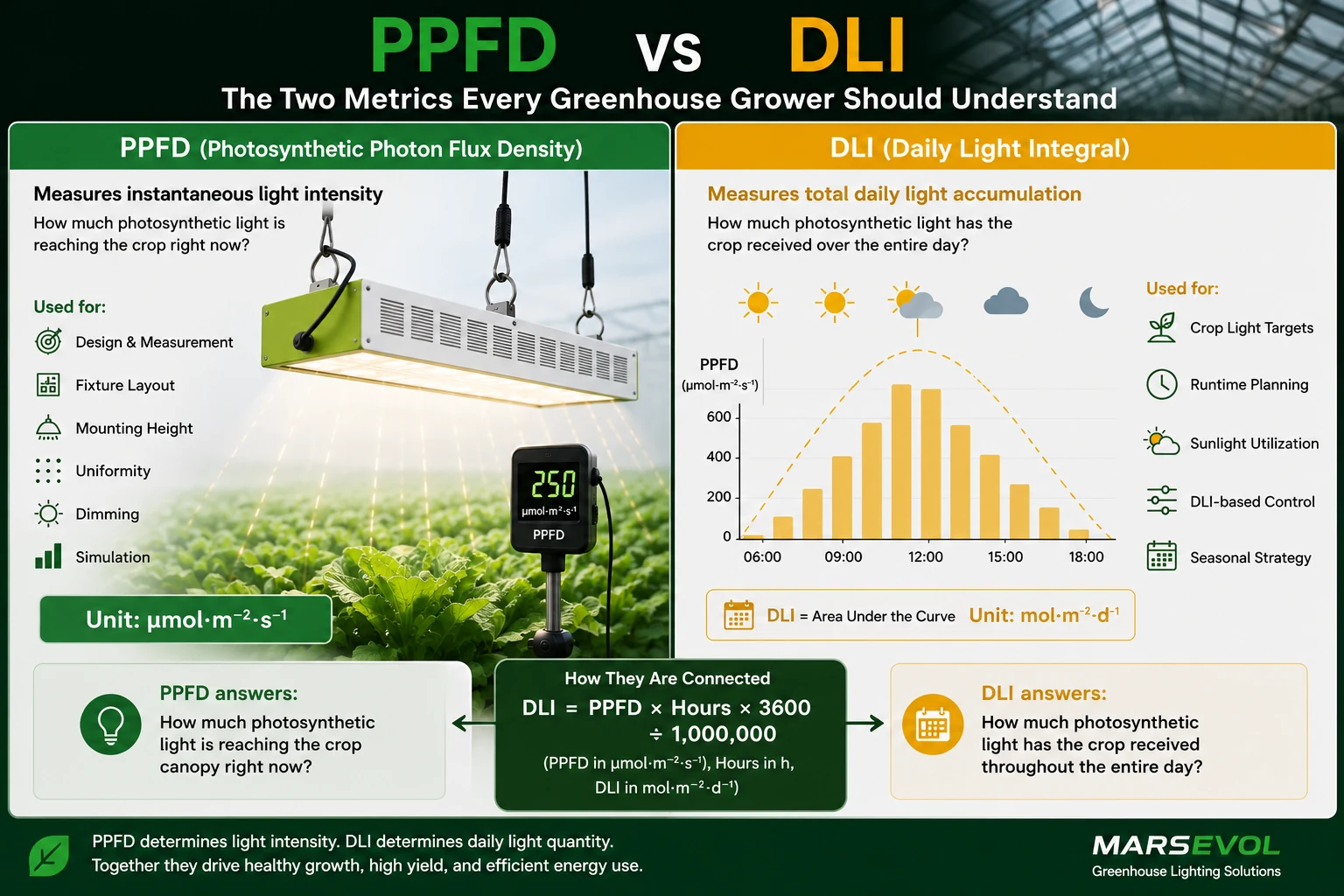
In greenhouse supplemental lighting, two metrics are used more frequently than almost any others: PPFD and DLI.
Both describe photosynthetically useful light, but they do not represent the same thing.
PPFD describes the instantaneous photosynthetic light intensity reaching the crop canopy at a specific moment.
DLI describes the total amount of photosynthetic light accumulated over an entire day.
For greenhouse growers, designers, and researchers, understanding PPFD vs DLI is essential because these two metrics answer different lighting questions. PPFD helps evaluate light intensity, fixture layout, mounting height, dimming, and uniformity. DLI helps evaluate crop daily light targets, seasonal light deficits, supplemental lighting runtime, and DLI-based control strategy.
Quick Answer
PPFD measures how much photosynthetic light reaches the crop canopy right now. Its unit is μmol·m⁻²·s⁻¹.
DLI measures how much photosynthetic light the crop receives over the whole day. Its unit is mol·m⁻²·d⁻¹.
A practical way to understand the difference is this:
PPFD = Instantaneous light intensity
DLI = Total daily light accumulation
This article explains the scientific meaning of PPFD and DLI, how they are connected, why greenhouse growers need both metrics, and how they can be used together for practical supplemental lighting design.

Key Takeaways
- PPFD measures light intensity at a specific moment. It is used for canopy-level measurement, fixture layout, mounting height, dimming, and uniformity analysis.
- DLI measures total daily light accumulation. It is used for crop target planning, seasonal light management, supplemental lighting runtime, and DLI-based control.
- PPFD and DLI are connected through time. A lighting system with a given PPFD will contribute different DLI values depending on how long it operates.
- Greenhouse lighting requires both metrics. Sunlight changes throughout the day, so growers need PPFD for design and DLI for daily crop light management.
- Professional greenhouse supplemental lighting should not be designed by wattage alone. The better approach is to connect crop target DLI, greenhouse sunlight, required supplemental PPFD, layout, uniformity, and control strategy.
1. Why PPFD and DLI Matter in Greenhouse Lighting
Greenhouse lighting is different from indoor farming because sunlight is already part of the crop’s light environment.
However, greenhouse sunlight is not constant. It changes with season, latitude, day length, cloud cover, greenhouse glazing, shade curtains, structural shadows, and local weather conditions.
This means a greenhouse crop may receive enough sunlight during part of the day but still fail to reach its target daily light level during winter, cloudy periods, or short-day seasons.
Supplemental lighting is therefore not simply about adding more brightness. It is about managing the crop’s light environment in a measurable way.
To do this properly, growers need to answer two different questions:
- How much photosynthetic light is reaching the crop right now?
- How much photosynthetic light does the crop receive over the full day?
The first question is answered by PPFD.
The second question is answered by DLI.
2. What Is PPFD?
PPFD stands for Photosynthetic Photon Flux Density.
PPFD measures the number of photosynthetically active photons reaching one square meter of crop canopy every second.
PPFD is commonly expressed as:
μmol·m⁻²·s⁻¹
In practical greenhouse lighting, PPFD answers this question:
How much photosynthetic light is reaching the crop canopy right now?
PPFD is especially useful for evaluating:
- fixture output at crop level;
- mounting height;
- fixture spacing;
- optical distribution;
- PPFD uniformity;
- dimming levels;
- lighting simulation results;
- field verification after installation.
PPFD should be evaluated at crop canopy level, not only at the fixture. Plants respond to the light they actually receive, and crop-level PPFD depends on fixture output, mounting height, spacing, optical distribution, greenhouse structure, shading, and canopy position.
3. What Is DLI?
DLI stands for Daily Light Integral.
DLI measures the total amount of photosynthetically active light received by one square meter of crop area during one day.
DLI is commonly expressed as:
mol·m⁻²·d⁻¹
In practical greenhouse lighting, DLI answers this question:
How much photosynthetic light has the crop received throughout the entire day?
A useful analogy is rainfall.
PPFD is like measuring how hard rain is falling at a specific moment.
DLI is like measuring how much rain has accumulated over the entire day.
Both values matter, but they support different decisions.
4. PPFD vs DLI: The Core Difference
The core difference between PPFD and DLI is time.
PPFD is an instantaneous measurement. It tells growers the light intensity at a specific moment.
DLI is an accumulated measurement. It tells growers how much photosynthetic light has been received over the full day.
| Metric | Meaning | Unit | Primary Use |
|---|---|---|---|
| PPFD | Instantaneous canopy-level photosynthetic light intensity | μmol·m⁻²·s⁻¹ | Fixture layout, measurement, mounting height, dimming, uniformity |
| DLI | Total daily accumulated photosynthetic light | mol·m⁻²·d⁻¹ | Crop target, runtime planning, daily light management, control strategy |
For greenhouse growers, the two metrics should not be treated as competitors.
PPFD and DLI should be used together.
5. How PPFD and DLI Are Connected
PPFD and DLI are mathematically connected through photoperiod, or lighting duration.
The basic formula is:
DLI = PPFD × Lighting Hours × 3600 ÷ 1,000,000
For example, if supplemental lighting delivers an average canopy-level PPFD of 250 μmol·m⁻²·s⁻¹ for 12 hours:
250 × 12 × 3600 ÷ 1,000,000 = 10.8 mol·m⁻²·d⁻¹
This means the lighting system contributes approximately 10.8 mol·m⁻²·d⁻¹ of supplemental daily light.
This formula is central to greenhouse supplemental lighting because it links lighting intensity, operating time, and crop daily light target.
6. Why PPFD Alone Is Not Enough
PPFD is essential, but it does not tell the full story.
A crop may receive high PPFD for a short period but still fail to reach the desired daily light total.
For example:
500 μmol·m⁻²·s⁻¹ for 6 hours ≈ 10.8 mol·m⁻²·d⁻¹
250 μmol·m⁻²·s⁻¹ for 12 hours ≈ 10.8 mol·m⁻²·d⁻¹
Both examples deliver a similar DLI, but the crop experience may not be identical.
Plant response can also be affected by photoperiod, temperature, CO₂ concentration, humidity, cultivar, growth stage, root-zone conditions, and light distribution.
This is why greenhouse lighting design should not use PPFD alone.
7. Why DLI Alone Is Not Enough
DLI is also essential, but it does not show how light is distributed across the crop area or throughout the day.
A greenhouse may achieve the target DLI on average, while some zones receive too much light and others receive too little.
This can lead to uneven crop growth, inconsistent biomass accumulation, variable flowering or harvest timing, and reduced repeatability in research greenhouses.
DLI also does not replace canopy-level PPFD measurement.
Professional greenhouse lighting design should therefore combine DLI planning with PPFD distribution and uniformity analysis.
8. How Greenhouse Transmission Affects DLI
Outdoor sunlight is not the same as crop-level greenhouse light.
Light transmission losses occur due to greenhouse glazing, structural framing, trusses, shade curtains, dust, condensation, suspended equipment, and crop canopy structure.
For example, if outdoor DLI is 20 mol·m⁻²·d⁻¹ and greenhouse transmission is 60%:
20 × 0.60 = 12 mol·m⁻²·d⁻¹
The crop may only receive approximately 12 mol·m⁻²·d⁻¹ inside the greenhouse.
If the crop target is 17 mol·m⁻²·d⁻¹, the supplemental lighting system needs to provide the remaining 5 mol·m⁻²·d⁻¹.
This is why greenhouse supplemental lighting should be designed around crop-level light availability rather than outdoor sunlight alone.
9. How to Use PPFD and DLI in Lighting Design
A practical greenhouse lighting design should use PPFD and DLI together.
The process can be summarized in five steps.
Step 1: Define the Crop Target DLI
Start with the crop, growth stage, and production objective.
Different crops and crop stages require different daily light levels.
Step 2: Estimate Available Greenhouse DLI
Use local weather data, DLI maps, greenhouse transmission estimates, or on-site measurements to estimate the light already available from sunlight.
Step 3: Calculate the Supplemental DLI Requirement
Subtract the available greenhouse DLI from the crop target DLI.
For example:
Target DLI 17 − Greenhouse DLI 12 = Supplemental DLI 5 mol·m⁻²·d⁻¹
Step 4: Convert Supplemental DLI to Required PPFD
If the grower wants to provide 5 mol·m⁻²·d⁻¹ over 10 hours:
Required PPFD = 5 × 1,000,000 ÷ 10 ÷ 3600
Required PPFD ≈ 139 μmol·m⁻²·s⁻¹
Step 5: Design Fixture Layout and Control Strategy
After the required PPFD is defined, the next step is fixture layout.
This includes fixture model, fixture spacing, mounting height, optical distribution, PPFD uniformity, dimming level, control zones, and seasonal operation strategy.
10. PPFD for Design, DLI for Operation
A useful way to summarize the relationship is:
PPFD is mainly used for system design, measurement, and verification.
DLI is mainly used for crop light targets, daily operation, and control strategy.
PPFD helps answer:
- Are the fixtures delivering enough light at canopy level?
- Is the lighting layout uniform?
- Is the mounting height appropriate?
- Are there hot spots or dark zones?
- Does the installed system match the design target?
DLI helps answer:
- Has the crop received enough light today?
- How much sunlight has already contributed?
- How much supplemental light is still needed?
- Should lights dim, turn on, or turn off?
- Is the crop meeting its daily light target consistently?
11. Common Mistakes When Comparing PPFD and DLI
Mistake 1: Treating PPFD and DLI as the Same Metric
PPFD and DLI are connected, but they are not the same.
PPFD is an instantaneous measurement. DLI is a daily accumulated value.
Mistake 2: Designing Only by Wattage
Wattage tells us how much electrical power a fixture consumes.
It does not directly tell us how much photosynthetic light reaches the crop canopy.
Mistake 3: Measuring PPFD at the Wrong Height
PPFD should be measured at crop canopy level.
Measurements taken too close to the fixture may not represent what the crop receives.
Mistake 4: Ignoring Greenhouse Transmission
Outdoor DLI must be adjusted for greenhouse transmission.
Glazing, structure, curtains, dust, and condensation can significantly reduce the light reaching the crop.
Mistake 5: Ignoring Uniformity
A good average PPFD does not guarantee even light distribution.
Poor PPFD uniformity can create uneven growth and inconsistent crop quality.
12. MarsEVOL Perspective: Connecting PPFD, DLI, and Greenhouse System Design
At MarsEVOL, PPFD and DLI are treated as part of a complete greenhouse supplemental lighting workflow rather than isolated numbers.
A practical lighting design should connect:
- crop light targets;
- available greenhouse sunlight;
- supplemental DLI requirement;
- required canopy-level PPFD;
- fixture layout and spacing;
- uniformity analysis;
- spectrum strategy;
- dimming strategy;
- control logic and runtime management.
The MarsEVOL SOLIFY Series is designed for greenhouse supplemental lighting projects where optical distribution, installation flexibility, durability, and control compatibility all matter.
For advanced greenhouse management, HARVESTATION supports zone-based dimming, sunlight-aware operation, and DLI-oriented control strategies that dynamically adjust lighting based on real greenhouse conditions.
The goal is not simply to install lights.
The goal is to deliver the right amount of photosynthetic light, with the right distribution, for the right duration, to achieve stable crop performance and operational efficiency.
FAQ: PPFD vs DLI in Greenhouse Lighting
What is the difference between PPFD and DLI?
PPFD measures instantaneous photosynthetic light intensity at the crop canopy. DLI measures the total amount of photosynthetic light accumulated over an entire day.
Which is more important for greenhouse lighting: PPFD or DLI?
Both are important. PPFD is used for lighting system design and measurement, while DLI is used for crop light targets and daily lighting operation.
Can two lighting strategies have the same DLI but different PPFD?
Yes. A higher PPFD for a shorter time and a lower PPFD for a longer time can result in similar DLI values. Crop response may still differ depending on crop type, photoperiod, temperature, CO₂, and growth stage.
Where should PPFD be measured?
PPFD should be measured at crop canopy level because this represents the light actually received by the crop.
How do you calculate DLI from PPFD?
DLI can be calculated with the formula: DLI = PPFD × Lighting Hours × 3600 ÷ 1,000,000.
Conclusion
PPFD and DLI are two of the most important metrics in greenhouse supplemental lighting.
PPFD describes instantaneous canopy-level light intensity.
DLI describes total daily accumulated photosynthetic light.
Both are essential.
PPFD helps growers design and verify lighting systems.
DLI helps growers manage crop light targets and daily lighting strategy.
Professional greenhouse lighting design requires understanding both metrics together rather than treating them independently.
The best greenhouse lighting systems are not necessarily the brightest systems. They are the systems that deliver the correct PPFD and DLI for the crop, with proper uniformity, timing, and operational control.
Need Help Planning Greenhouse Supplemental Lighting?
MarsEVOL supports commercial growers, greenhouse designers, integrators, and research teams with greenhouse lighting analysis and system planning.
Our support can include:
- DLI analysis;
- canopy-level PPFD planning;
- fixture layout design;
- PPFD simulation;
- uniformity evaluation;
- dimming strategy recommendations;
- DLI-based control planning.
Request a Free Greenhouse Lighting Plan →
Explore More MarsEVOL Greenhouse Lighting Resources
Read: What Is Greenhouse Supplemental Lighting →
Learn how greenhouse supplemental lighting works and how PPFD, DLI, sunlight transmission, and lighting control influence crop production.
Explore SOLIFY Greenhouse Lighting Series →
Discover greenhouse supplemental lighting fixtures designed for commercial applications, uniformity optimization, and flexible installation.
Learn About HARVESTATION Smart Control →
Explore sunlight-aware greenhouse lighting control strategies based on DLI targets and dynamic dimming.
Request a Free Greenhouse Lighting Plan →
Contact MarsEVOL to discuss your greenhouse size, crop type, target PPFD, target DLI, and lighting design requirements.
References
Runkle, E.
Daily Light Integral Defined, Michigan State University Extension.
Torres, A. P., & Lopez, R. G.
Measuring Daily Light Integral in a Greenhouse, Purdue University Extension.
Michigan State University Extension.
Daily Light Integral Maps.
LI-COR Biosciences.
Quantum Sensors for PPFD Measurement.
Apogee Instruments.
Quantum Sensors for PAR and PPFD Measurement.
Faust, J. E., & Logan, J.
Daily Light Integral: A Research Review and High-Resolution Maps of the United States, HortScience.