
Evaluate a commercial greenhouse LED proposal in two stages: reject unresolved safety, identity, layout and interface gaps first; then score only compliant offers against the same project baseline. Compare delivered light, verified fixture evidence, integration, lifecycle cost and acceptance—not headline efficacy or purchase price alone. Keep assumptions, exclusions and deviations visible so the final decision can be audited.
Key Takeaways
- Freeze one bid baseline before comparing suppliers; otherwise every score measures a different project.
- Use pass/fail evidence gates before weighted scoring. A missing safety certificate or unreproducible layout is not a minor point deduction.
- Match every test report, spectrum, driver and control claim to the exact quoted configuration.
- Normalize installed scope and lifecycle energy before comparing prices.
- Write commissioning evidence and remedies into the purchase package before award.
A commercial greenhouse LED proposal should be evaluated as a project offer, not as a fixture brochure. The buyer must determine whether the proposed system can meet one crop-lighting brief, fit the greenhouse and controls, satisfy applicable requirements, and be commissioned against measurable criteria.
The earlier greenhouse lighting proposal checklist explains what to request from suppliers. This guide begins after comparable offers arrive. It provides a gated evaluation and weighted decision method; it does not repeat the request-for-proposal checklist or replace engineering, electrical, legal or commercial review.
What Must Be Fixed Before You Compare LED Proposals?
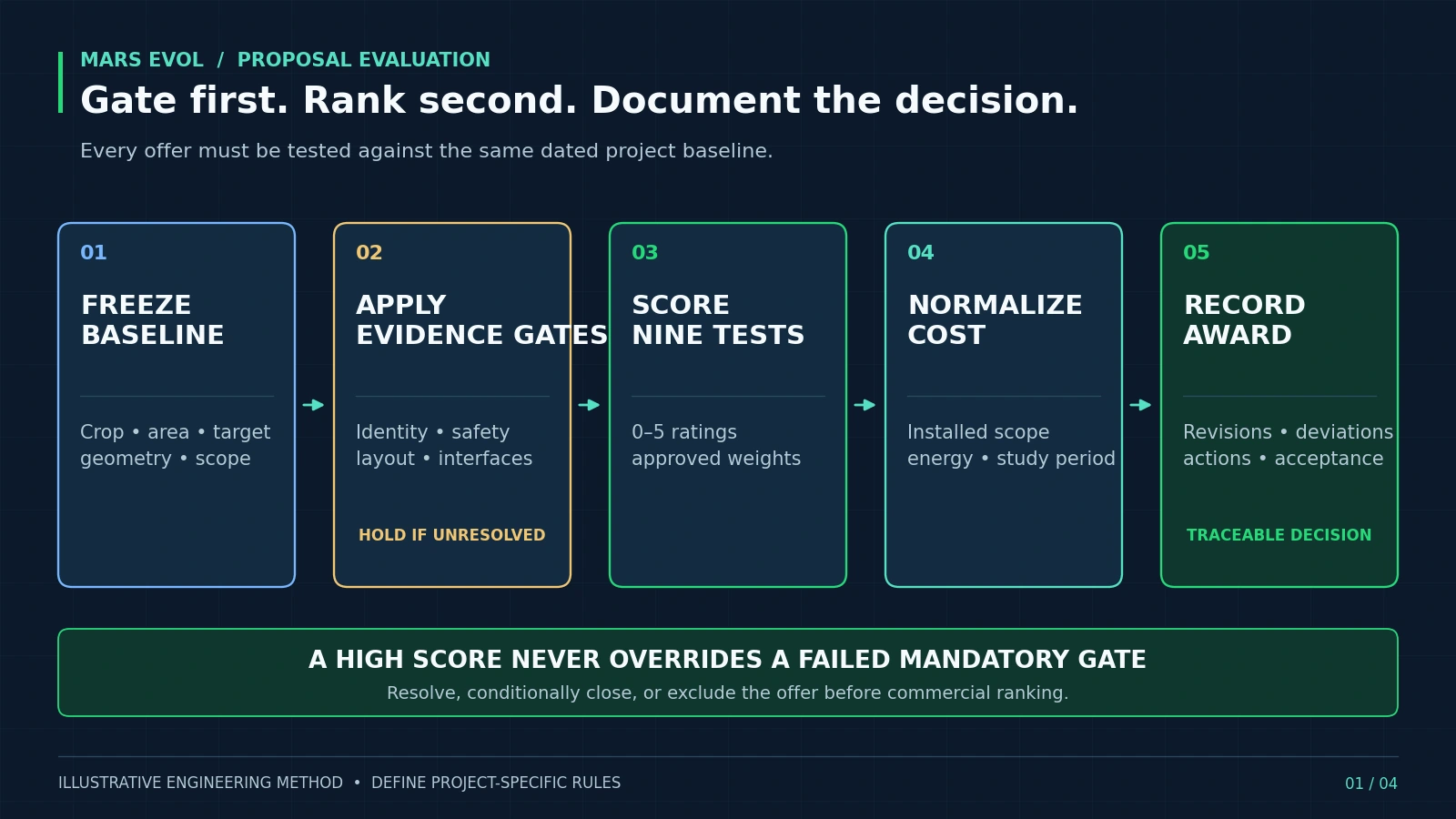
Freeze a dated comparison baseline that every bidder must accept, qualify or reject explicitly. Without that baseline, a lower price may simply represent less cropped area, a different mounting height, fewer operating hours or an excluded control package.
The baseline should identify the crop and stage, growing-area boundary, target supplemental PPFD or DLI contribution, photoperiod constraints, daylight basis, calculation plane, greenhouse geometry, obstructions, mounting limits, supply conditions, control architecture, scope split, schedule and acceptance method. The supplemental-lighting design guide explains the relationship among PPFD, DLI and system design. Record unresolved inputs as assumptions with an owner and due date.
Require each supplier to return a compliance matrix with three possible responses: complies, deviation or not offered. A statement such as “included as standard” is insufficient unless it points to a model, drawing, test report or contract clause.
Which Evidence Gaps Should Stop the Evaluation?
Stop and clarify any gap that prevents the buyer from verifying safety, product identity, lighting performance or system compatibility. Do not let a high weighted score compensate for an unresolved mandatory condition.
| Evidence gate | Minimum decision evidence | Action if unresolved |
|---|---|---|
| Exact product identity | Model, spectrum, driver, input voltage, control option and revision match across quote and evidence | Request a corrected, traceable schedule |
| Safety and environment | Applicable certification and ratings for the jurisdiction, wet/damp conditions, temperature and installation method | Hold technical acceptance |
| Reproducible light design | Geometry, calculation plane, reflectance assumptions, fixture file, quantity and full PPFD result set | Return the layout for clarification |
| Electrical and controls | Compatible supply, load schedule, dimming interface, zoning, fail state and responsibility boundary | Require an interface resolution |
| Commercial scope | Priced inclusions, exclusions, quantities, delivery basis, warranty terms and acceptance obligations | Normalize or exclude from ranking |
UL Solutions notes that horticultural equipment presents application-specific safety issues and identifies UL 8800, photobiological considerations, PPF/PPE testing, environmental suitability and wiring methods among the relevant areas. [3] Certification must still be checked against the actual model, mark, installation and local authority requirements.
How Do You Score a Commercial Greenhouse LED Proposal?
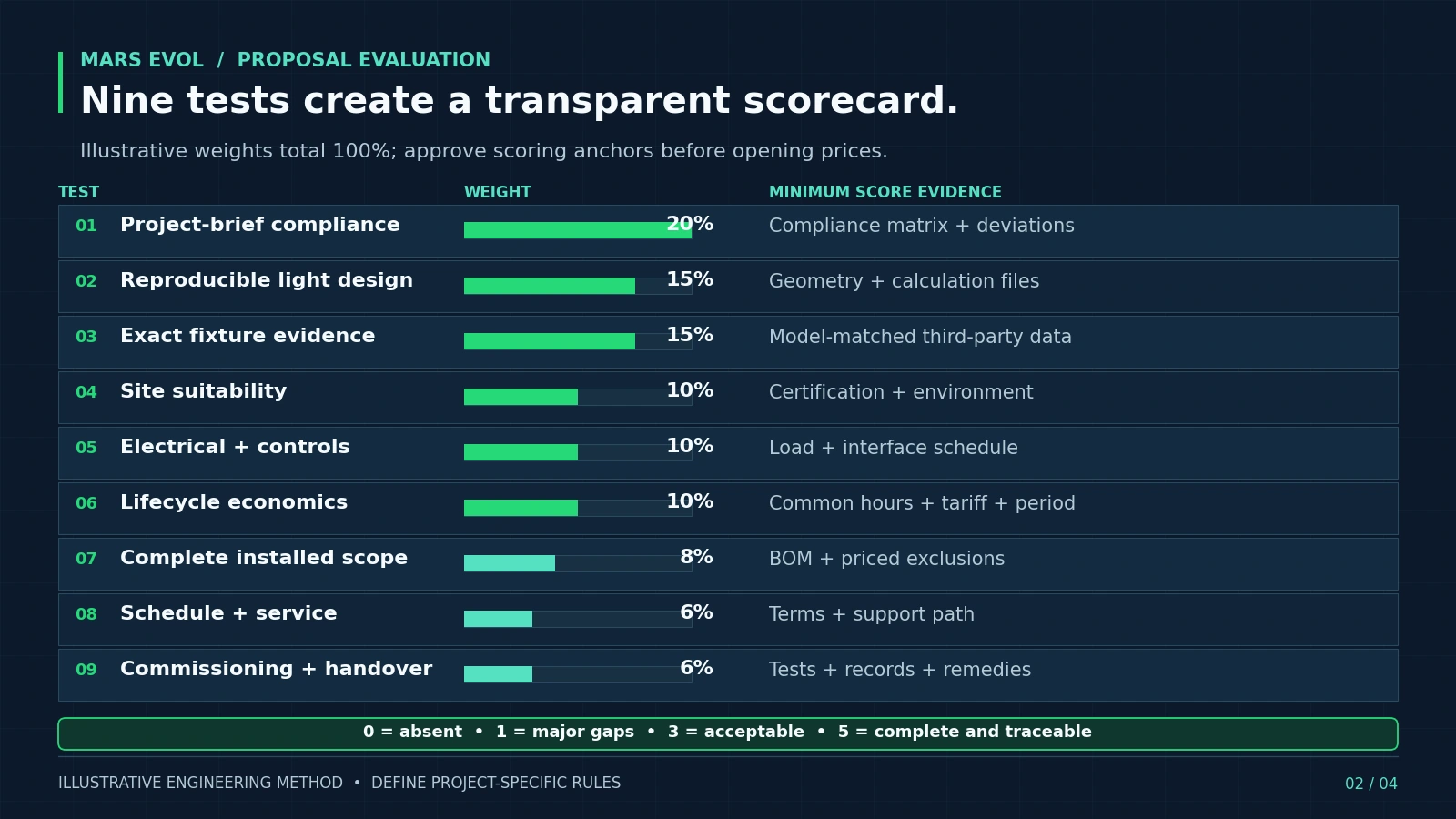
Score nine tests with predefined weights and evidence rules after all mandatory gates pass. A practical scale is 0 for absent evidence, 1 for major gaps, 3 for acceptable evidence and 5 for complete, traceable evidence. Define what each score means before opening commercial prices.
1. Does the offer answer the frozen project brief?
Score the explicit compliance matrix, not the persuasiveness of the narrative. Check the cropped area, crop objective, target, operating window and every exception. Penalize silent changes more heavily than clearly stated alternatives.
2. Can the lighting result be reproduced?
Require the model inputs and spatial results needed for an independent review. Average PPFD alone cannot reveal the minimum or pattern. Confirm the fixture photometric file, mounting locations, calculation grid and treatment of structure, screens and existing light. Use the greenhouse layout method and PPFD mapping protocol as separate design and field-verification references.
3. Does independent evidence match the quoted luminaire?
Match model numbers and operating configurations across the quote, specification, certification and laboratory report. DLC Horticultural V4.0 requires full LM-79 evidence for listed products and specifies matching model identification in LM-79 and TM-33 documents. It also explains that total PPF contains no directional information. [2] Therefore, efficacy can support fixture comparison but cannot prove canopy PPFD or uniformity by itself.
4. Is the proposed equipment suitable for the site?
Verify conditions rather than accepting an isolated IP number. Review ambient temperature, humidity, wet or damp exposure, cleaning, chemicals, suspension, wiring and maintenance access. Record who confirms local compliance.
5. Will electrical and control interfaces work as one system?
Trace power and commands from the facility connection to every zone and fixture state. Review exact input data, startup behavior, circuit allocation, control protocol, dimming range, off behavior, sensor ownership and restoration after power or communication loss. Use the electrical design checks and control-system guide for the detailed handoff.
6. Is lifecycle cost calculated on a common basis?
Normalize fixture quantity, installed scope, operating hours, tariff and study period. Include priced exclusions and use model-specific input power. NIST Handbook 135 describes lifecycle cost analysis as a method for comparing capital investments with operating costs over the study period. [5]
7. Is the installed scope complete?
Convert every exclusion into a responsibility, quantity and price allowance. Include mounting hardware, cabling, control devices, sensors, gateways, commissioning, freight, taxes, permits and integration work as applicable. “By others” is a scope marker, not a zero-cost item.
8. Are schedule, warranty and service commitments usable?
Score the obligations that can be enforced and operated. Record manufacturing lead time, shipping basis, spare strategy, response path, warranty exclusions and evidence required for a claim. Do not convert a warranty duration into an assumed light-maintenance curve.
9. Can the installed system be accepted objectively?
Define tests, instruments, conditions, tolerances, records and remedies before award. Commissioning should cover fixture identity, controls, representative electrical states and agreed light measurements. Purdue Extension describes DLI measurement with a quantum sensor at crop level and time-based logging; the project protocol must add its own grid and acceptance boundary. [4]
How Is the Weighted Proposal Score Calculated?
Multiply each 0–5 evidence score by its approved weight, divide by five and sum the contributions. Keep raw notes and document links beside the number; a score without evidence is not auditable.
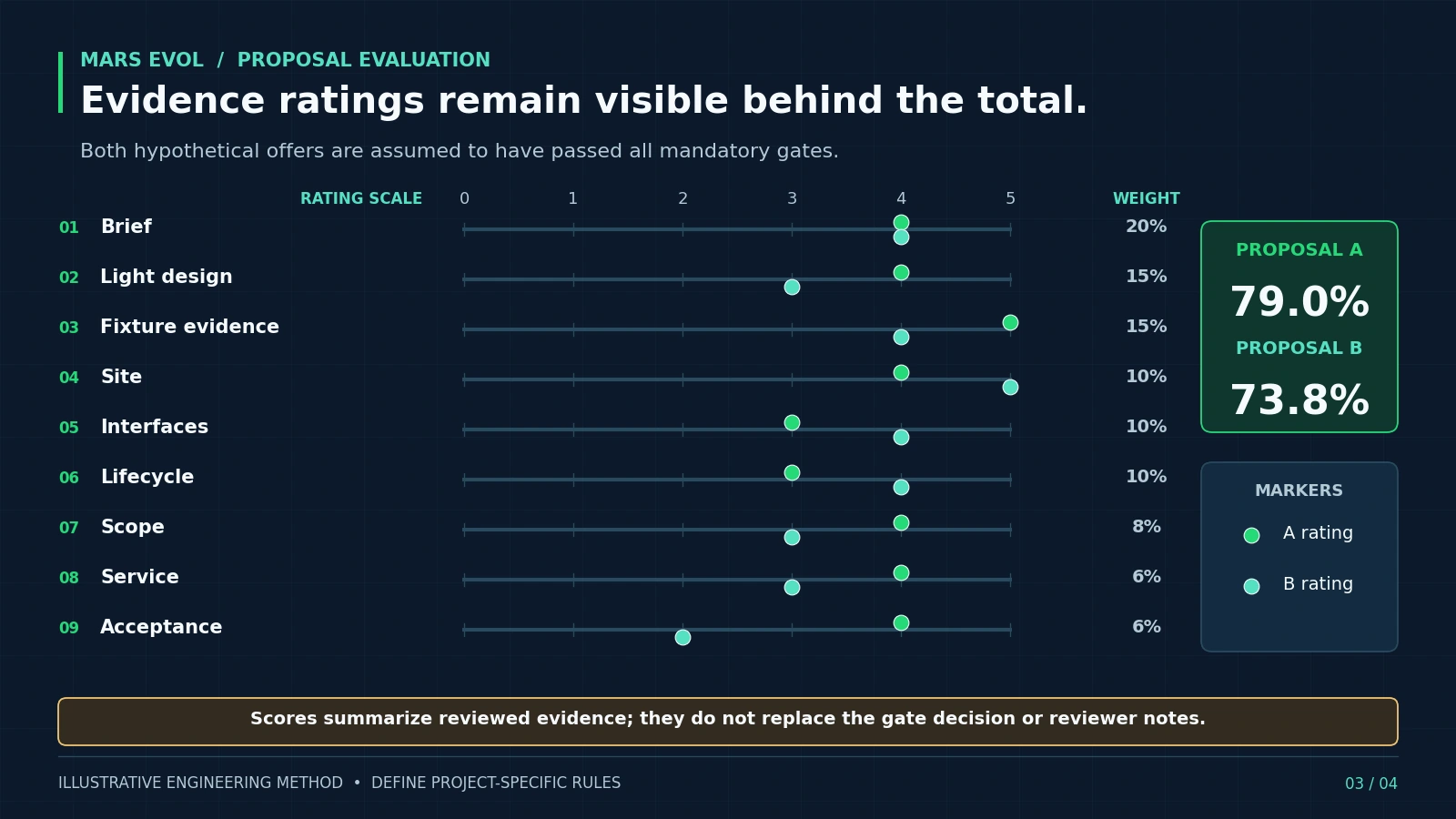
In the hypothetical comparison below, both offers have passed the mandatory gates. Proposal A receives ratings of 4, 4, 5, 4, 3, 3, 4, 4 and 4 across the nine tests; Proposal B receives 4, 3, 4, 5, 4, 4, 3, 3 and 2. With the illustrated weights, the totals are 79.0% and 73.8%.
Worked Example: How Do You Normalize Lifecycle Cost?
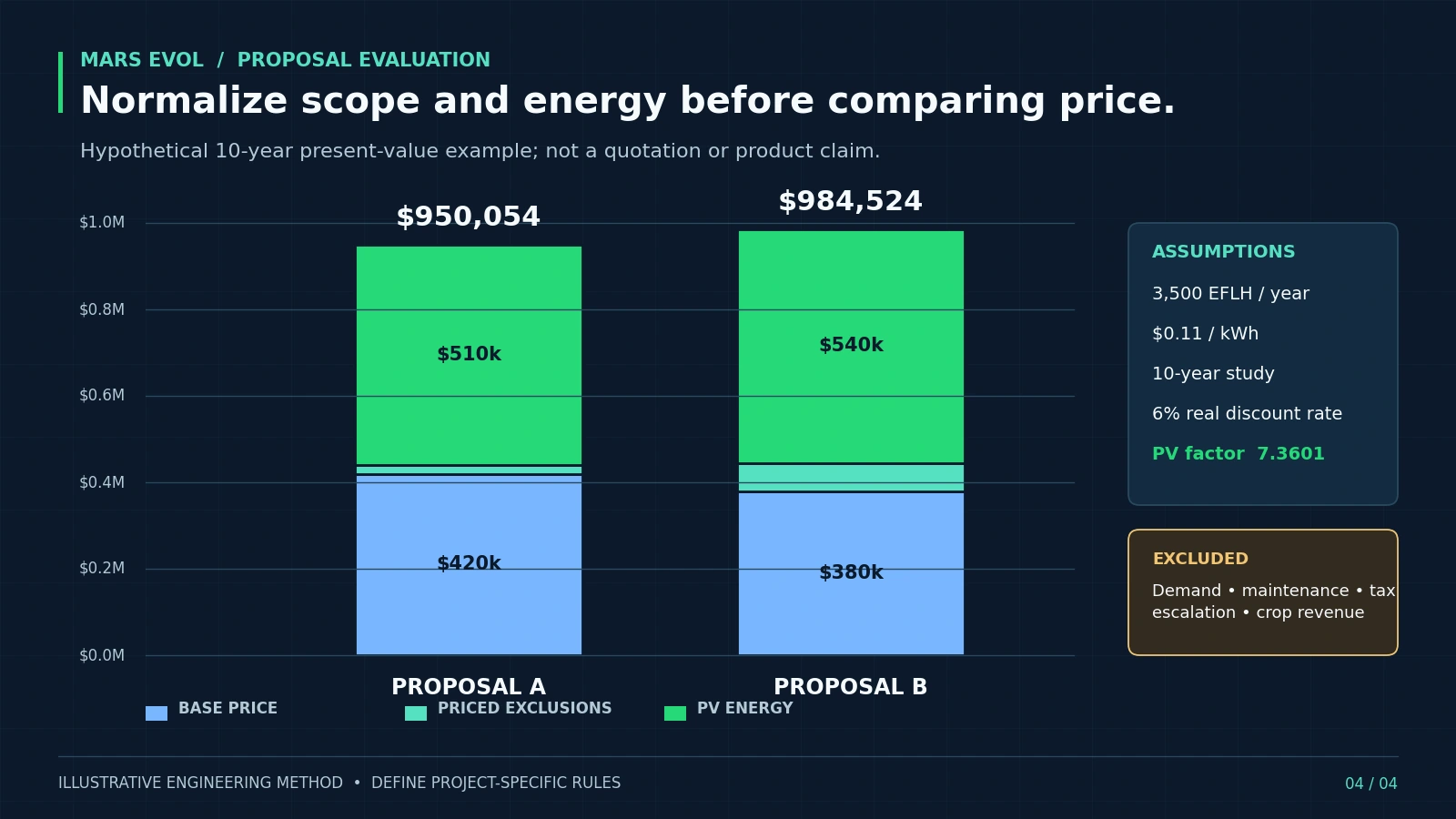
Compare lifecycle cost only after both layouts are accepted against the same lighting target and boundary. The following arithmetic is a teaching example, not a quotation, energy forecast or product claim.
Assume 3,500 equivalent full-load hours per year, an energy-only rate of $0.11/kWh, a 10-year study period and a 6% real discount rate. Proposal A has 300 hypothetical 600 W fixtures, a $420,000 base installed price and $20,000 of priced exclusions. Proposal B has 280 hypothetical 680 W fixtures, a $380,000 base price and $65,000 of priced exclusions. Demand charges, maintenance, tax, escalation, degradation and residual value are excluded from this simplified comparison.
The lower base quote in Proposal B does not remain lower after exclusions and the simplified present value of energy are normalized. That result is sensitive to hours, tariff, demand, financing and scope. Nelson and Bugbee’s peer-reviewed greenhouse-lighting analysis likewise evaluated photons and economic assumptions together rather than treating fixture price as the complete cost. [6]
How Should the Final Award Decision Be Documented?
Issue a short decision record that links the winning offer to the approved baseline, evidence revisions, clarifications, scorecard, evaluated cost and residual risks. Keep technical score and cost visible separately; do not hide them inside an invented “dollars per point” ratio.
The record should name every accepted deviation, action owner and completion date. Attach the final bill of materials, drawings, interface schedule, commissioning plan and commercial terms. If a preferred bidder still has a resolvable gap, make award conditional on a dated deliverable rather than silently treating the gap as closed.
Common Mistakes When Comparing Greenhouse LED Offers
- Scoring before setting gates: a high total can conceal an unresolved safety or compatibility issue.
- Comparing different boundaries: confirm equal cropped area, calculation plane, target and scope.
- Using PPF as canopy PPFD: PPF is total fixture output and contains no directional or layout information.
- Trusting family-level documents: evidence must match the quoted model, spectrum, driver and control configuration.
- Ranking on purchase price: add exclusions and operating costs on a common basis.
- Double-counting evidence: one certificate should not earn points in several unrelated categories.
- Accepting vague commissioning: define instruments, conditions, records and remedies before ordering.
FAQ: Commercial Greenhouse LED Proposal Evaluation
Should the lowest-price compliant proposal win?
Not automatically. Compare technical evidence, installed scope, lifecycle cost, delivery risk and acceptance obligations. Procurement rules may define the final method, but every bidder should face the same disclosed basis.
Is DLC listing enough to approve a greenhouse layout?
No. A listing can support product-level evidence, but DLC states that total PPF contains no directional information. The project layout still needs geometry, distribution data and calculated spatial results.
Can two proposals with different fixture quantities be compared?
Yes, if both use the same crop area, target, calculation boundary, accepted layout method and operating assumptions. Compare complete systems, not fixture count in isolation.
What if a supplier will not provide a full test report?
Record the missing evidence and apply the predefined gate or score. Do not infer unavailable values from a similar model. The buyer can request a controlled clarification before deciding eligibility.
Should warranty years receive a large score?
Score the enforceable terms, exclusions, claim process and local service path. Warranty duration alone does not prove photon maintenance, uptime or replacement speed.
Can the weighted score replace engineering judgment?
No. It makes judgment traceable. Qualified reviewers still need to assess evidence quality, safety, local requirements, assumptions and residual risk.
MarsEVOL Perspective: Make the Decision Traceable
MarsEVOL recommends a single project evidence index that connects the approved layout, exact fixture schedule, electrical interface, control zones, commercial scope and commissioning record. The current MarsEVOL product portfolio and HarveStation system page describe available product families and system concepts; project suitability must be confirmed for the exact proposed configuration and site.
For proposal support, MarsEVOL starts with crop targets and greenhouse geometry, then connects fixture selection, layout and control logic. The evaluation file should clearly distinguish published evidence, project calculations, supplier commitments and buyer assumptions.
Conclusion
A defensible commercial greenhouse LED proposal decision is a documented comparison of like-for-like systems. Freeze the baseline, apply mandatory evidence gates, score nine defined tests, normalize lifecycle cost and preserve the decision record. That method does not guarantee crop performance, but it exposes assumptions and scope gaps before they become installation changes, commissioning disputes or unexpected operating costs.
Comparing Commercial Greenhouse LED Proposals?
Send the common project brief, greenhouse drawing, crop-light target, proposal schedules, layout files, control requirements and commercial exclusions. MarsEVOL can help organize a traceable technical comparison and identify clarification items before procurement approval.
Explore More MarsEVOL Resources
Build a complete request package before inviting suppliers to quote.
Connect crop targets, fixture selection, layout support and dimming strategy within one project boundary.
References
Technical sources checked September 19, 2026. Standards, listings and product documents can change; confirm the current edition and exact project applicability.
- American Society of Agricultural and Biological Engineers. ANSI/ASABE S640: Quantities and Units of Electromagnetic Radiation for Plants (Photosynthetic Organisms). ASABE standard.
- DesignLights Consortium. Technical Requirements for LED-Based Horticultural Lighting V4.0. Released March 11, 2025; revised October 1, 2025.
- UL Solutions. Horticultural Lighting Testing and Certification. Official overview of UL 8800 and related safety and performance considerations, accessed 2026.
- Torres, A. P., and Lopez, R. G. Measuring Daily Light Integral in a Greenhouse. Purdue University Extension HO-238-W, 2010.
- Kneifel, J. D., and Webb, D. Life Cycle Costing Manual for the Federal Energy Management Program. NIST Handbook 135e2022-upd1, 2022.
- Nelson, J. A., and Bugbee, B. Economic Analysis of Greenhouse Lighting: Light Emitting Diodes vs. High Intensity Discharge Fixtures. PLOS ONE 9(6):e99010, 2014. DOI: 10.1371/journal.pone.0099010.