
Greenhouse supplemental lighting is the engineered use of electric light to close crop-light shortfalls when available greenhouse sunlight is insufficient. A professional system starts with the crop objective and seasonal sunlight, then coordinates fixture layout, runtime, uniformity, dimming, controls and verification. For metric definitions and conversion logic, use the dedicated PPFD vs DLI guide.
Key Takeaways
- Start with crop target DLI and measured or estimated greenhouse sunlight—not fixture wattage.
- Use PPFD and DLI for different decisions: intensity at a moment versus accumulated daily light.
- Calculate the deficit in the dedicated greenhouse DLI guide, then determine supplemental-light runtime.
- Verify mounting height, spacing and uniformity with a documented greenhouse lighting layout.
Last reviewed: September 27, 2026 · Pillar guide
Greenhouse Supplemental Lighting Hub
Use this page as the system-design roadmap. Start with crop light targets, quantify the DLI deficit, translate it into PPFD and runtime, then validate layout, uniformity, controls and commercial feasibility.
- Light fundamentals: PPFD vs DLI · Calculate crop DLI · Estimate runtime
- Sunlight & transmission: Greenhouse light transmission · Winter & cloudy-season lighting
- Layout & verification: Lighting layout · Spacing & mounting height · PPFD uniformity · PPFD mapping
- Controls: DLI-based control · 0–10V & zone control · HARVESTATION
- Crop guides: Tomato, cucumber, lettuce, strawberry and seedling lighting
- Commercial design: Energy, electrical design, cost and proposal evaluation
Jump to: design workflow · layout & uniformity · DLI control · crop guides · commercial design
What Is Greenhouse Supplemental Lighting?
Greenhouse supplemental lighting is the use of electric lighting to increase the amount of photosynthetically useful light available to crops when natural sunlight is insufficient.
Unlike indoor farming, a greenhouse does not rely entirely on artificial light. It already receives sunlight. However, that sunlight is not constant. It changes with location, season, weather, day length, greenhouse structure, glazing material, shading system, and crop canopy position.
For this reason, professional greenhouse supplemental lighting design should not start with fixture wattage alone. It should start with a more fundamental question:
How much photosynthetic light does the crop need each day, and how much of that requirement is already provided by sunlight?
This is where Daily Light Integral (DLI) becomes one of the most important concepts in greenhouse supplemental lighting.
Why Greenhouses Need Supplemental Lighting
A greenhouse is designed to capture sunlight, but sunlight is not always sufficient for predictable crop production.
In commercial greenhouse production, light influences photosynthesis, crop timing, rooting, plant morphology, flowering, biomass accumulation, fruit development, and final crop quality.
When natural light is too low, crops may grow more slowly, stretch excessively, produce weaker transplants, or show inconsistent performance across seasons.
Greenhouse supplemental lighting helps close the gap between available sunlight and the crop’s target light requirement.
However, more light is not always better. Once a crop’s light requirement is satisfied, additional lighting may increase energy cost without producing a proportional improvement in growth, quality, or yield.
Therefore, greenhouse supplemental lighting should not be understood simply as “making the greenhouse brighter.” It is a method for managing the crop’s daily light environment.
The Key Metric: Daily Light Integral
Daily Light Integral (DLI) describes the total amount of photosynthetically active light received by one square meter of crop area during one day.
DLI is commonly expressed as mol·m⁻²·d⁻¹.
A useful way to understand DLI is to compare it with rainfall. A rain gauge does not only tell us how hard it rained at one moment; it tells us how much rain accumulated over time. DLI works in a similar way. It tells us how much photosynthetic light accumulated over an entire day.
This matters because plants respond not only to instantaneous light intensity, but also to the total quantity of usable light received over time.
In horticultural lighting, DLI refers to photons in the photosynthetically active radiation range, commonly 400–700 nm, which provide energy for photosynthesis.
How PPFD and DLI Support Supplemental Lighting Design
PPFD and DLI are supporting metrics within the broader supplemental-lighting workflow. For the full definitions, formulas and comparison, use the dedicated PPFD vs DLI greenhouse lighting guide. This section focuses on how those metrics feed fixture sizing, runtime and control decisions.
What Is PPFD?
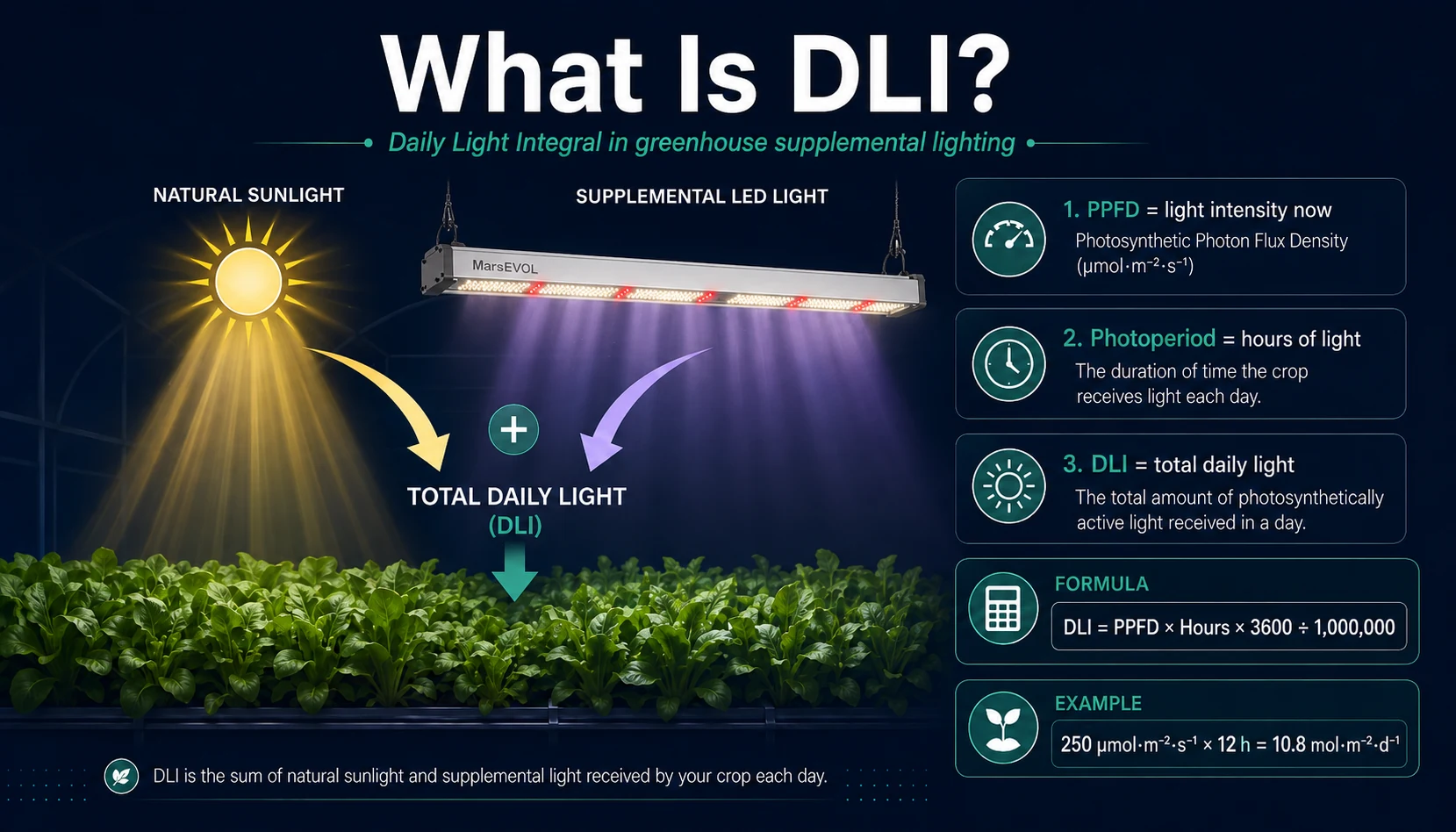
Photosynthetic Photon Flux Density (PPFD) is the instantaneous photosynthetic light intensity reaching the crop canopy.
It is commonly expressed as μmol·m⁻²·s⁻¹.
PPFD answers a simple question: How much photosynthetic light is reaching the crop right now?
What Is DLI?
DLI answers a different question: How much photosynthetic light has the crop received over the entire day?
PPFD is an instantaneous measurement. DLI is an accumulated daily value. The two are connected by photoperiod.
Formula
DLI = PPFD × Lighting Hours × 3600 ÷ 1,000,000
For example, if a lighting system provides an average canopy-level PPFD of 250 μmol·m⁻²·s⁻¹ for 12 hours:
250 × 12 × 3600 ÷ 1,000,000 = 10.8 mol·m⁻²·d⁻¹
This means the lighting system contributes approximately 10.8 mol·m⁻²·d⁻¹ of daily light.
This calculation is central to greenhouse supplemental lighting design because it allows growers, greenhouse designers, and lighting engineers to translate fixture output and operating hours into a crop-relevant daily light contribution.
Why Location and Season Matter
Outdoor DLI changes dramatically across the year.
It is affected by latitude, day length, solar angle, cloud cover, local weather patterns, and season. A greenhouse in the northern United States in winter faces a very different light environment from a greenhouse in the southern United States in summer.
Even within the same country, monthly DLI can vary substantially.
This seasonal and geographical variation is one of the main reasons supplemental lighting should be designed around local light conditions rather than using a fixed, one-size-fits-all lighting recommendation. For seasonal operating considerations, see the practical guide to greenhouse lighting in winter and cloudy periods.
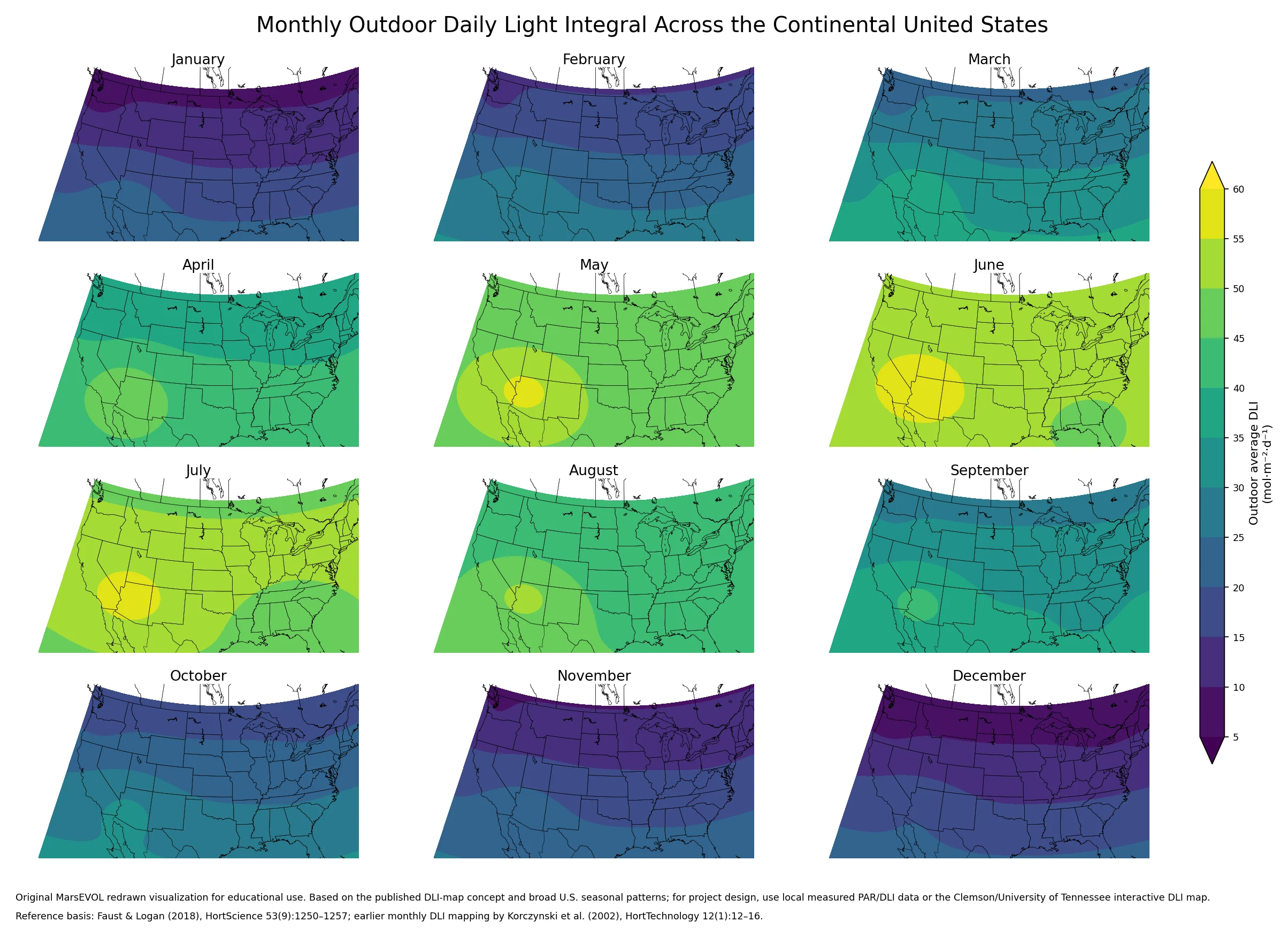
Outdoor average Daily Light Integral varies significantly by location and season. Original MarsEVOL redrawn visualization based on the published U.S. DLI map concept from Faust and Logan, 2018. For project-level design, local measured PAR/DLI data should be used whenever possible.
Outdoor DLI Is Not the Same as Greenhouse DLI
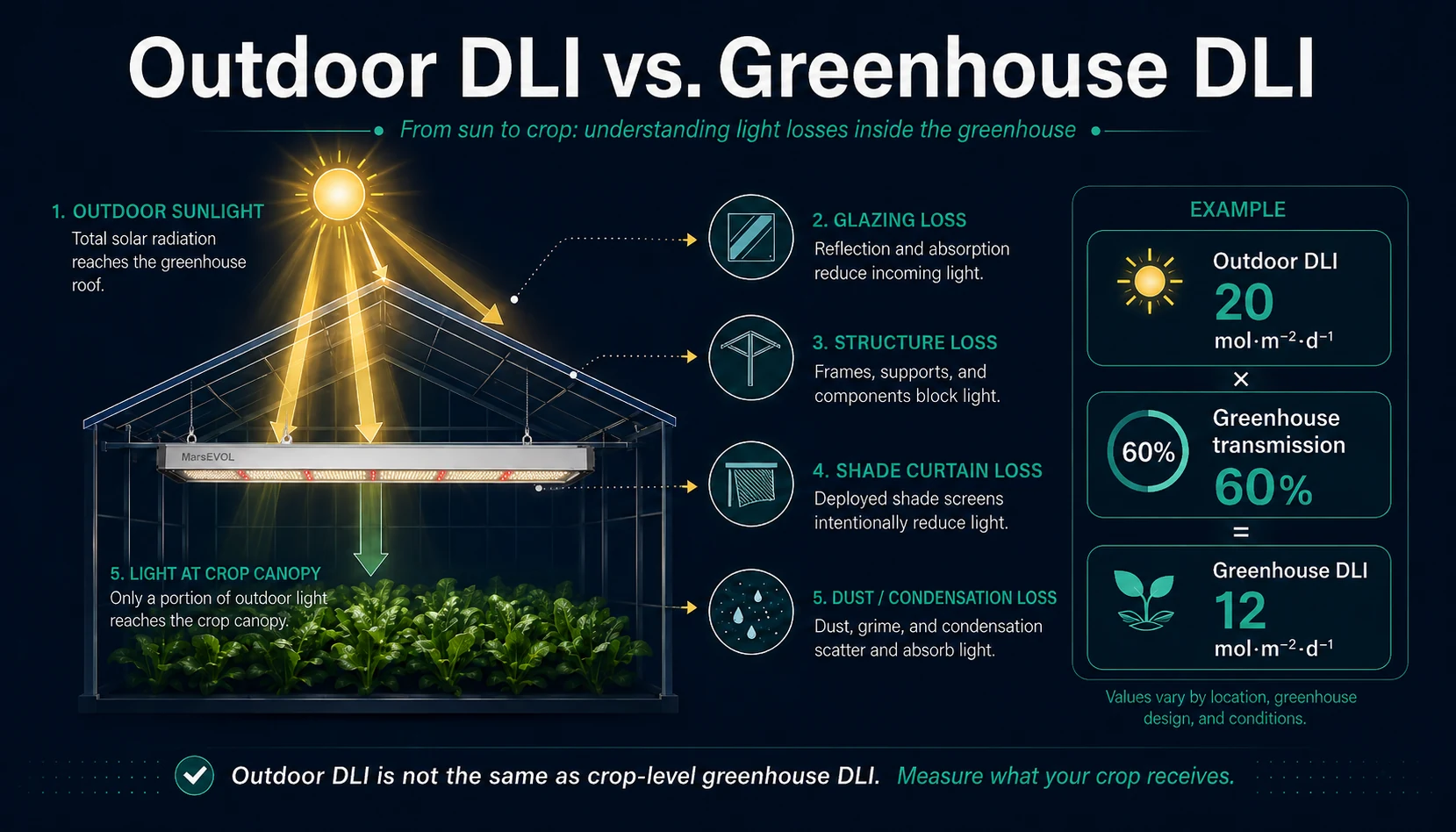
A common mistake is assuming that outdoor DLI equals the DLI received by crops inside the greenhouse.
In reality, greenhouse crops receive less light than outdoor measurements because light is reduced by many factors, including:
- greenhouse glazing material;
- frame and structural shadows;
- trusses and pipes;
- hanging equipment;
- shade curtains;
- dust or condensation on covering materials;
- screen systems;
- crop canopy overlap.
For example, if the outdoor DLI is 20 mol·m⁻²·d⁻¹ and the greenhouse has an estimated light transmission of 60%, the crop-level greenhouse DLI may be approximately:
20 × 0.60 = 12 mol·m⁻²·d⁻¹
This means that even when the outdoor environment provides 20 mol·m⁻²·d⁻¹, the crop inside the greenhouse may receive only around 12 mol·m⁻²·d⁻¹ before supplemental lighting is added.
That difference is exactly where greenhouse supplemental lighting becomes important.
For a material-by-material comparison and project measurement considerations, review greenhouse covering materials and light transmission.
Crop Target DLI: Not Every Crop Needs the Same Light
Different crops require different DLI ranges.
Leafy greens, seedlings, herbs, fruiting vegetables, ornamentals, and research crops do not have the same light requirement.
Even within the same crop type, the target DLI may vary depending on cultivar, growth stage, production objective, temperature, CO₂ concentration, and desired crop quality.
For example, propagation crops and young seedlings usually require a different lighting strategy from fruiting crops such as tomatoes, cucumbers, or peppers.
Research greenhouses may require even more precise lighting control because repeatability and uniformity are critical for experimental reliability.
Every greenhouse lighting project should begin with three questions:
- What crop is being grown?
- What is the target DLI for that crop and production objective?
- How much DLI is already supplied by natural sunlight inside the greenhouse?
Only after answering these questions should fixture output, spacing, mounting height, photoperiod, dimming strategy, and control zones be determined.
Crop-Specific Supplemental Lighting Guides
Target DLI, PPFD, photoperiod and control strategy should be adapted to the crop and growth stage. Use the system-design framework on this page first, then move into the crop-specific guides below.
- Tomato greenhouse lighting — DLI, PPFD and photoperiod for fruiting-crop production.
- Cucumber greenhouse lighting — canopy light, DLI and supplemental-light strategy.
- Lettuce DLI & PPFD — light targets for controlled greenhouse production.
- Strawberry greenhouse lighting — DLI and photoperiod considerations.
- Seedling DLI lighting — propagation, uniformity and early-stage crop control.
Research Evidence: DLI Influences Growth, Flowering, and Crop Quality
DLI is not only a theoretical metric. It has been studied extensively in greenhouse crop research.
Faust and Logan reviewed DLI research and provided updated high-resolution monthly DLI maps of the United States. Their work helped connect geographical light availability with greenhouse crop production decisions.
Faust, Holcombe, Rajapakse, and Layne studied the effect of DLI on bedding plant growth and flowering. Their research supported the use of DLI as a practical measurement for describing the greenhouse light environment and improving crop management decisions.
Pramuk and Runkle investigated the effect of photosynthetic DLI during the seedling stage on several ornamental species, including celosia, impatiens, salvia, tagetes, and viola. Their study showed that DLI during early growth stages can influence subsequent plant growth and flowering after transplant.
These studies support a practical conclusion:
Greenhouse supplemental lighting should be designed around plant response, not fixture wattage alone.
A lighting system should therefore be evaluated by:
- the biological light delivered to the crop canopy;
- the accumulated daily light contribution;
- the uniformity of distribution;
- the spectrum strategy;
- the level of control available to match crop objectives.
How to Estimate Supplemental Lighting Needs
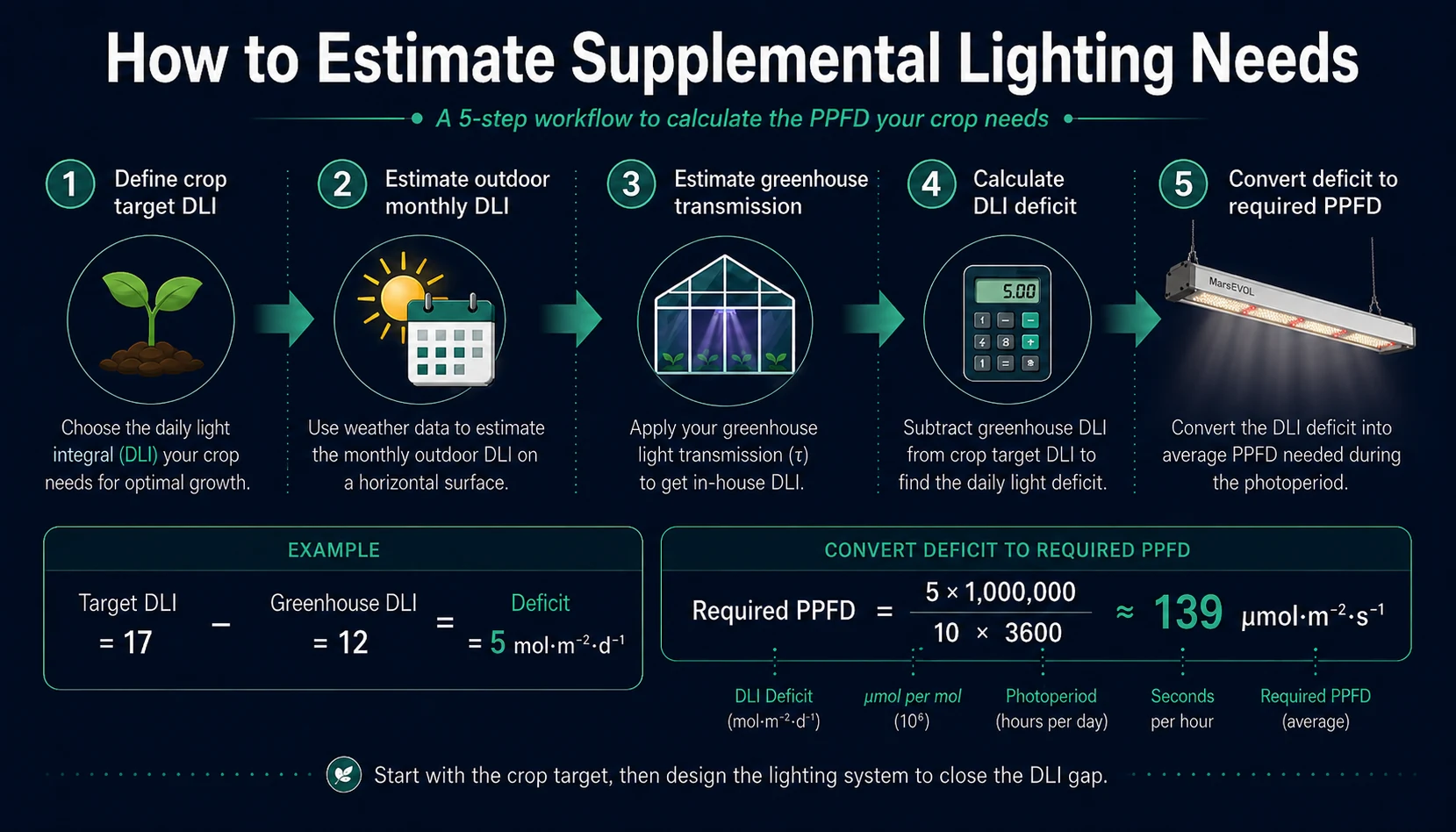
A simplified greenhouse supplemental lighting design workflow can be described in five steps.
Step 1: Define the Crop Target DLI
The first step is to define the target daily light level based on crop type, growth stage, and production objective.
For example, a leafy green crop may require a moderate DLI target, while fruiting vegetables often require a higher daily light level to support biomass accumulation, flowering, fruit development, and yield.
The target should not be selected randomly. It should be based on crop research, production experience, and the grower’s economic objective.
Step 2: Estimate Outdoor Monthly DLI
The second step is to estimate the local outdoor DLI by month.
This can be done using regional DLI maps, local weather data, or on-site light measurements. Monthly DLI maps are useful for early-stage planning because they help growers understand seasonal light availability.
However, maps should be treated as an estimation tool, not a final design value. Local climate, microclimate, weather variation, and greenhouse structure can all affect the actual available light.
Step 3: Estimate Greenhouse Light Transmission
The third step is to estimate how much outdoor light actually reaches the crop canopy inside the greenhouse.
If the outdoor DLI is 20 mol·m⁻²·d⁻¹ and greenhouse transmission is estimated at 60%, the estimated indoor DLI is:
20 × 0.60 = 12 mol·m⁻²·d⁻¹
This indoor DLI value represents the approximate sunlight contribution before supplemental lighting is added.
For better accuracy, growers should measure actual PPFD or DLI inside the greenhouse at canopy height.
Step 4: Calculate the DLI Deficit
The fourth step is to calculate the difference between the crop target DLI and the available greenhouse DLI.
For example, if the crop target is 17 mol·m⁻²·d⁻¹ and the estimated greenhouse sunlight contribution is 12 mol·m⁻²·d⁻¹:
17 − 12 = 5 mol·m⁻²·d⁻¹
The supplemental lighting system needs to provide approximately 5 mol·m⁻²·d⁻¹. This value is the supplemental DLI requirement.
Step 5: Convert DLI Deficit to Required PPFD
The fifth step is to convert the DLI deficit into the average PPFD contribution required from the lighting system.
If the grower wants to provide the 5 mol·m⁻²·d⁻¹ deficit over 10 hours:
Required PPFD = 5 × 1,000,000 ÷ 10 ÷ 3600
Required PPFD ≈ 139 μmol·m⁻²·s⁻¹
This means the lighting system should provide an average canopy-level PPFD contribution of approximately 139 μmol·m⁻²·s⁻¹ over 10 operating hours.
This calculation does not yet determine the fixture model or quantity. It only defines the required average light contribution.
The next step is to design fixture layout, spacing, mounting height, uniformity, dimming capacity, and control zones.
Design next step: Once the target average canopy PPFD is defined, use the greenhouse lighting layout guide to evaluate fixture count, mounting height, spacing, edge conditions and uniformity.
Why Uniformity Matters
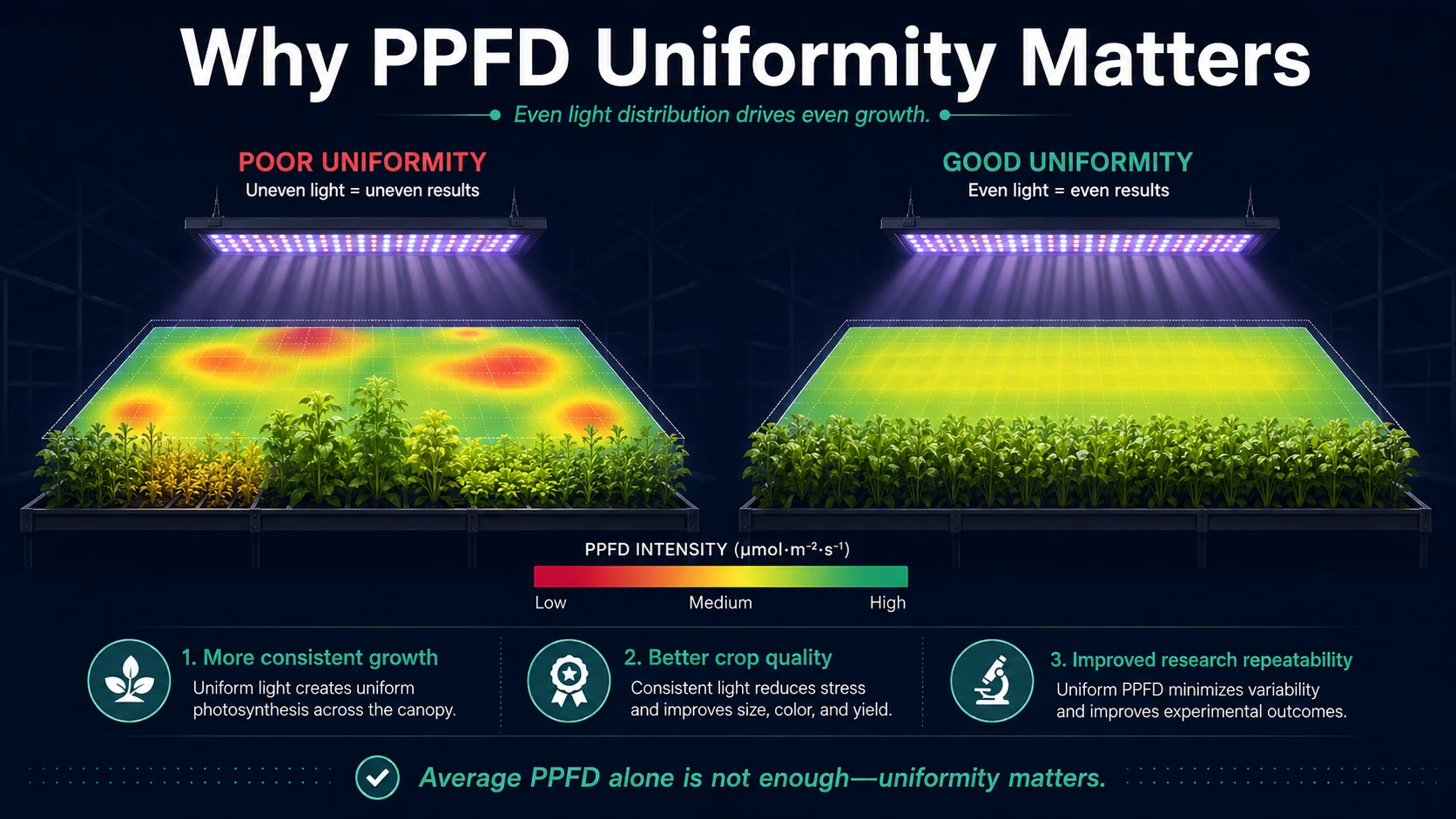
In greenhouse lighting, the average PPFD is not enough.
Uniformity matters because plants growing under different light levels may develop at different rates. If one area receives significantly more light than another, crop growth, morphology, flowering, and harvest timing can become inconsistent.
Poor lighting uniformity can cause:
- uneven crop height;
- inconsistent biomass accumulation;
- non-uniform flowering;
- variable research results;
- inconsistent harvest quality;
- reduced predictability in crop scheduling.
This is especially important in research greenhouses, propagation benches, and commercial production systems where repeatability and crop uniformity are critical.
A professional greenhouse lighting proposal should therefore include:
- target PPFD;
- estimated DLI contribution;
- fixture layout;
- mounting height;
- PPFD distribution map;
- uniformity analysis;
- control zone strategy.
Why DLI-Based Control Matters
Traditional greenhouse lighting often uses simple time-based schedules. For example, lights may run from 6:00 a.m. to 6:00 p.m. regardless of actual sunlight.
However, this approach may waste energy on bright days and under-supply light on cloudy days.
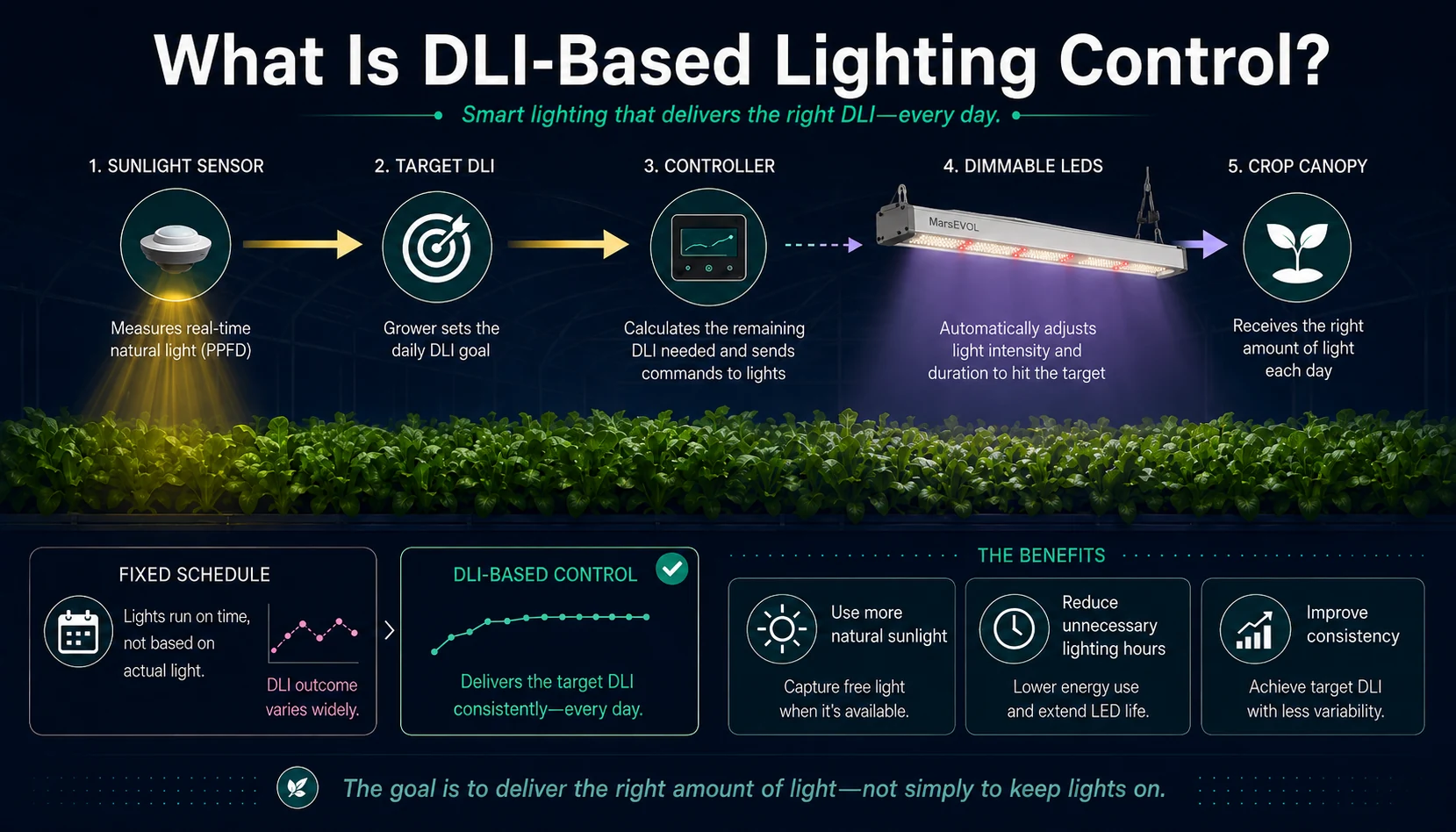
A more advanced approach is DLI-based lighting control.
DLI-based control uses sunlight data, target DLI, dimming, and zone control to deliver the required daily light amount more precisely.
Instead of asking, “Should the lights be on or off at this time?”, a DLI-based strategy asks, “How much light has the crop already received today, and how much additional light is still needed to reach the target DLI?”
This shift is important because it moves greenhouse lighting from fixed scheduling toward crop-based light management.
For commercial greenhouses, DLI-based control can support:
- better use of natural sunlight;
- more consistent crop light exposure;
- reduced unnecessary lighting hours;
- zone-based crop management;
- improved energy efficiency;
- more predictable production planning.
The future of greenhouse lighting is not only high-efficiency fixtures. It is the combination of fixtures, sensors, dimming, zoning, and DLI-based control logic.
Common Mistakes in Greenhouse Supplemental Lighting
Mistake 1: Designing by Wattage Alone
Wattage tells us how much electrical power a fixture consumes. It does not directly tell us how much photosynthetic light reaches the crop canopy.
A professional greenhouse lighting design should focus on canopy-level PPFD, DLI contribution, uniformity, spectrum, fixture efficiency, and control strategy.
Mistake 2: Ignoring Greenhouse Transmission
Outdoor light is not equal to crop-level greenhouse light.
Greenhouse glazing, structure, shade systems, and internal equipment can significantly reduce the light that reaches the crop. If greenhouse transmission is ignored, the lighting design may underestimate the supplemental light requirement.
Mistake 3: Using One Lighting Strategy for All Seasons
The light deficit in January is not the same as the light deficit in June.
A fixed lighting schedule may over-light crops during high-sunlight periods and under-light crops during low-sunlight periods. Seasonal adjustment and DLI-based control are therefore important for practical greenhouse operation.
Mistake 4: Ignoring Uniformity
A lighting system may have a good average PPFD but poor distribution.
In commercial production, poor uniformity can cause inconsistent crop quality. In research greenhouses, poor uniformity can compromise experimental repeatability.
Mistake 5: Treating the Fixture as the Whole System
A greenhouse lighting system is more than the fixture.
It includes fixture selection, optical distribution, mounting height, spacing, wiring, dimming, control zones, sunlight sensing, DLI logic, and operational strategy. A professional system should be designed as a complete lighting solution.
Practical Example: Estimating Supplemental Light for a Greenhouse Crop
Consider a greenhouse crop with a target DLI of 18 mol·m⁻²·d⁻¹.
In a winter month, the outdoor DLI is estimated at 15 mol·m⁻²·d⁻¹.
The greenhouse transmission is estimated at 60%.
The available greenhouse DLI from sunlight is:
15 × 0.60 = 9 mol·m⁻²·d⁻¹
The crop target is 18 mol·m⁻²·d⁻¹, so the supplemental DLI requirement is:
18 − 9 = 9 mol·m⁻²·d⁻¹
If the grower wants to provide this supplemental DLI over 14 hours:
Required PPFD = 9 × 1,000,000 ÷ 14 ÷ 3600
Required PPFD ≈ 179 μmol·m⁻²·s⁻¹
This means the greenhouse lighting system should be designed to provide approximately 179 μmol·m⁻²·s⁻¹ of average supplemental PPFD at crop canopy level during the selected operating period.
The final fixture layout should then be verified through PPFD simulation, field measurement, and operational adjustment.
Commercial Design, Energy & Proposal Evaluation
After the crop-light requirement is defined, the project still has to work electrically, operationally and economically. Commercial greenhouse lighting should therefore be evaluated as a complete system rather than as a fixture-only purchase.
- LED vs HPS — compare energy, heat load and operating implications.
- Greenhouse lighting cost calculator — structure the major project and operating cost inputs.
- Electrical design checks — voltage, circuits, load, protection and installation planning.
- Commercial LED proposal evaluation — test supplier claims against engineering and project criteria.
- Proposal checklist — verify that PPFD, uniformity, layout, controls, warranty and project boundaries are documented.
What a Professional Greenhouse Lighting Design Should Include
A complete greenhouse supplemental lighting design should include more than fixture quantity. It should include:
- crop type and production objective;
- target DLI;
- estimated outdoor DLI by season;
- greenhouse transmission estimate;
- supplemental DLI requirement;
- target canopy-level PPFD;
- photoperiod and operating schedule;
- fixture model and optical distribution;
- mounting height and spacing;
- PPFD uniformity analysis;
- control zone layout;
- dimming strategy;
- sunlight-based or DLI-based control logic;
- energy and operation considerations.
This is especially important for commercial growers, greenhouse designers, integrators, and research facilities that need a lighting system that can be justified scientifically and operated practically.
MarsEVOL Perspective: From Light Target to Lighting System
At MarsEVOL, greenhouse supplemental lighting is approached as a complete system design problem.
The design logic begins with the crop objective and ends with a measurable lighting strategy:
- Crop Objective
- Target DLI
- Available Sunlight
- Supplemental DLI Requirement
- Fixture Architecture
- PPFD Uniformity
- Zone Control
- DLI-Based Operation
This approach helps ensure that the lighting system is not simply bright, but crop-relevant, measurable, controllable, and practical for commercial operation.
For greenhouse applications, the MarsEVOL SOLIFY Series is developed to support different supplemental lighting scenarios, from flexible low-profile installations to higher-output applications where greater DLI contribution is required.
For projects that require advanced lighting management, HARVESTATION provides a control layer for zone-based dimming, sunlight-aware operation, DLI management, and data-driven lighting decisions.
The goal is not simply to turn lights on. The goal is to deliver the right amount of photosynthetic light, at the right time, in the right zone, with the right level of control.
Conclusion
Greenhouse supplemental lighting is not just about adding artificial light. It is about managing the crop’s daily light environment.
The most important concept is DLI: the total amount of photosynthetically active light received by the crop each day.
Because sunlight changes by location, season, weather, and greenhouse transmission, supplemental lighting should be designed around the gap between crop target DLI and available greenhouse sunlight.
A research-based lighting strategy should consider crop target DLI, canopy-level PPFD, photoperiod, greenhouse transmission, seasonal DLI variation, fixture layout, PPFD uniformity, dimming, zone control, and energy efficiency.
For professional growers and research greenhouses, the best lighting system is not simply the brightest system. It is the system that can deliver a predictable, measurable, and crop-relevant light environment.
Need Help Designing a Greenhouse Supplemental Lighting System?
MarsEVOL supports commercial growers, greenhouse designers, integrators, and research teams with greenhouse supplemental lighting analysis and system planning.
Our support can include:
- crop-based DLI analysis;
- fixture layout planning;
- PPFD simulation;
- lighting zone strategy;
- spectrum selection;
- DLI-based control recommendations;
- greenhouse supplemental lighting proposal support.
Request a Free Greenhouse Lighting Plan
Contact MarsEVOL to discuss your crop, greenhouse size, target PPFD, target DLI, and lighting design requirements.
Explore More MarsEVOL Greenhouse Lighting Resources
Explore Greenhouse Lighting Solutions →
Learn how MarsEVOL approaches commercial greenhouse lighting applications, crop-based lighting requirements, and project-level solution design.
View SOLIFY Greenhouse Lighting Series →
Explore MarsEVOL greenhouse lighting fixtures designed for different output levels, installation conditions, and supplemental lighting strategies.
Learn About HARVESTATION Smart Control →
Discover how zone-based dimming, sunlight-aware operation, and DLI-oriented control can improve greenhouse lighting management.
Learn About MarsEVOL Spectra Guide →
Review MarsEVOL spectrum options for greenhouse, indoor farming, vertical farming, and crop-specific lighting strategies.
Request a Free Greenhouse Lighting Plan →
Contact MarsEVOL to discuss your greenhouse size, crop type, target PPFD, target DLI, and lighting design requirements.
References
Faust, J. E., & Logan, J. (2018).
Daily Light Integral: A Research Review and High-Resolution Maps of the United States
HortScience, 53(9), 1250–1257. https://doi.org/10.21273/HORTSCI13144-18
Korczynski, P. C., Logan, J., & Faust, J. E. (2002).
Mapping Monthly Distribution of Daily Light Integrals Across the Contiguous United States
HortTechnology, 12(1), 12–16.
Faust, J. E., Holcombe, V., Rajapakse, N. C., & Layne, D. R. (2005).
The Effect of Daily Light Integral on Bedding Plant Growth and Flowering
HortScience, 40(3), 645–649.
Pramuk, L. A., & Runkle, E. S. (2005).
Photosynthetic Daily Light Integral During the Seedling Stage Influences Subsequent Growth and Flowering of Celosia, Impatiens, Salvia, Tagetes, and Viola
HortScience, 40(5), 1336–1339. https://doi.org/10.21273/HORTSCI.40.5.1336
Runkle, E.
Daily Light Integral Defined
Michigan State University Extension.
Torres, A. P., & Lopez, R. G.
Measuring Daily Light Integral in a Greenhouse
Purdue Extension.
Virginia Cooperative Extension.
Calculating and Using Daily Light Integral: An Introductory Guide