
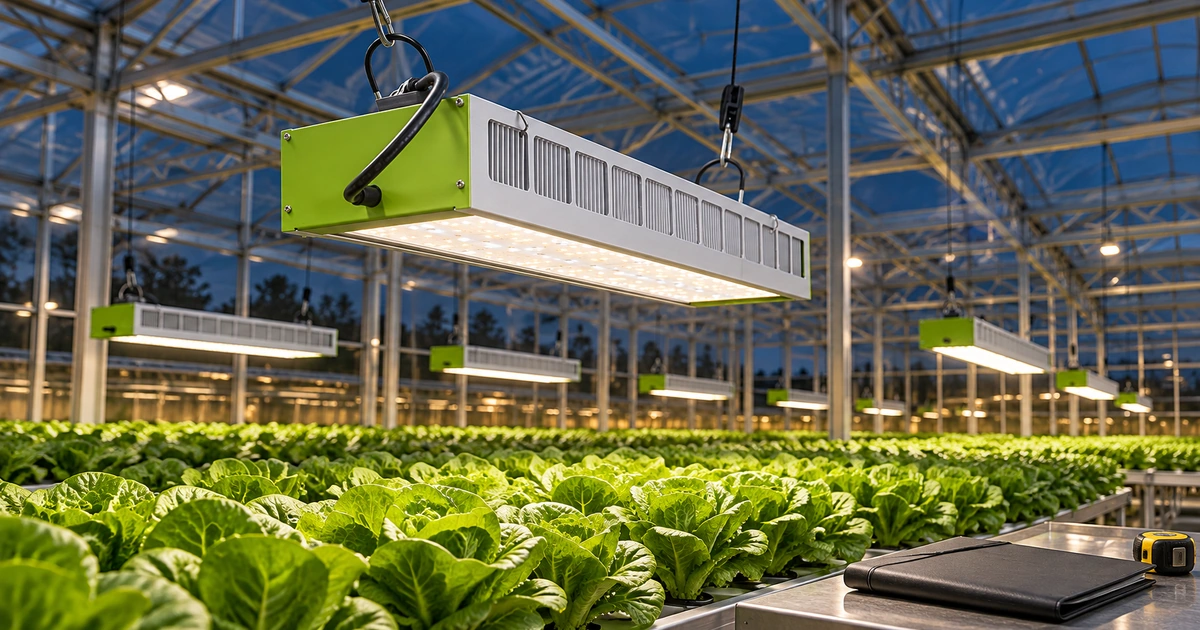
Greenhouse LED rebates depend on your utility territory, project type, exact equipment and purchasing sequence. Confirm the applicable program before making a binding commitment, preserve the existing lighting baseline, and submit the required technical and financial evidence. A qualified fixture does not approve a project, and an application or preliminary estimate does not guarantee payment.
This greenhouse LED rebates guide turns incentive research into an application plan for commercial growers in the United States and Canada. Begin with the greenhouse lighting resources hub if you still need to identify the responsible organizations. Here, the focus is protecting eligibility and assembling a reviewable submission.
Verified October 1, 2026: regional examples below were checked against official program pages. Their dates and conditions apply only to the named jurisdictions. Recheck before procurement; the program administrator determines eligibility.
Key Takeaways
- Match the site, electricity account and retrofit or new-build scope to a current program.
- Separate product qualification, project approval and final payment.
- Capture baseline photographs and operating records before equipment disappears.
- Keep the quote, application, delivered models and final invoices consistent.
Who can qualify for greenhouse LED rebates?
Qualification starts with the applicant and site, then moves to the project and equipment. Record the legal applicant, service address, electricity account, property rights and person authorized to accept program terms. Distinguish replacing existing fixtures from adding light to an unlit area; those cases need different baseline evidence.
Identify the funding mechanism. A prescriptive incentive uses defined eligible measures and calculation rules. A custom incentive evaluates a project’s accepted savings methodology. A grant has its own applicant and award conditions. A guaranteed loan still involves borrowing and repayment. These routes cannot be treated as interchangeable discounts on a supplier quotation.
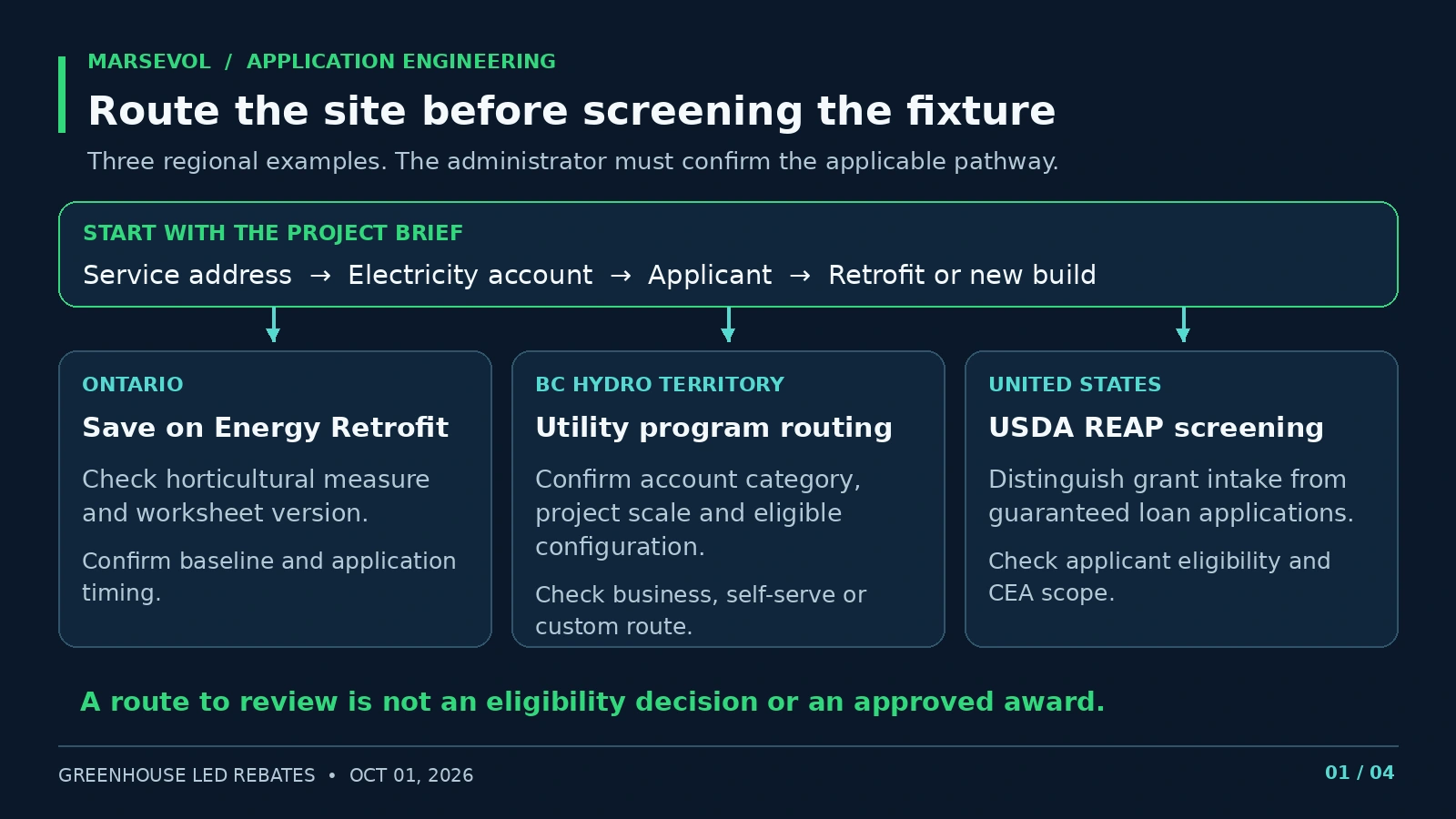
Comparison matrix: these are screening routes, not a nationwide list of available awards. The BC Hydro routes require confirmation that the proposed horticultural configuration is supported.
| Region and route | Current checkpoint | Evidence to obtain |
|---|---|---|
| Ontario: IESO Save on Energy Retrofit | Horticultural LEDs and advanced controls remain in Retrofit. The measures list reflects changes effective June 30, 2026. [1, 2] | Applicable horticultural worksheet, accepted baseline and dated application requirements. |
| British Columbia: BC Hydro business or self-serve incentives | Business incentives primarily serve sites below 500 MWh/year, with exceptions. Self-serve targets facilities above 500 MWh/year. [5, 6] | Utility-confirmed route, eligible configuration and required Alliance contractor details. |
| United States: USDA REAP | The live page says grant applications are not currently accepted; guaranteed loan applications may be submitted, subject to applicable restrictions. [7, 8] | State program officer’s scope review and current application instructions. |
Ontario’s May 29, 2026 announcement changed horticultural incentive measures effective June 30. That is a practical reason to save the worksheet version with the application rather than reuse an older quote’s allowance. The linked general Program Requirements PDF is Version 1.2, June 30, 2025; read it together with later measure updates. [2–4]
For REAP, the separate USDA administrative letter extends the pause affecting specified controlled environment agriculture loan guarantees from April 14 through December 31, 2026, or until further guidance. Its FAQ excludes traditional greenhouses used to reduce temperature risk. A greenhouse using hydroponics should obtain a project-specific classification instead of assuming that the word “greenhouse” resolves the issue. [8]
When should you apply for greenhouse LED rebates?
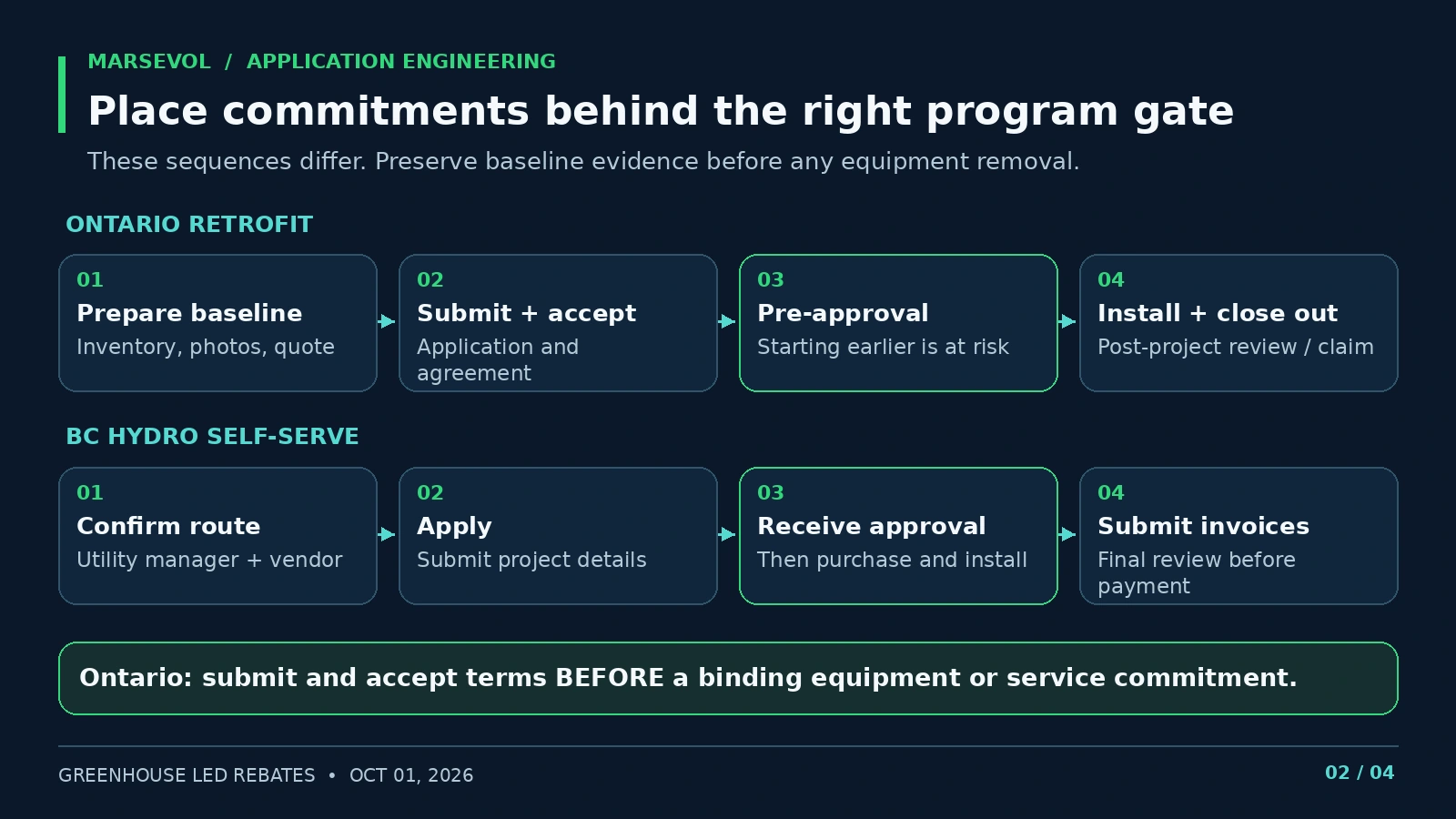
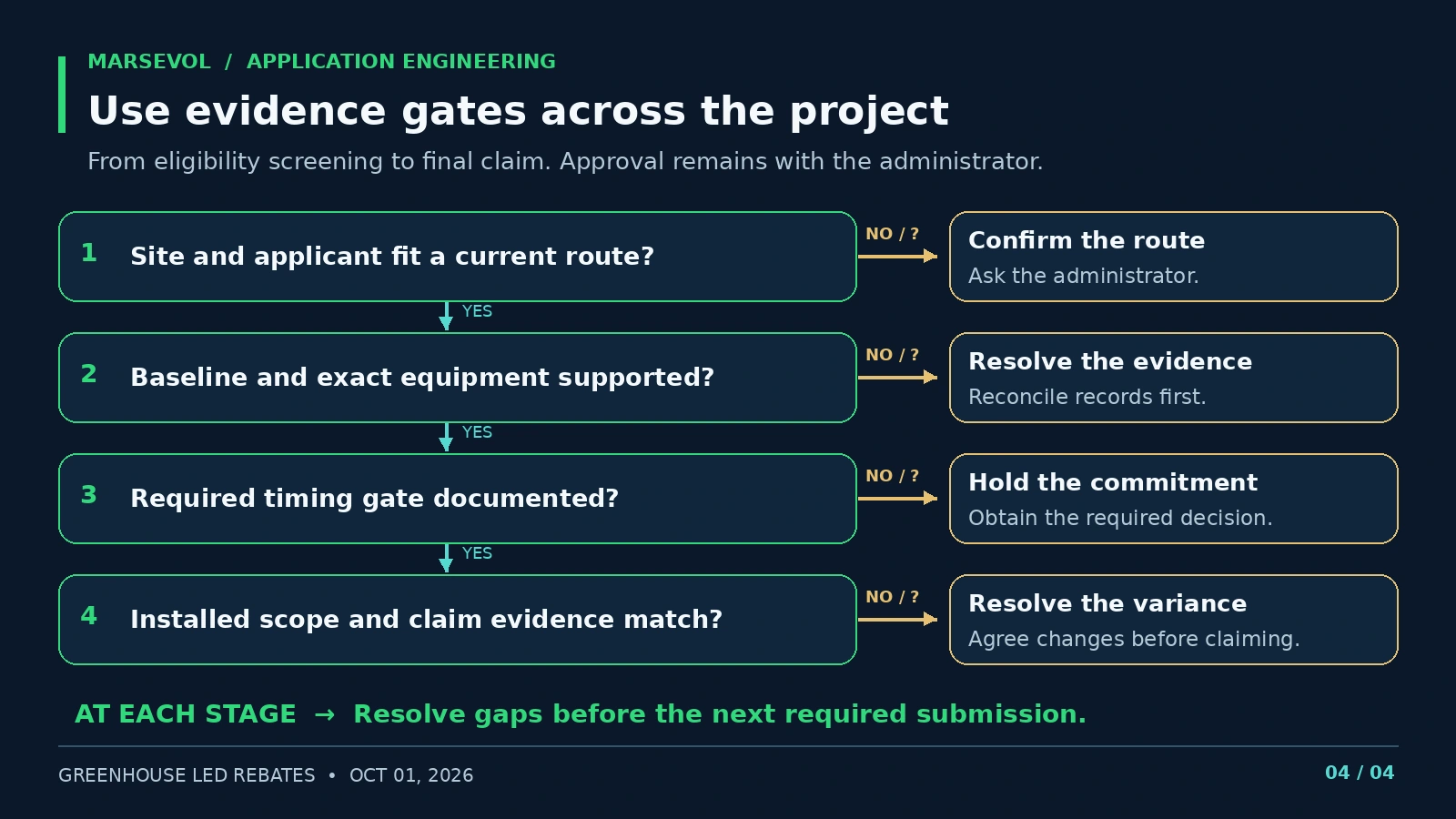
Check the program’s commitment rules before issuing a purchase order, signing an installation contract or placing an equipment order. Submission, acceptance of terms, pre-approval and permission to proceed are distinct events.
Ontario requires submission and agreement acceptance before commitment
The Save on Energy FAQ instructs applicants to submit the application and accept the participant agreement before a binding commitment. Ordering equipment can count even without payment. It permits starting after submission but before pre-approval at the applicant’s risk: funding may be reduced or refused. Preserve evidence needed for any pre-installation review. [1]
BC Hydro self-serve places approval before purchase and installation
The self-serve instructions say to confirm eligibility with a utility manager, use an Alliance vendor, apply, then purchase and install after approval. The business incentive route also calls for pre-approval before starting. Follow the selected route’s written instructions. [5, 6]
Assign one purchasing owner to release commitments only after the relevant gate is documented. Request a non-binding, itemized quotation during review, and record any supplier reservation or deposit conditions. If a deadline and delivery lead time conflict, ask the administrator for a written decision before changing the sequence.
What evidence supports greenhouse LED rebates?
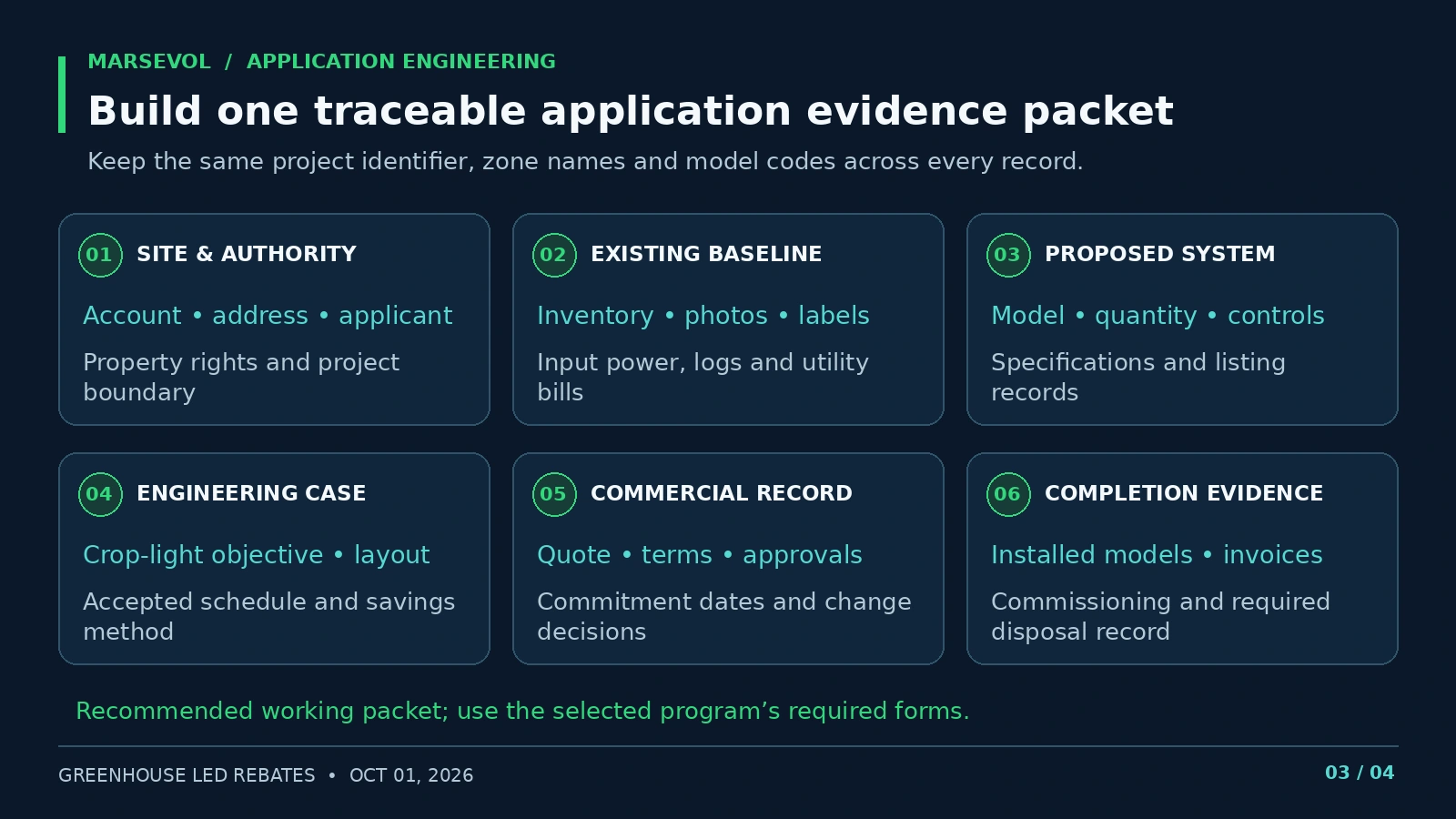
A strong submission lets a reviewer trace every proposed change from the existing installation to the final invoice. Use a shared project identifier and zone names across drawings, photographs, schedules and equipment lists. The following is a recommended working packet; the selected program’s forms remain controlling.
| Packet section | What to retain | Responsible owner |
|---|---|---|
| Site and authority | Account, service address, applicant identity, property authorization and project boundary. | Applicant |
| Existing baseline | Zone inventory, model and ballast labels, dated photos, input-power evidence, operating logs and bills. | Grower and assessor |
| Proposed equipment | Exact model/configuration, specification revision, product-list record when required, quantity and control description. | Supplier |
| Engineering case | Accepted baseline, crop-light objective, layout assumptions, schedules, savings method and measurement plan. | Designer or energy assessor |
| Commercial record | Itemized quote, dated submission, agreements, approval conditions, change decisions and funding disclosures. | Purchasing lead |
| Completion record | Installed inventory, invoices, required payment evidence, commissioning and disposal documentation. | Contractor and applicant |
Use the greenhouse lighting proposal checklist to request missing technical details before the quotation becomes a commitment.
Verify the exact fixture, not just the brand
Search the horticultural section of the DLC Qualified Products Lists when the program requires it. Match the quoted model and relevant configuration to the record, and retain the listing date and identifier. DLC Horticultural V4.0 became effective April 18, 2025; older screenshots are insufficient evidence of current listing. Product qualification supports product verification, not approval of your site’s incentive claim. [9, 10]
A product family name may cover different power, voltage, spectrum or control options. Resolve inconsistencies before submission. Do not infer qualification from a logo on a brochure or from another model’s test report.
Keep the lighting objective and energy baseline consistent
Document system input power, including relevant driver or ballast losses, rather than lamp wattage alone. Separate measured values, manufacturer data and assumptions. Use actual operating records where available, and explain seasonal hours, dimming, crop changes and missing intervals. Bills can support the overall picture but do not isolate lighting from heating, pumps or ventilation.
The replacement must also meet the intended crop-light conditions. Explain the crop, lit area, mounting geometry and target canopy measurements. Our LED versus HPS lighting guide helps define the light and heat boundaries. A lower connected load alone does not establish equivalent horticultural performance.
If controls are included, describe which zones change output and how the operating record will support claimed savings. Ask the reviewer whether an energy assessment, baseline monitoring or formal measurement and verification is required before collecting data. Do not add independently estimated fixture and control savings if they describe the same avoided electricity.
How should a grower resolve an incomplete application?
Resolve conflicting evidence before calculating an incentive. Consider this hypothetical retrofit review; it is not a MarsEVOL customer case or an approved application.
Assumptions: a greenhouse proposes replacing 80 existing fixtures across two zones with 80 LEDs, while preserving the agreed crop-light objective. Its quote uses 3,000 annual operating hours, but the available controller export records 2,400 hours and omits part of winter. Neither number has been accepted by the program.
- Reconcile inventory. Check that zone photographs and equipment labels support all 80 replacements. Keep expansion areas outside this baseline.
- Resolve the schedule gap. Identify missing dates, recover logs where possible, and document any proposed reconstruction for reviewer acceptance. Do not silently use the larger number.
- Lock the proposed configuration. Match quotation, specification and any required product listing. Confirm the lighting design assumptions separately.
- Record the decision. Mark the packet “awaiting baseline acceptance,” retain the correspondence and hold the relevant purchasing gate.
An estimate for greenhouse LED rebates cannot follow from fixture count alone. After eligibility and assumptions are accepted, evaluate cash flow with the greenhouse lighting cost calculator, retaining a scenario without an unapproved incentive.
What happens between approval and final payment?
Approval creates conditions to manage through installation; it does not close the evidence file. Read the approved scope, completion and claim deadlines, inspection requirements and change procedure. Calendar each deadline separately, with an owner and time for corrections.
Check delivered model codes before installation. If a supplier proposes a substitute, obtain the program’s written disposition before assuming the approval transfers. Record installed quantities by zone and preserve the original baseline. The Save on Energy requirements allow photographic, physical or virtual verification and requests for cost evidence. [4]
Combine the required incentive evidence with lighting commissioning records: operating state, zone response and agreed light measurements should describe the installed system. Retain disposal or decommissioning documents when required. In Ontario, the FAQ places the incentive invoice after post-project approval. [1]
Reconcile final invoices against approved line items and disclose other funding. Ask which costs are eligible and how overlapping support is treated; do not assume installation, tax, design or financing all receive the same treatment. Retain the final decision and payment record with the project documentation.
Which mistakes commonly weaken an application?
- Committing too early: the supplier’s delivery date does not override program timing.
- Mixing project types: an expansion cannot silently inherit a replacement baseline.
- Using an obsolete listing: check the exact product record and applicable measure version.
- Removing evidence: photograph and document existing equipment before dismantling.
- Changing scope informally: retain written decisions for substitutions and revised quantities.
- Budgeting estimated funding as cash: keep approval conditions and payment timing visible.
FAQs About Greenhouse LED Rebates
Does a DLC listing guarantee a rebate?
No. It supports product verification when required. The applicant, site, project scope, timing and claim still need to satisfy the chosen program.
Can an existing LED installation qualify for an upgrade?
Possibly, but confirm the measure and baseline first. Replacing LED with LED is not automatically eligible, and previous incentives may affect the review.
Can a supplier complete the application for the grower?
Technical assistance can help, but applicant responsibilities remain. Ontario’s FAQ allows an applicant representative to prepare information while the applicant submits and accepts the terms. [1]
Are new greenhouses treated like HPS retrofits?
No. There is no existing HPS installation to document. Ask which new-construction or other baseline pathway applies before using a replacement worksheet.
Can greenhouse rebates and grants be combined?
Only when the relevant terms permit it. Disclose all support and obtain guidance on eligible costs and overlap rather than adding advertised funding percentages.
How much rebate should a grower expect?
Use the current program calculation and written review for the exact project. Fixture counts and supplier estimates alone cannot determine an award or payment date.
The MarsEVOL Perspective
For greenhouse LED rebates, a useful supplier contribution is a consistent technical packet. For a SOLIFY PRO proposal, request the exact offered configuration and supporting documents; this guide does not claim program qualification for any model. For HarveStation lighting management, agree the control scope and evidence available for the review. An application should describe the system actually being supplied.
Conclusion
Successful planning for greenhouse LED rebates starts before procurement. Establish the correct program route, preserve the baseline, reconcile the technical packet and control changes through the final claim. The most valuable early outcome is a documented decision about what can proceed and what still needs evidence.
Prepare your lighting proposal for incentive review
Share your location, utility, existing fixture inventory, crop-light objective, project schedule and current program requirements. MarsEVOL can help identify the technical information your lighting proposal needs.
Explore More MarsEVOL Resources
Find official sources for incentives, electricity charges and local project requirements.
Compare scope, technical assumptions and supporting evidence before selection.
References
Official sources checked October 1, 2026. Live pages without a stated version are identified below; confirm the rules applicable to your application.
- IESO / Save on Energy. Frequently Asked Retrofit Questions. Ontario; live guidance.
- IESO / Save on Energy. Retrofit Measures and Incentives. Ontario; updates effective June 30, 2026.
- IESO / Save on Energy. Retrofit Program Updates. Announcement May 29, 2026; relevant horticultural changes effective June 30, 2026.
- IESO. Retrofit Program Requirements. Version 1.2, June 30, 2025; read with subsequent measure updates.
- BC Hydro. Self-serve Incentives. British Columbia service territory; live eligibility and sequence guidance.
- BC Hydro. Business Energy-saving Incentives. Live eligibility, configuration and application guidance.
- USDA Rural Development. REAP. United States; live application notice.
- USDA Rural Development. CEA and Biodigester Administrative Pause Extension. April 14–December 31, 2026, or further guidance; includes scope FAQs.
- DesignLights Consortium. Qualified Products Lists. Live horticultural product verification database.
- DesignLights Consortium. Horticultural Technical Requirements V4.0. Effective April 18, 2025.