
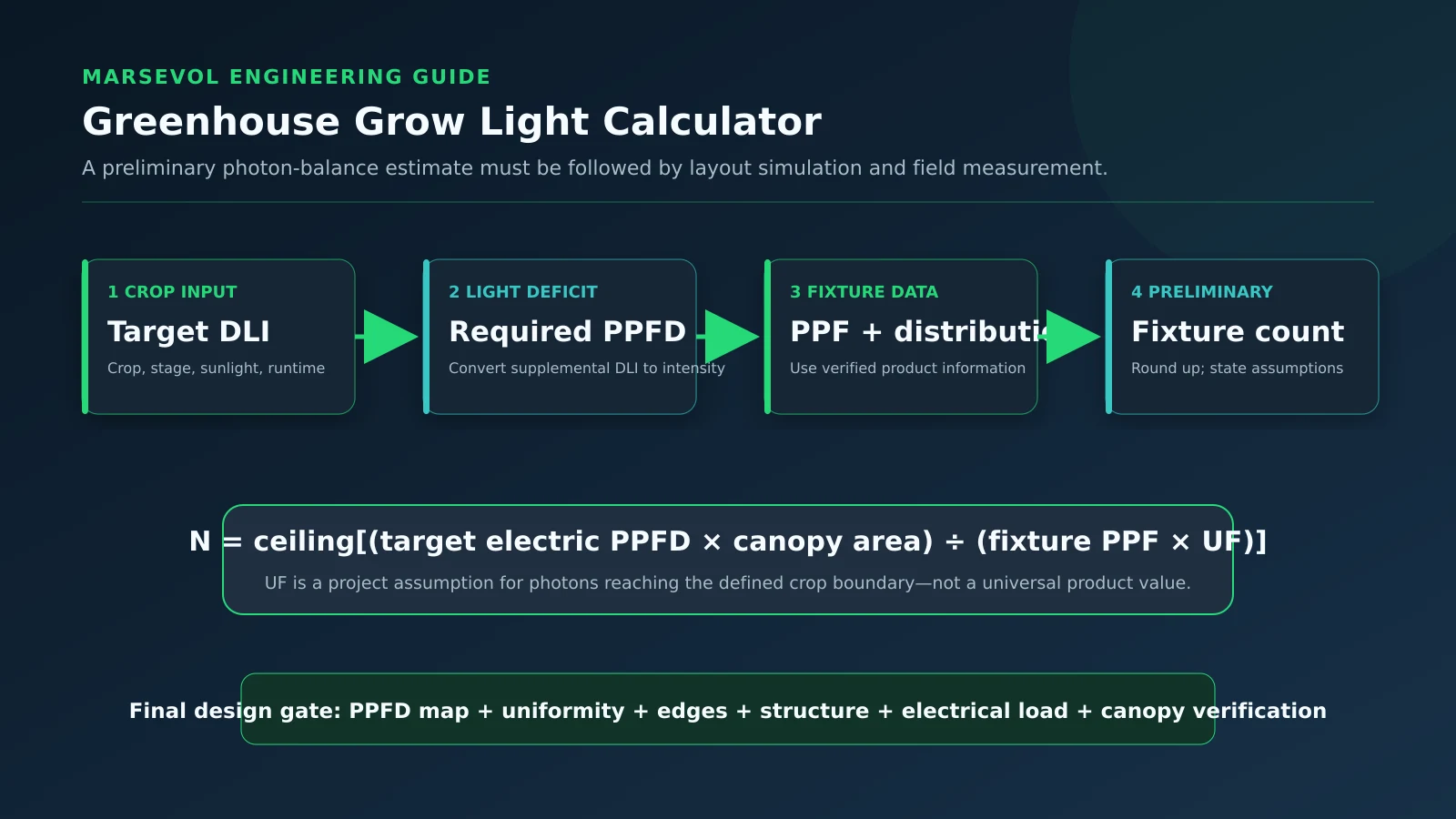
A greenhouse grow light calculator gives a preliminary fixture count by dividing the crop area’s required electric photon rate by the usable PPF from one fixture. First determine supplemental PPFD from the crop DLI deficit and operating time. Then multiply PPFD by planted canopy area, divide by verified fixture PPF and an explicitly stated utilization factor, and round upward. The result must still pass photometric simulation, electrical coordination and canopy-level measurement.
Key Takeaways
- Calculate from planted canopy area and supplemental PPFD—not total floor area or fixture wattage.
- PPF describes a fixture’s photon output; PPFD describes photons reaching each square meter of canopy.
- A utilization factor is a project assumption for boundary capture, distribution and geometry. It is not a universal product constant.
- A photon-balance count cannot prove spacing, uniformity, edge performance or structural compatibility.
- Round the preliminary count upward, then iterate the actual layout and verify it at crop level.
The question “How many lights do I need?” sounds like a fixture-selection problem, but the correct starting point is the crop. A professional estimate connects crop DLI, measured or modeled greenhouse sunlight, supplemental-lighting hours, required electric PPFD, planted area, fixture PPF and photon capture within the calculation boundary. If these terms are new, review the MarsEVOL guide to PPFD versus DLI before using the method below.
This article calculates a preliminary quantity. It does not replace a greenhouse model, an IES/ULD photometric file, structural coordination, electrical design or commissioning. The e-GRO Edible Alert How Many Light Fixtures Do I Need? similarly presents fixture quantity as an estimate based on the desired light level, growing area and fixture output. ANSI/ASABE S644:2025 goes further by establishing performance criteria for complete horticultural radiation-system designs.
What Inputs Does a Greenhouse Grow Light Calculator Need?
A useful calculator needs the supplemental PPFD target, planted canopy area, verified fixture PPF and a justified utilization factor. Those four values are the minimum for a photon-balance estimate; the design still needs geometry and acceptance conditions.
| Input | Unit | How to obtain it | Common error |
|---|---|---|---|
| Supplemental electric PPFD | μmol·m−2·s−1 | Convert the crop-level DLI deficit over the allowed lighting hours | Using total target PPFD without subtracting available sunlight |
| Planted canopy area | m² | Measure active beds, benches or crop rows inside the calculation boundary | Including aisles, headhouses or unplanted service space |
| Fixture PPF | μmol·s−1 | Use current verified product documentation for the selected SKU and setting | Substituting watts, lumens or a different spectrum/SKU |
| Utilization factor (UF) | dimensionless | Estimate from distribution, height, spacing, boundary losses and simulation | Treating a favorable generic value as guaranteed |
| Canopy-height range | m | Measure both young and mature crop positions | Designing to floor height |
| Acceptance metrics | project-specific | Define average, minimum, maximum, U0, CV and boundary | Approving the average alone |
Use crop-level sunlight rather than outdoor sunlight. Greenhouse glazing, frames, gutters, screens, dust and condensation change transmission; the MarsEVOL guide to greenhouse covering light transmission explains why this assumption must be seasonal and site-specific.
What Is the Greenhouse Grow Light Calculator Formula?
The preliminary count equals the crop’s required electric photon rate divided by the usable PPF per fixture, rounded upward.
The units cancel correctly: μmol·m−2·s−1 multiplied by m² becomes μmol·s−1. Dividing by usable μmol·s−1 per fixture produces a dimensionless quantity. Round up because a fraction of a fixture cannot supply the assumed design.
Do not insert lumens or lux into this equation. ANSI/ASABE S640 defines plant-radiation quantities, while ANSI/ASABE S642.1:2025 describes methods for testing horticultural radiation sources. Use PPF for the selected device and PPFD for the receiving crop plane.
How Do You Convert a DLI Deficit into Supplemental PPFD?
Subtract expected crop-level sunlight DLI from the crop target, then divide the supplemental DLI by the available electric-light hours. Purdue Extension defines DLI as accumulated photosynthetic light over a day and recommends measuring it near the crop. UNH Extension likewise begins runtime planning with the light deficit that lamps must supply.
For example, a supplemental deficit of 6.48 mol·m−2·d−1 delivered over 10 hours requires an average electric PPFD of 180 μmol·m−2·s−1. If the chosen runtime changes, the PPFD and therefore preliminary fixture count also change. See the detailed supplemental-lighting runtime method before fixing operating hours.
Worked Example: How Many SOLIFY PRO Fixtures for 300 m²?
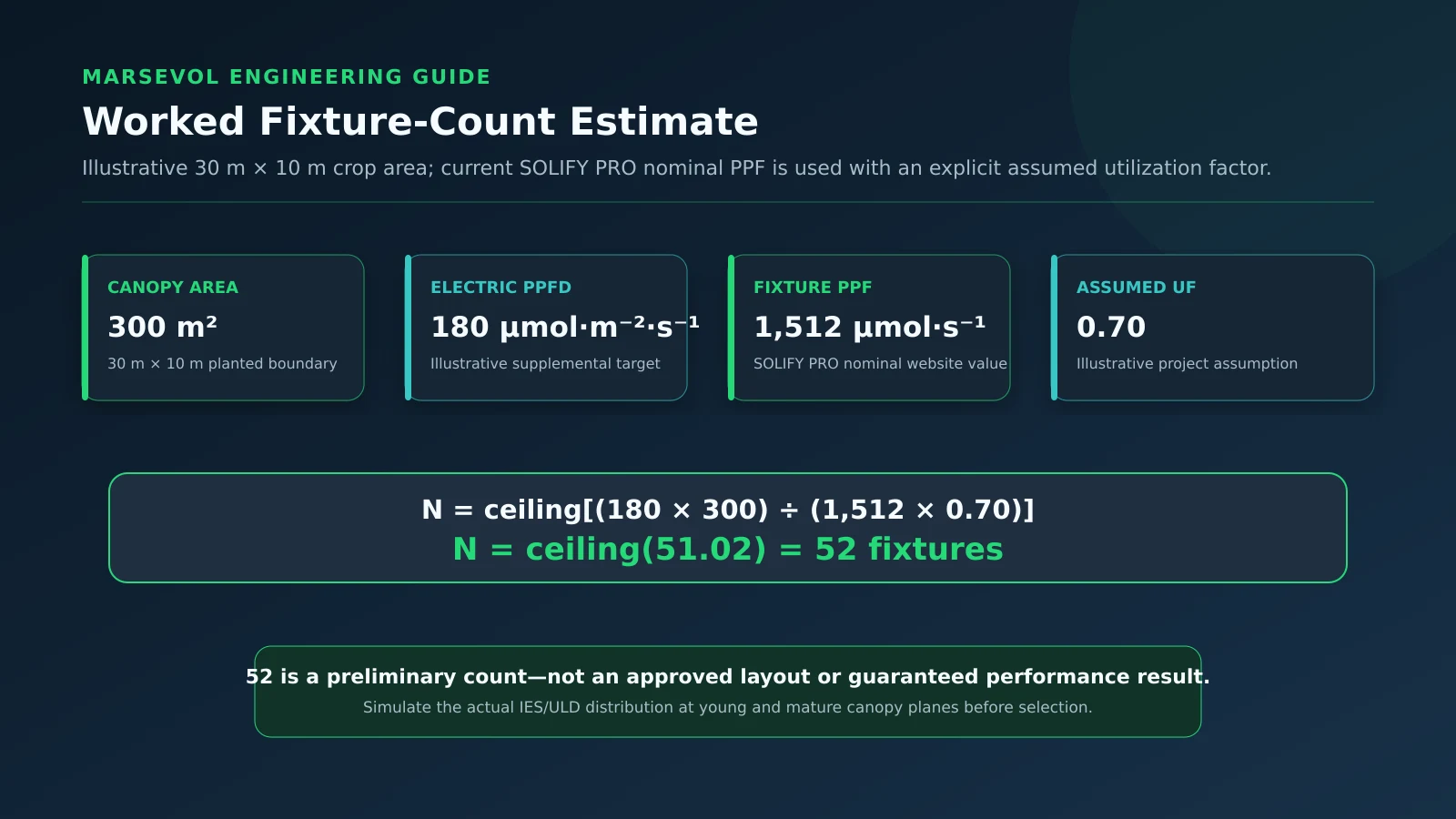
Under the explicit illustrative assumptions below, the preliminary estimate is 52 fixtures. This is not a project recommendation, customer case or guaranteed product result.
Assume:
- defined planted canopy area: 30 m × 10 m = 300 m²;
- required average electric PPFD: 180 μmol·m−2·s−1;
- selected fixture: SOLIFY PRO nominal PPF 1,512 μmol·s−1, as currently stated on the official SOLIFY PRO product page;
- illustrative utilization factor: 0.70;
- all fixtures assumed at the rated output used for the PPF value.
The same 52 fixtures can perform differently when arranged in different grids. Fixture orientation, mounting height, spacing, crop-row geometry and perimeter offset determine where photons land. Use the published greenhouse grow light spacing guide to turn a count into trial geometry.
How Does the Utilization Factor Change the Fixture Count?
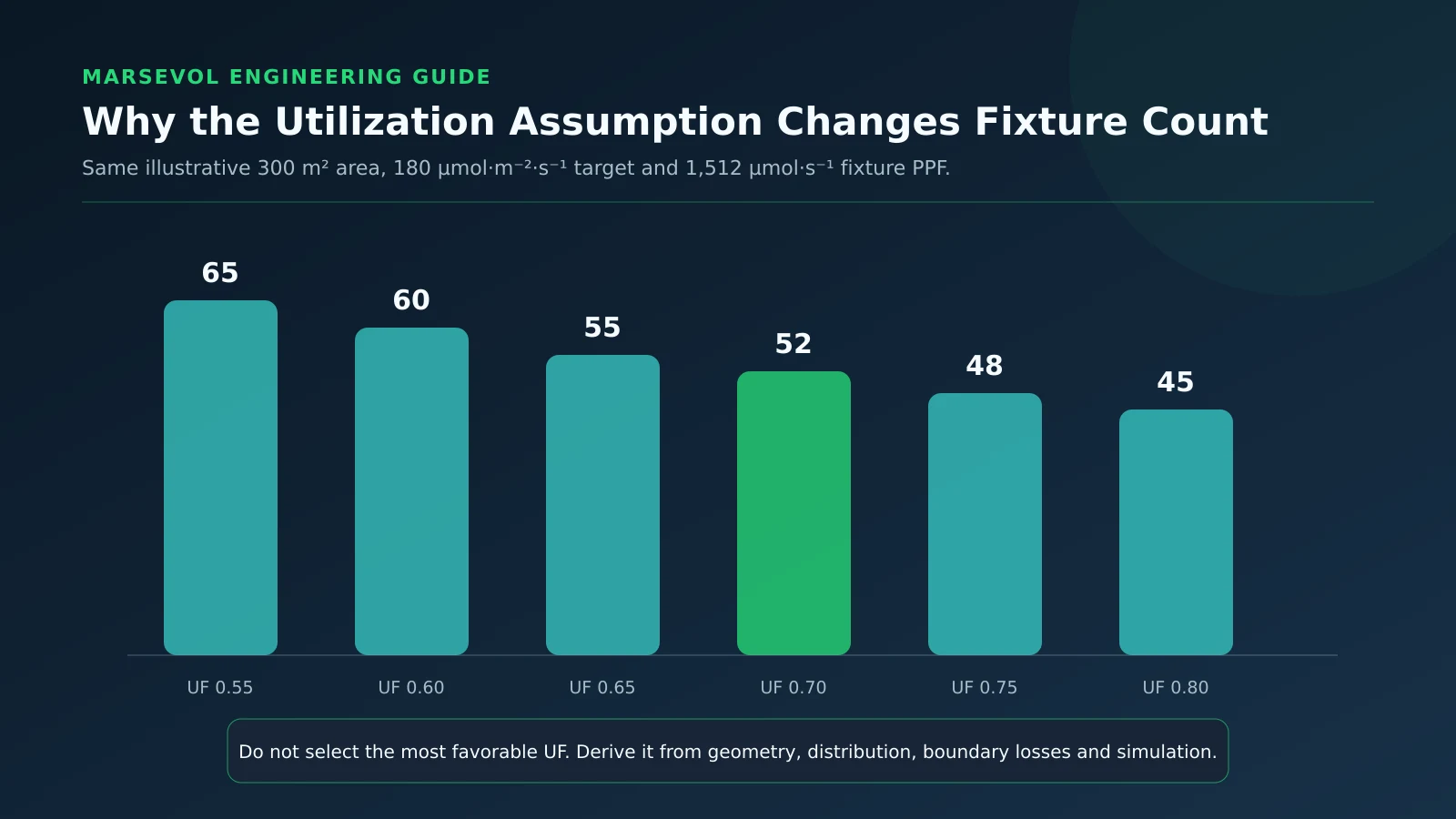
The lower the fraction of fixture PPF captured by the planted boundary, the more fixtures the preliminary calculation requires. UF is sensitive to fixture distribution, height, spacing, greenhouse width, edge offset, obstructions and calculation boundary.
| Condition | Likely effect on captured photons | Required design response |
|---|---|---|
| Narrow crop block with many edges | More spill outside the planted boundary | Model perimeter rows and offsets explicitly |
| Fixture mounted excessively high | Potentially broader overlap but more boundary spill | Review useful PPFD, structure and maintenance together |
| Fixture too low or spacing too wide | Local hot spots and dark bands | Iterate height and two-direction spacing |
| Gutters, trusses or screens | Persistent local losses and shadows | Add real obstructions to the model |
| Large repeated interior area | Interior overlap may improve capture | Still check edges, corners and zones separately |
Never choose UF only to make a budget fit. Run at least a low, central and high sensitivity case during concept design, then replace the assumption with the simulated relationship between total installed PPF and average PPFD over the agreed crop boundary.
Why Can a Calculator Not Finalize the Fixture Layout?
A calculator balances total photons; it cannot show their spatial distribution. Two layouts with the same count and total PPF may have different minima, hot spots, dark bands and perimeter losses.
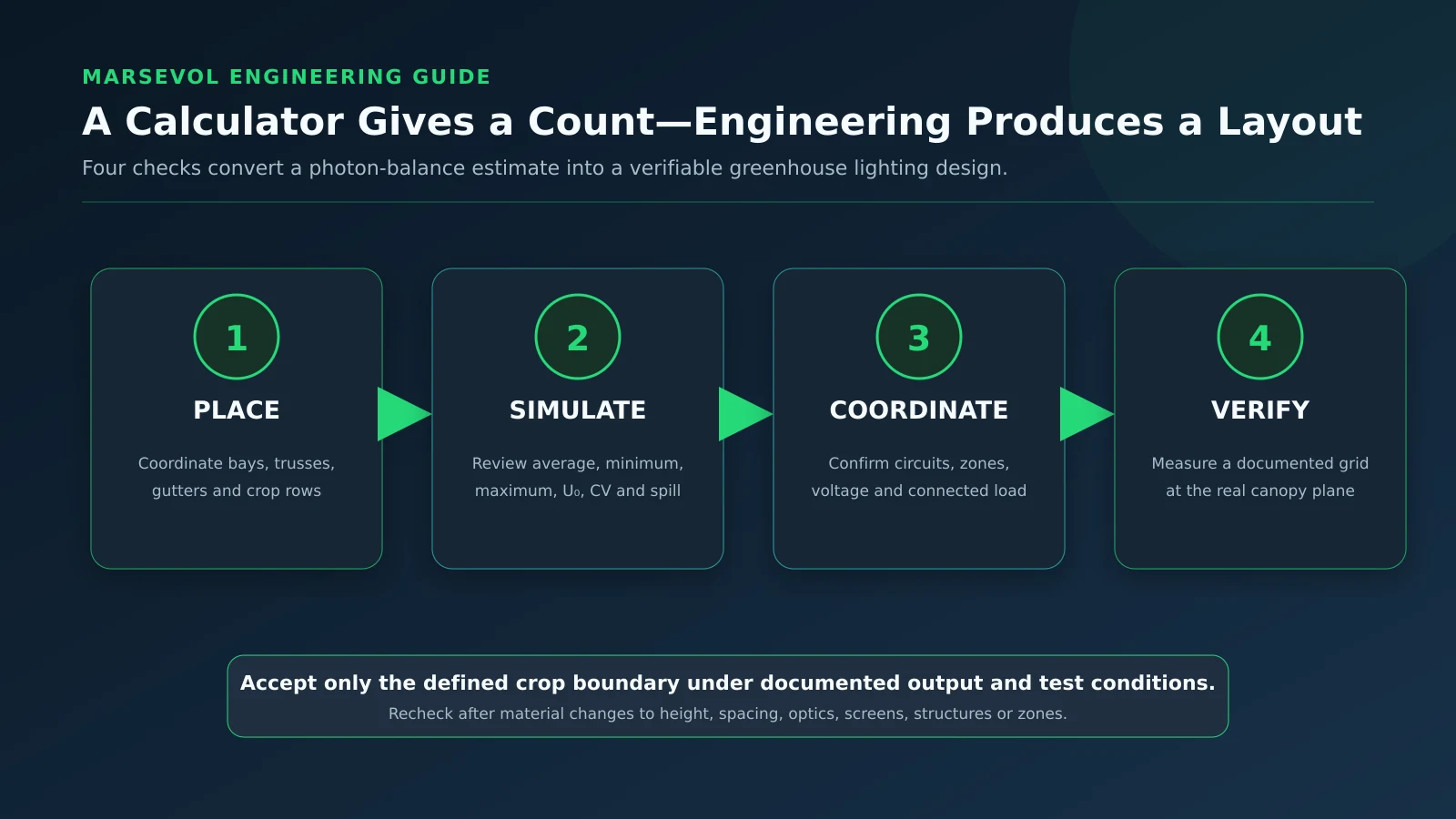
Use the selected fixture’s verified distribution file in a model that includes crop boundaries, young and mature canopy planes, real mounting locations and major structural obstructions. Report average, minimum and maximum PPFD plus the agreed uniformity metrics. The MarsEVOL greenhouse lighting layout guide explains the complete design chain.
Ciolkosz, Both and Albright showed that luminaire selection and placement affect greenhouse lighting uniformity, including perimeter behavior. This is why simply dividing total PPF by area should be treated as a feasibility check—not a final schedule.
What Electrical and Control Checks Can Change the Practical Quantity?
The photometric count must fit the available voltage, circuits, connected load, inrush characteristics, dimming architecture and operational zones. A grid that works optically may conflict with trusses, service access or circuit capacity.
- Confirm selected SKU power, input voltage and control interface from current project documentation.
- Calculate connected load and branch-circuit allocation under applicable electrical requirements.
- Separate crop compartments, perimeter regions or research treatments into logical zones.
- Coordinate cable routes, junctions, suspension, maintenance clearance and environmental protection.
- Check the consequences of one failed fixture or circuit on minimum PPFD and research repeatability.
For projects using variable sunlight and multiple zones, the MarsEVOL HARVESTATION control system supports partitioned dimming and DLI-oriented operation. Control can reduce unnecessary runtime or tune a viable layout, but it cannot recover photons from a fundamentally undersized or poorly distributed installation.
How Should the Calculated Fixture Count Be Verified After Installation?
Measure a documented PPFD grid at the actual canopy plane under a stable, known electric-light condition. Record the crop boundary, sensor, grid, fixture output, active zones, mounting height, screens, obstructions and presence or absence of sunlight.
- Check installed quantity, model, orientation, spacing and height against the approved drawing.
- Set each zone to the documented commissioning output and allow the system to stabilize as required.
- Measure PPFD at repeatable points, including edges and corners, with a suitable quantum sensor kept level and unobstructed.
- Calculate average, minimum, maximum, U0 and CV using the agreed boundary and convention.
- Compare the measured pattern with the model and investigate systematic differences.
- Repeat after material changes to fixture position, canopy height, optics, screens or control zones.
Purdue Extension emphasizes crop-level placement, clean sensors and time-based measurements when DLI is required. Do not validate a production canopy with one reading directly beneath one lamp.
Common Greenhouse Grow Light Calculator Mistakes
Calculating from watts per square meter
Watts describe electrical input, not photon output or canopy distribution. Use verified PPF and a photometric model.
Using total greenhouse floor area
Define the actively planted boundary. Aisles and service areas may require safe visibility, but they should not silently inflate crop photon demand.
Using outdoor DLI as crop-level DLI
Adjust or measure for glazing, structure, screens, dust, condensation, season and local weather.
Treating UF as a fixture specification
UF belongs to the installed geometry and selected calculation boundary. State the assumption and test sensitivity.
Ignoring dimming level
PPF changes when fixtures operate below rated output. Use the output level intended for the design condition.
Stopping after rounding up
Quantity is only the beginning. Verify spacing, uniformity, electrical load and field performance.
FAQ: Greenhouse Grow Light Calculator
How many LED grow lights are needed per square meter?
There is no universal fixture-per-square-meter rule. Quantity depends on required supplemental PPFD, fixture PPF, distribution, mounting height, planted boundary, uniformity criteria and photon utilization.
Can I calculate grow light quantity from wattage?
No. Wattage is electrical input. Use verified PPF to estimate total photon output and a canopy-level PPFD model to assess delivered light.
Should I use crop DLI or target PPFD?
Use both. DLI defines the daily crop-light deficit; operating hours convert that deficit into a supplemental PPFD target for fixture sizing and layout.
What utilization factor should I use?
There is no universal value. During concept design, test a documented range. For final design, derive usable photon capture from the selected fixture distribution, actual geometry, boundary and simulation.
Why does the calculator round upward?
The equation can produce a fractional fixture, but installed quantity must be whole. Rounding upward preserves the preliminary photon balance; simulation may still change the final count.
Does a higher fixture count guarantee better uniformity?
No. More fixtures can improve overlap, but orientation, spacing, height, edges, obstructions and zoning determine the spatial result. A poor arrangement can remain uneven.
MarsEVOL Perspective: Count Photons, Then Engineer the System
MarsEVOL treats fixture count as one step in a connected workflow: crop target → measured sunlight → supplemental DLI → electric PPFD → preliminary quantity → layout simulation → uniformity and zoning → electrical coordination → field verification.
The MarsEVOL greenhouse lighting planning workflow can combine crop inputs, fixture selection, layout concepts, PPFD simulation and control recommendations. Product selection should use the current SKU, spectrum, output setting, distribution and project environment—not a generic fixture name.
Conclusion
A greenhouse grow light calculator is most useful as a transparent feasibility tool. Define the crop-level supplemental PPFD, multiply it by the planted canopy area, divide by verified fixture PPF and a justified utilization factor, and round upward. Then challenge every assumption. A professional final quantity is the outcome of simulation, structural and electrical coordination, control planning and canopy-level measurement—not arithmetic alone.
Need a Project-Specific Fixture Count?
Share the crop, planted dimensions, canopy-height range, target DLI or PPFD, seasonal sunlight data, available drawings and operating hours.
Explore More MarsEVOL Resources
Connect crop DLI, available sunlight, supplemental PPFD, fixture layout, controls and verification.
Continue with practical guides on DLI, PPFD, spacing, covering transmission and greenhouse controls.
References
- Mattson, N. S. How Many Light Fixtures Do I Need? e-GRO Edible Alert 2(5), 2017.
- American Society of Agricultural and Biological Engineers. ANSI/ASABE S640: Quantities and Units of Electromagnetic Radiation for Plants. ASABE, 2017 (R2022).
- American Society of Agricultural and Biological Engineers. ANSI/ASABE S642.1:2025—Recommended Methods for Measurement and Testing of Electromagnetic Radiation Sources. ASABE, 2025.
- American Society of Agricultural and Biological Engineers. ANSI/ASABE S644:2025—Design of Electromagnetic Radiation Systems for Plants. ASABE, 2025.
- Torres, A. P., and Lopez, R. G. Measuring Daily Light Integral in a Greenhouse. Purdue Extension HO-238-W.
- University of New Hampshire Extension. Supplemental Lighting Run Time Worksheet.
- Ciolkosz, D. E., Both, A. J., and Albright, L. D. Selection and Placement of Greenhouse Luminaires for Uniformity. Applied Engineering in Agriculture 17(6), 2001. DOI: 10.13031/2013.6842.