
Greenhouse glazing light transmission is the fraction and distribution of plant-useful solar photons that reach a defined crop plane after the covering, structure, screens, contamination, condensation and incidence angle are considered. Do not substitute a datasheet’s perpendicular transmission for whole-house crop-level performance. Compare materials with named test metrics, then use paired inside/outside quantum measurements and a documented operating state for lighting design.
Key Takeaways
- Material transmittance and effective whole-greenhouse transmittance are different design inputs.
- Record whether a value is perpendicular, angular or hemispherical PAR transmission and keep haze separate.
- Measure paired outdoor and indoor PPFD at the same time, with electric lights off and the screen state documented.
- Use integrated data across the relevant season or sky conditions; one midday ratio is not a yearly design factor.
- Carry transmission uncertainty into the DLI deficit, layout sensitivity and commissioning plan.
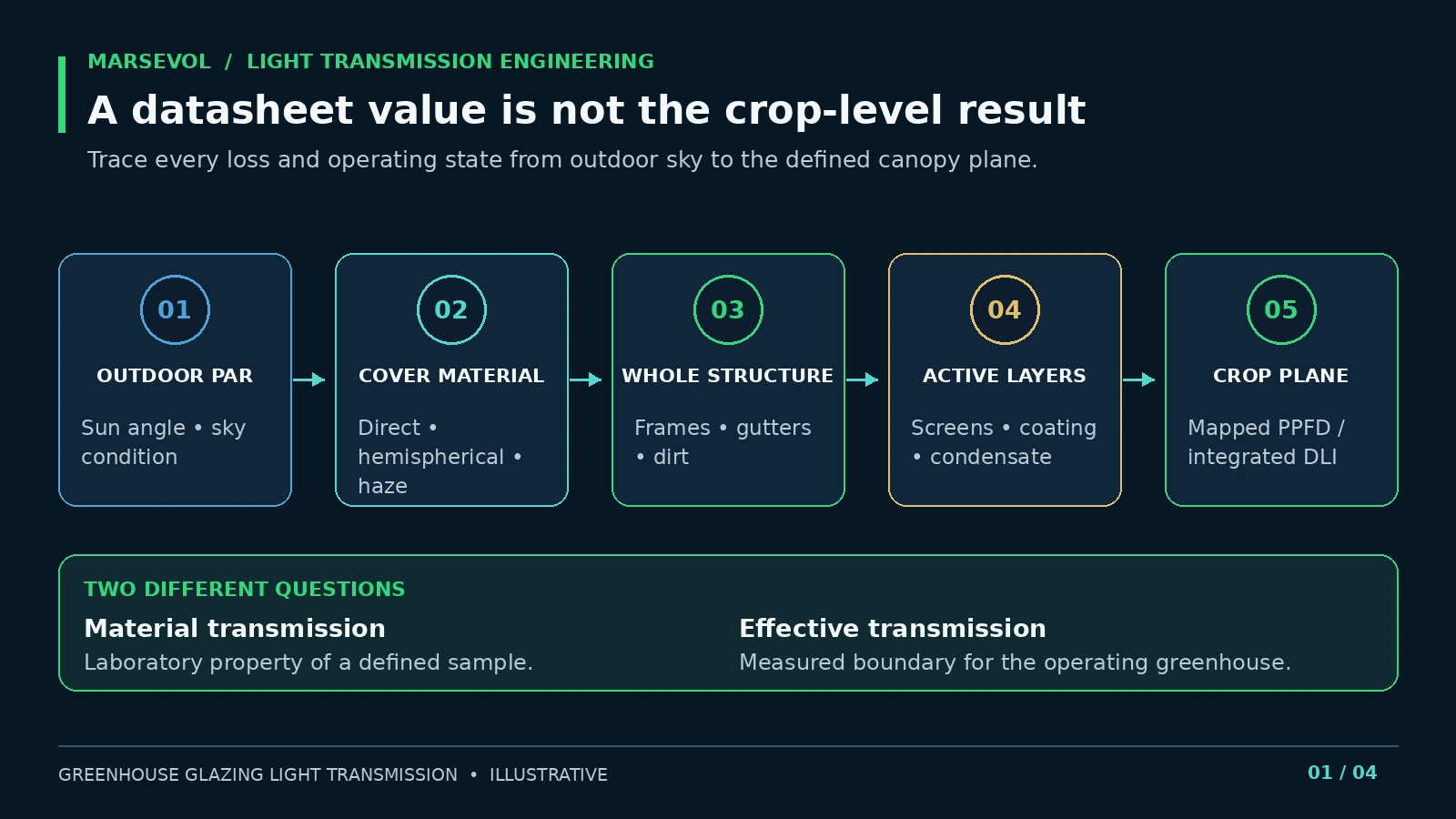
Greenhouse glazing light transmission should be treated as a measured project condition, not a universal percentage. The number affects the natural DLI available to the crop, the supplemental-light deficit and the hours or PPFD the electric system must deliver. It also changes with the boundary being measured. A laboratory value for one clean material sample does not include roof framing, gutters, screens, contamination, coatings or the geometry between the roof and canopy.
For the plant-light definitions, use PPFD vs DLI for Greenhouse Lighting. For the system workflow, see the Greenhouse Supplemental Lighting Guide.
What Does Greenhouse Glazing Light Transmission Mean?
It means how much relevant incident radiation crosses a stated boundary under stated conditions. A useful transmission value always identifies the radiation basis, test geometry, material or system boundary, cover condition and measurement period. Without those qualifiers, two percentages may describe different things and cannot be compared responsibly.
Material transmission is a sample property
A manufacturer or laboratory may report transmission for a glass pane, film or structured sheet. The result can depend on wavelength range, angle of incidence, direct versus diffuse illumination, sample thickness, coating and whether the material was dry or carrying condensate. Wageningen researchers developed methods that distinguish angular and hemispherical transmission because modern diffuse, layered and structured greenhouse materials are not adequately described by one perpendicular beam measurement. Their work identifies hemispherical transmission as a key comparison metric for greenhouse coverings, especially where a range of solar angles matters.
Effective transmission is a greenhouse-system property
At crop level, photons have also encountered frames, purlins, gutters, vents, service equipment, dirt, mineral deposits, screens and crop-support hardware. The effective value can differ by bay, row, time of day and screen position. It can also drift as the cover ages or becomes contaminated. Therefore, the number used in a lighting design should identify the measurement plane and operating state instead of being labelled simply “glazing transmission.”
Which Greenhouse Glazing Light Transmission Metrics Matter?
Use plant-relevant photon metrics and name the optical test. ANSI/ASABE S640 provides the terminology for radiation quantities used in plant growth. For practical greenhouse work, PPFD describes the photosynthetic photon flux density at an instant and DLI integrates that photon exposure through the day. Lux or foot-candle readings are weighted for human vision and should not replace a calibrated quantum measurement in a crop-light calculation.
| Metric or condition | What it describes | How to use it | Do not assume |
|---|---|---|---|
| Perpendicular transmission | Light crossing a sample near normal incidence | Compare products only when wavelength range and method match | That winter or low-angle solar transmission is the same |
| Hemispherical transmission | Transmission integrated over incident directions under the stated method | Use as a material-level greenhouse comparison input | That it includes structural shading or deployed screens |
| Haze / scattering | How the material redistributes transmitted light directionally | Evaluate with transmission, crop architecture and climate | That higher haze guarantees higher yield |
| Effective crop-plane transmission | Paired inside/outside PAR or DLI ratio for a defined system state | Use for the documented design case and sensitivity range | That one point represents every bay, season or screen state |
Transmission and diffusion are not interchangeable. A peer-reviewed Belgian greenhouse study comparing low-haze diffuse glass with reference float glass found results depended on crop, stem density, season and screen use. It supports project-specific assessment, not copying a yield percentage into another greenhouse.
How Should Greenhouse Glazing Light Transmission Be Measured?
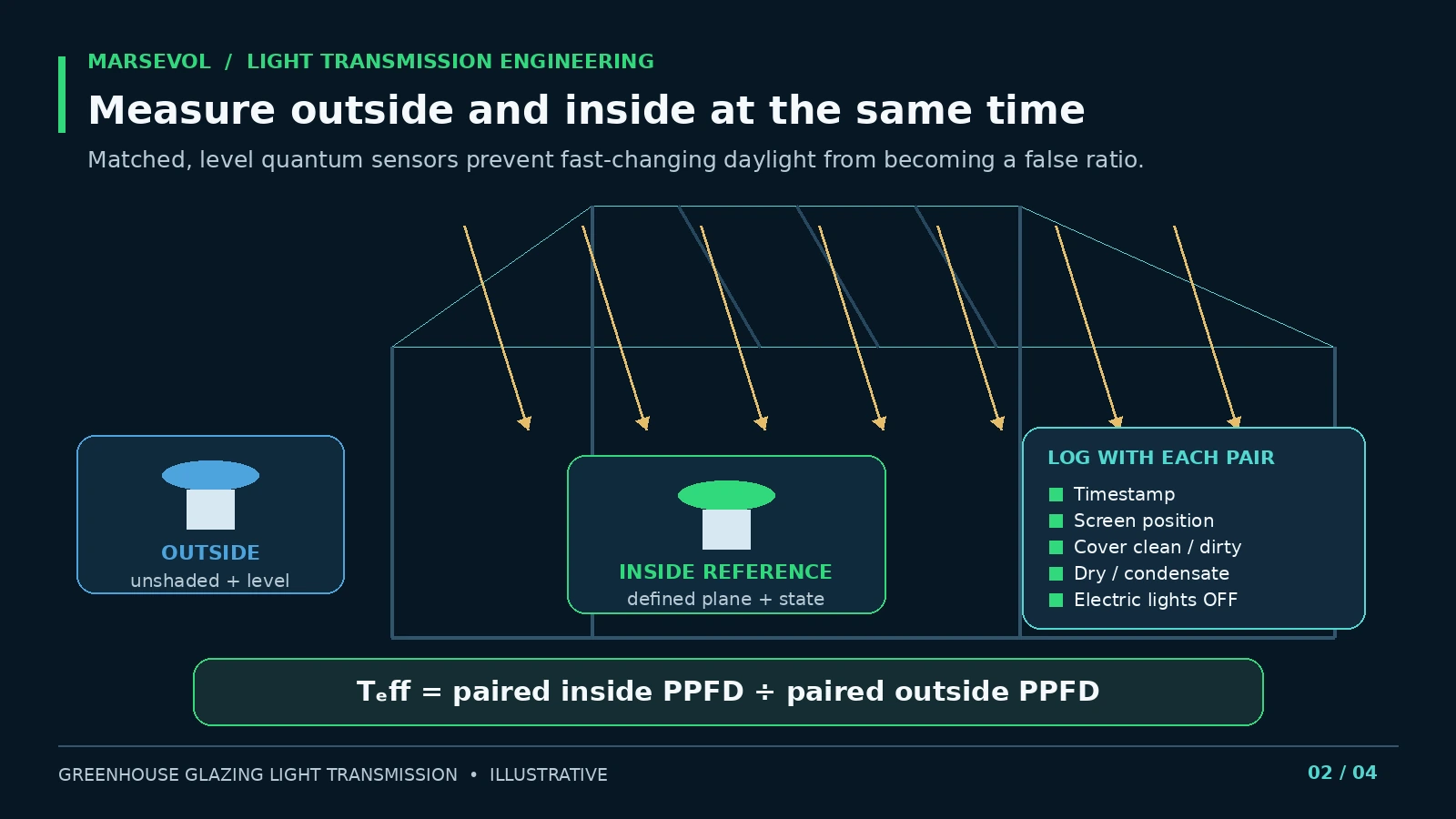
Measure outdoor and indoor PPFD simultaneously with matched, level quantum sensors and a written state record. Sunlight can change faster than a person can move one meter between locations. Sequential readings taken under passing clouds can create a false transmission ratio even when the arithmetic is correct.
1. Define the boundary and purpose
State whether the measurement supports a preliminary model, compares cover conditions, verifies cleaning or supplies a seasonal DLI estimate. Define the inside reference plane: crop top, mature canopy height, bench plane or another agreed surface. Keep that plane consistent with later PPFD mapping.
2. Prepare and cross-check the sensors
Use quantum sensors suitable for the expected spectrum and irradiance. Level them, confirm calibration status and place both side by side outdoors for a short cross-check before separating them. Record any correction factor rather than silently mixing unmatched sensors. Follow the project’s PAR sensor placement plan so permanent monitoring and survey measurements share a known reference.
3. Log paired data and the greenhouse state
Keep electric lights off. Record synchronized PPFD, screen position, coating, cleanliness, condensation and unusual obstructions. The outdoor sensor needs an unobstructed sky view; the indoor sensor must represent the defined boundary. One inside sensor supports trends, but a spatial survey is still needed.
4. Build a distribution, not a single magic number
Review ratios across relevant solar angles and sky conditions. Integrate daily photon data for DLI and separate screen states. Map representative locations, then report a central value plus a suitable sensitivity range. Purdue Extension notes that natural light changes continuously; one noon observation is weak evidence for a seasonal design factor.
How Does Greenhouse Glazing Light Transmission Change DLI?
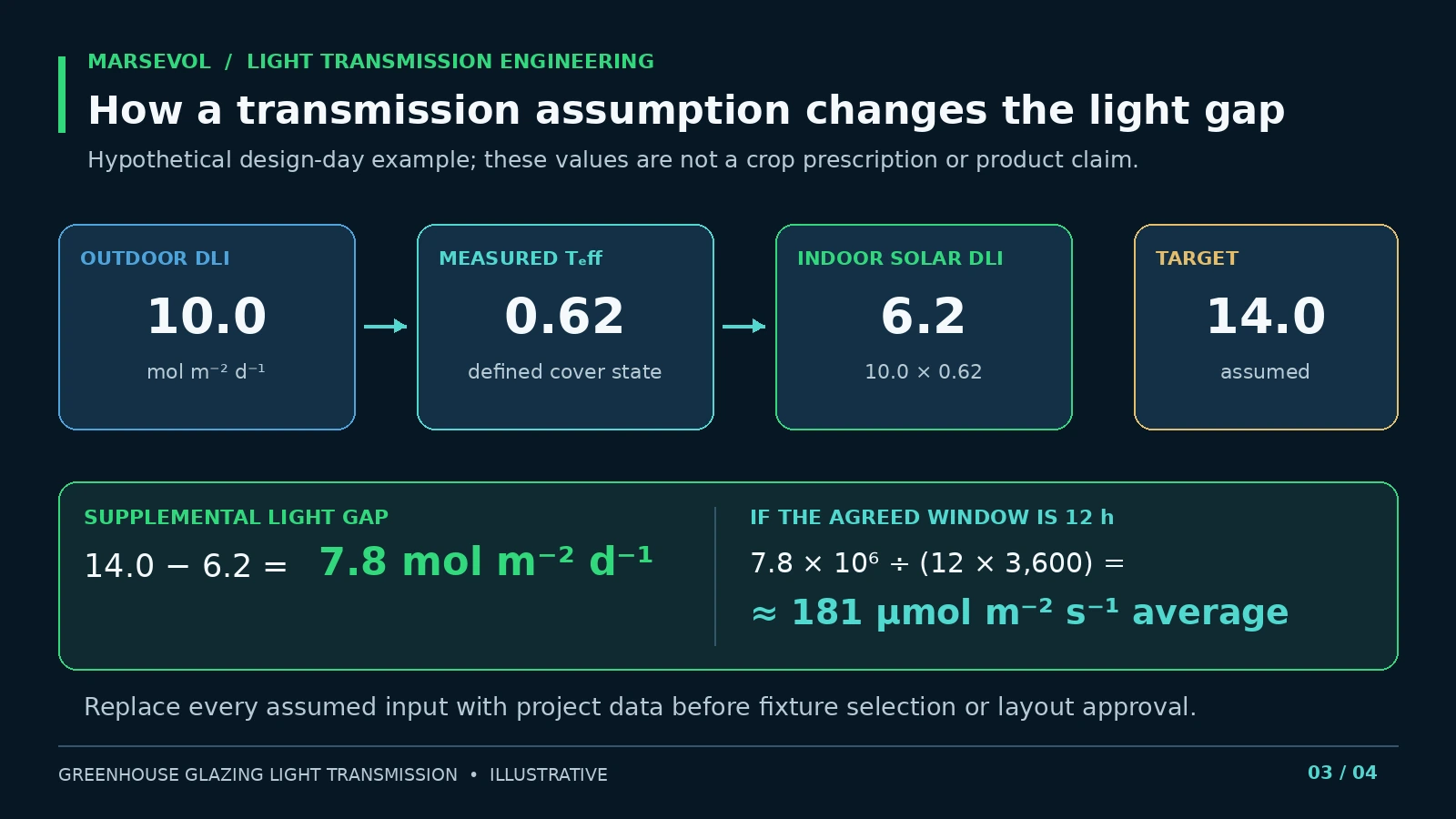
Transmission changes the estimated natural DLI first; the remaining crop-light gap then changes the required supplemental contribution. The following is an illustrative calculation, not a crop prescription, product performance claim or forecast.
Hypothetical inputs: outdoor design-day DLI of 10.0 mol m−2 d−1; measured effective transmission of 0.62 for the stated clean-cover, screens-open condition; agreed crop target of 14.0 mol m−2 d−1; and a 12-hour supplemental-light window.
With an unsupported 0.75 factor, estimated natural DLI becomes 7.5 and the same arithmetic returns about 150 µmol m−2 s−1. The difference is not a real-project claim; it shows how an optimistic assumption propagates into the lighting requirement. Use How to Calculate DLI for Greenhouse Crops for the full method, then carry the verified gap into the layout.
What Transmission Basis Should a Lighting Designer Use?
Use the strongest available evidence while keeping the assumption traceable. A new project may begin with only covering specifications; an operating greenhouse may provide interval data and field surveys. The design basis should improve as evidence improves.
| Available evidence | Appropriate use | Required qualifier | Next verification step |
|---|---|---|---|
| Cover datasheet only | Early sensitivity range and material comparison | Exact product, PAR basis, test method and sample condition | Add structure/screen assumptions; plan field measurement |
| Matched paired sensors at one location | Local operating-state ratio and trend | Timestamp, sky, solar angle, plane and cover state | Repeat across relevant conditions and mapped locations |
| Mapped paired interval data | Project design factor and spatial sensitivity | Season, percentile or aggregation method and exclusions | Confirm the selected case after installation |
| Integrated indoor/outdoor DLI records | Daily solar-light budget and control tuning | Sensor calibration, missing data, screen states and dates | Maintain records and recheck after cover or screen changes |
The assumption register should name an owner for each provisional input, state which value drives fixture quantity and identify commissioning measurements. If uncertainty changes spacing or connected load, simulate more than one case.
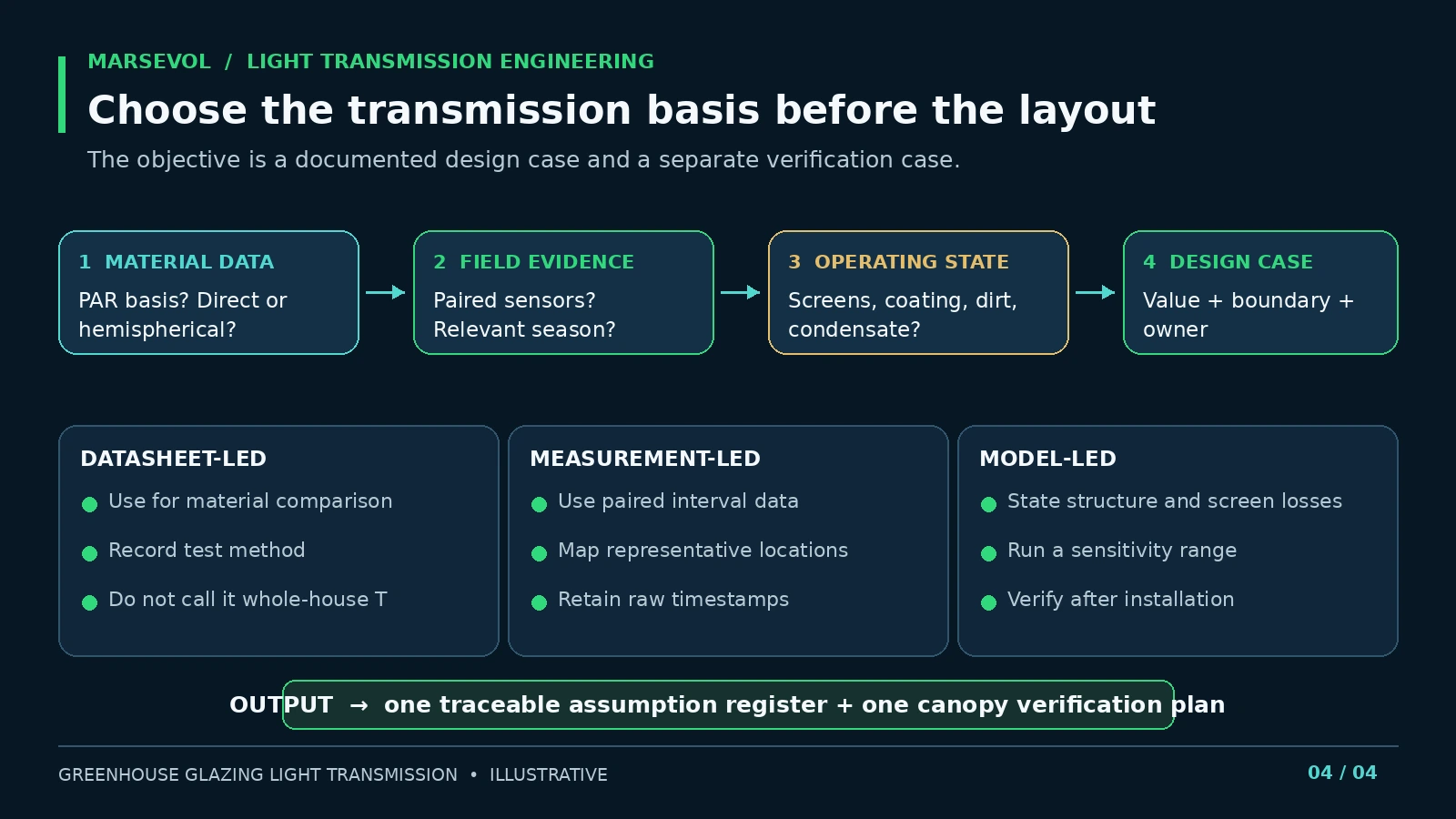
Account for active screens and control states
Energy screens, shade curtains and light-abatement curtains create distinct optical states. Do not apply a screens-open factor when an energy screen is deployed. A blackout condition may define when electric lighting can operate rather than a useful solar factor. Keep these states in the control requirements; detailed logic belongs in DLI Lighting Control.
Recheck after physical changes
Cover replacement, coating, cleaning, a new screen, altered hanging systems or a canopy-height change can invalidate the previous basis. Define a trigger for remeasurement. A clean-cover commissioning survey and a later in-service survey can also reveal whether maintenance or sensor drift is changing the usable natural-light budget.
Common Glazing-Transmission Mistakes
Using the highest brochure number
A high perpendicular value may be valid for its test but still be the wrong metric for the greenhouse boundary. Record the method and run an effective-transmission sensitivity.
Measuring inside and outside at different times
Rapid cloud movement can dominate the result. Use synchronized sensors or a validated reference station.
Mixing lux with PPFD
Human-vision weighting does not represent plant photon flux. Use calibrated plant-light instruments and ASABE terminology.
Ignoring structure, dirt and screen position
Those losses are part of the system experienced by the crop. Document them instead of attributing every difference to the cover material.
Treating diffuse light as a guaranteed yield increase
Scattering can improve distribution, but crop response depends on transmission, canopy, climate and operating practice. Do not convert one research result into a universal commercial promise.
The MarsEVOL Perspective
MarsEVOL treats greenhouse glazing light transmission as an input to the crop-light budget and the verification plan, not as a fixture specification. Before selecting equipment, we want the target canopy plane, outside-light basis, effective transmission state, crop objective and allowed runtime to be explicit. That lets the proposal separate natural DLI from the supplemental contribution and prevents a material datasheet from becoming an undocumented whole-house assumption.
The luminaire model is considered after that boundary is established. For example, SOLIFY PRO can be evaluated against a project-specific layout, mounting and control requirement, but no product page can supply the greenhouse’s solar-transmission factor. The cover and system state must come from the project evidence.
FAQ
What is a good greenhouse glazing transmission percentage?
There is no universal greenhouse glazing light transmission percentage. The appropriate value depends on the exact cover, optical test, structure, screens, condition, location, season and crop plane. Use manufacturer data for comparison and measured effective transmission for the stated greenhouse state when available.
Can I calculate greenhouse transmission with one quantum sensor?
You can move one sensor between positions only under unusually stable conditions, but simultaneous matched sensors are more defensible because daylight changes quickly. If one sensor must be used, document the sequence and uncertainty and avoid treating the result as a precise seasonal factor.
Should transmission be based on PPFD or DLI?
Use paired PPFD for synchronized interval ratios and integrated inside/outside photon totals when the decision concerns daily light. Both must use compatible sensors, timestamps and boundaries. DLI is usually more useful for a daily crop-light budget.
Does diffuse glazing always reduce PPFD?
No universal statement is valid. Diffuse materials change angular distribution, while total transmission depends on the material and test. Compare hemispherical transmission and scattering characteristics together, then verify crop-plane distribution under project conditions.
How often should effective transmission be checked?
Set triggers rather than one fixed interval: cover replacement, screen changes, coating or cleaning changes, visible contamination, sensor replacement or a design review for a new crop season. Trend monitoring can indicate when a new mapped survey is justified.
Conclusion
Greenhouse glazing light transmission connects the outside solar resource to the crop-level DLI budget. The defensible workflow is to name the optical metric, separate material data from whole-house losses, measure paired inside/outside PAR for defined states, integrate the relevant period, and carry the result—plus uncertainty—into the supplemental-light calculation.
A percentage without a boundary is not a design input. A traceable transmission register, sensitivity case and canopy verification plan give growers and engineers a shared basis for deciding how much electric light is actually needed.
Need a Project-Specific Greenhouse Lighting Plan?
Send the greenhouse location, crop, dimensions, canopy and mounting heights, glazing and screen details, available light records, electrical supply and control requirements. MarsEVOL can turn those inputs into a documented preliminary lighting plan.
Explore More MarsEVOL Resources
Connect solar DLI, crop objectives, supplemental PPFD, layout and control constraints.
Define representative sensor planes, locations and installation checks for crop-light data.
Translate the verified light gap into mounting, spacing, overlap and canopy-level validation.
References
Source links rechecked October 3, 2026. Research examples are not transferable product or yield guarantees.
- Swinkels, G. L. A. M. (2012). Transvision: A Light Transmission Measurement System for Greenhouse Covering Materials. Acta Horticulturae 956, 563–568.
- Swinkels, G. L. A. M., Hemming, S., Mohammadkhani, V., & van Ruijven, J. P. M. (2013). Protocol for Measuring Light Transmission of Horticultural Screens. Wageningen UR Greenhouse Horticulture, Report 1252.
- American Society of Agricultural and Biological Engineers. ANSI/ASABE S640: Quantities and Units of Electromagnetic Radiation for Plants. July 2017 (reaffirmed 2022).
- Torres, A. P., & Lopez, R. G. Measuring Daily Light Integral in a Greenhouse. Purdue Extension HO-238-W.
- Holsteens, K., Moerkens, R., Van de Poel, B., & Vanlommel, W. (2020). The Effect of Low-Haze Diffuse Glass on Greenhouse Tomato and Bell Pepper Production and Light Distribution Properties. Plants, 9(7), 806.