
Estimating greenhouse supplemental lighting runtime is one of the most practical steps in greenhouse lighting design.
After growers know the crop target DLI, available greenhouse sunlight, and supplemental DLI requirement, the next question is simple:
How many hours should the supplemental lights run each day?
The answer depends on the crop target DLI, seasonal sunlight, greenhouse transmission, fixture PPFD, lighting uniformity, dimming level, energy cost, and control strategy.
In greenhouse production, runtime should not be guessed from fixture wattage alone. A professional supplemental lighting strategy should estimate runtime from the crop’s daily light requirement and the actual light delivered at canopy level.
This article explains how to estimate greenhouse supplemental lighting runtime using DLI, PPFD, greenhouse sunlight contribution, and practical control logic.
Quick Answer
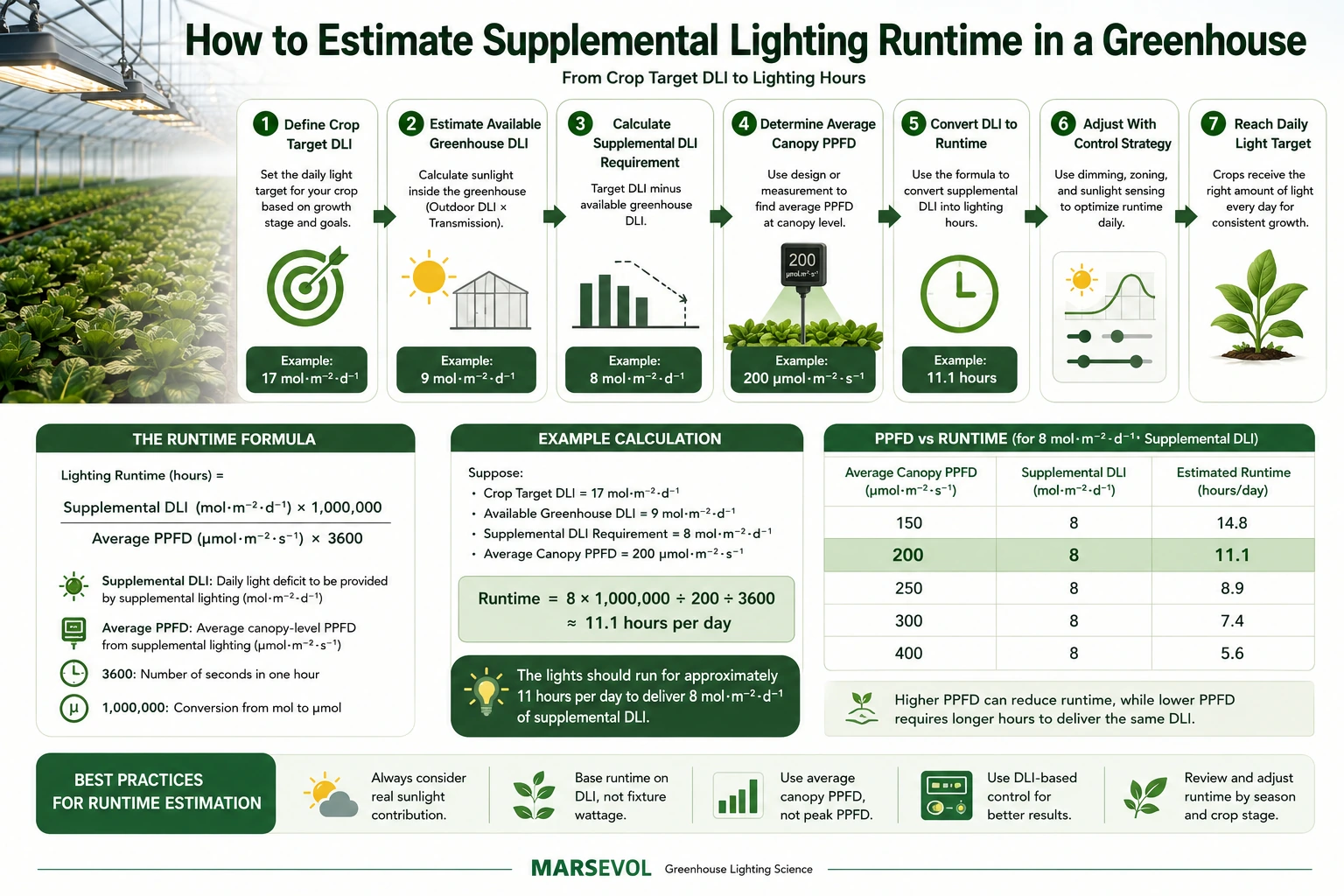
Lighting Runtime = Supplemental DLI × 1,000,000 ÷ Average PPFD ÷ 3600
For example, if a greenhouse needs 8 mol·m⁻²·d⁻¹ of supplemental DLI and the lighting system provides 200 μmol·m⁻²·s⁻¹, the estimated runtime is about 11.1 hours per day.
Key Takeaways
- Runtime should be calculated from DLI deficit. The goal is to close the gap between crop target DLI and available greenhouse sunlight.
- Average canopy-level PPFD matters. Runtime should be based on the light reaching the crop, not fixture wattage alone.
- Higher PPFD can reduce runtime. A stronger lighting system can deliver the same DLI in fewer hours, but crop response and energy cost must still be considered.
- Lower PPFD requires longer runtime. A lower-intensity system may need more hours to provide the same supplemental DLI.
- Smart control can improve runtime decisions. Sunlight-aware dimming and DLI-based control can reduce unnecessary lighting while helping crops reach daily light targets.
1. Why Lighting Runtime Matters in a Greenhouse
Lighting runtime is the number of hours supplemental lights operate during a day.
In greenhouse production, runtime directly affects:
- crop daily light accumulation;
- electricity cost;
- fixture operating hours;
- thermal load;
- crop timing;
- production consistency;
- return on investment.
Running lights longer can increase crop DLI, but it also increases energy use.
Running lights for too few hours may save electricity, but crops may fail to reach their target daily light requirement.
This is why greenhouse supplemental lighting runtime should be estimated from crop need and available sunlight, not simply from a fixed schedule.
2. Start with the Crop Target DLI
The first step is to define the crop target DLI.
DLI, or Daily Light Integral, describes the total amount of photosynthetically active light received by one square meter of crop area during one day.
DLI is commonly expressed as:
mol·m⁻²·d⁻¹
The crop target DLI depends on:
- crop type;
- cultivar;
- growth stage;
- production objective;
- temperature strategy;
- CO₂ concentration;
- desired crop quality;
- economic return from additional light.
For runtime estimation, the crop target DLI defines the total daily light goal.
Without this target, lighting runtime becomes guesswork.
3. Estimate Available Greenhouse DLI
Greenhouse crops receive light from natural sunlight before supplemental lighting is added.
However, outdoor sunlight is not the same as crop-level greenhouse light.
Greenhouse transmission losses occur due to:
- glazing material;
- roof angle;
- structural frames;
- trusses and pipes;
- shade curtains;
- dust and condensation;
- hanging equipment;
- crop canopy structure.
A simplified estimate is:
Greenhouse DLI = Outdoor DLI × Greenhouse Transmission
For example, if outdoor DLI is 15 mol·m⁻²·d⁻¹ and greenhouse transmission is 60%:
15 × 0.60 = 9 mol·m⁻²·d⁻¹
The crop may receive approximately 9 mol·m⁻²·d⁻¹ from sunlight inside the greenhouse.
4. Calculate the Supplemental DLI Requirement
Once the crop target DLI and available greenhouse DLI are known, the supplemental DLI requirement can be calculated.
Supplemental DLI = Crop Target DLI − Available Greenhouse DLI
For example:
- Crop target DLI: 17 mol·m⁻²·d⁻¹
- Available greenhouse DLI: 9 mol·m⁻²·d⁻¹
The supplemental DLI requirement is:
17 − 9 = 8 mol·m⁻²·d⁻¹
This means the supplemental lighting system should provide approximately 8 mol·m⁻²·d⁻¹ to reach the crop’s daily light target.
5. Convert Supplemental DLI into Lighting Runtime
After the supplemental DLI requirement is known, runtime can be estimated from the average canopy-level PPFD delivered by the lighting system.
The formula is:
Lighting Runtime = Supplemental DLI × 1,000,000 ÷ Average PPFD ÷ 3600
Where:
- Supplemental DLI is the daily light deficit to be provided by electric lighting, in mol·m⁻²·d⁻¹;
- Average PPFD is the average canopy-level supplemental light intensity, in μmol·m⁻²·s⁻¹;
- 3600 converts hours to seconds;
- 1,000,000 converts mol to μmol.
For example, if the supplemental DLI requirement is 8 mol·m⁻²·d⁻¹ and the lighting system provides an average PPFD of 200 μmol·m⁻²·s⁻¹:
Runtime = 8 × 1,000,000 ÷ 200 ÷ 3600
Runtime ≈ 11.1 hours
The supplemental lights should run for approximately 11 hours to provide 8 mol·m⁻²·d⁻¹ of supplemental DLI under these assumptions.
6. Runtime Table: Different PPFD Levels
The same supplemental DLI requirement can be achieved with different PPFD and runtime combinations.
The table below shows estimated runtime required to provide 8 mol·m⁻²·d⁻¹ of supplemental DLI.
| Average Canopy PPFD | Target Supplemental DLI | Estimated Runtime |
|---|---|---|
| 150 μmol·m⁻²·s⁻¹ | 8 mol·m⁻²·d⁻¹ | 14.8 hours |
| 200 μmol·m⁻²·s⁻¹ | 8 mol·m⁻²·d⁻¹ | 11.1 hours |
| 250 μmol·m⁻²·s⁻¹ | 8 mol·m⁻²·d⁻¹ | 8.9 hours |
| 300 μmol·m⁻²·s⁻¹ | 8 mol·m⁻²·d⁻¹ | 7.4 hours |
| 400 μmol·m⁻²·s⁻¹ | 8 mol·m⁻²·d⁻¹ | 5.6 hours |
This table shows why greenhouse supplemental lighting runtime depends strongly on average canopy-level PPFD.
Higher PPFD can reduce runtime, while lower PPFD requires longer operation to deliver the same DLI.
7. Higher PPFD Is Not Always the Best Runtime Strategy
A higher PPFD system can deliver the same DLI in fewer hours.
However, shorter runtime is not always better.
Crop response can be affected by:
- photoperiod;
- temperature;
- CO₂ concentration;
- humidity;
- cultivar;
- growth stage;
- leaf temperature;
- crop stress tolerance;
- light distribution and uniformity.
For some crops, a moderate PPFD over a longer period may be more practical than very high PPFD for a short period.
For other crops, a higher PPFD and shorter runtime may fit the production schedule better.
This is why greenhouse supplemental lighting runtime should be evaluated together with crop physiology, climate strategy, and energy cost.
8. Fixed Runtime vs DLI-Based Runtime
Many greenhouse lighting systems use a fixed daily runtime.
For example, lights may operate from 6:00 a.m. to 8:00 p.m. every day during winter.
This approach is simple, but it does not respond to changing sunlight.
On bright days, fixed runtime may over-deliver light and waste energy.
On dark days, fixed runtime may under-deliver light and fail to reach the crop target DLI.
A DLI-based runtime strategy is more adaptive.
Instead of running lights for the same number of hours every day, DLI-based control adjusts operation according to sunlight already received and remaining daily light requirement.
9. How DLI-Based Control Adjusts Runtime
DLI-based control uses sensors and control logic to monitor light conditions and adjust supplemental lighting operation.
A simplified control logic is:
- define crop target DLI;
- measure or estimate accumulated greenhouse sunlight DLI;
- calculate remaining DLI requirement;
- adjust lighting intensity or runtime;
- stop or dim lighting when the daily target is reached.
This approach helps growers use sunlight instead of fighting it.
When natural sunlight is strong, lights can dim or operate for fewer hours.
When natural sunlight is weak, lights can run longer or at higher output to close the DLI gap.
For commercial greenhouses, this can improve energy efficiency while supporting more consistent crop light delivery.
10. Runtime Should Be Calculated by Zone
Greenhouses are not always uniform light environments.
Different zones may receive different sunlight and supplemental PPFD due to:
- orientation;
- structural shadows;
- bench location;
- curtain position;
- crop height;
- fixture spacing;
- adjacent equipment;
- greenhouse expansion or compartment design.
For this reason, a single greenhouse-wide runtime may not be ideal.
Zone-based lighting allows different areas to receive different supplemental lighting strategies.
This is especially useful for research greenhouses, propagation areas, mixed crop production, and facilities with multiple crop stages.
11. Practical Runtime Estimation Workflow
A practical workflow for estimating greenhouse supplemental lighting runtime includes the following steps.
Step 1: Define Crop Target DLI
Start with the crop type, growth stage, and production objective.
Step 2: Estimate Available Greenhouse DLI
Use outdoor DLI data, greenhouse transmission estimates, local weather data, or actual PAR sensor readings.
Step 3: Calculate Supplemental DLI Requirement
Subtract available greenhouse DLI from crop target DLI.
Step 4: Determine Average Canopy-Level PPFD
Use simulation, fixture layout design, or field measurement to estimate the average supplemental PPFD at crop canopy level.
Step 5: Calculate Runtime
Use the formula:
Runtime = Supplemental DLI × 1,000,000 ÷ Average PPFD ÷ 3600
Step 6: Check Practical Limits
Review photoperiod, crop response, electricity cost, utility demand charges, heat load, and operation schedule.
Step 7: Refine with Control Strategy
Use dimming, zoning, sunlight sensing, and DLI-based control to improve runtime decisions over time.
12. Common Mistakes When Estimating Lighting Runtime
Mistake 1: Calculating Runtime from Fixture Wattage
Wattage tells us electrical power consumption.
It does not directly tell us how much photosynthetic light reaches the crop canopy.
Runtime should be based on canopy-level PPFD and DLI requirement.
Mistake 2: Ignoring Greenhouse Sunlight
In greenhouse production, sunlight already contributes to crop DLI.
Runtime should be calculated after estimating available greenhouse sunlight.
Mistake 3: Using Outdoor DLI Without Transmission Adjustment
Outdoor DLI must be adjusted for greenhouse transmission losses.
Glazing, structure, curtains, dust, and equipment can reduce crop-level DLI.
Mistake 4: Ignoring Uniformity
Average PPFD is not enough if light distribution is uneven.
Poor uniformity can create crop zones that are over-lit or under-lit even when average runtime appears correct.
Mistake 5: Using One Runtime for All Seasons
Winter, spring, summer, and fall have very different sunlight availability.
Runtime should be seasonal and ideally sunlight-aware.
13. MarsEVOL Perspective: Runtime Is a System Design Question
At MarsEVOL, greenhouse supplemental lighting runtime is treated as part of a complete system design workflow.
A practical runtime strategy should connect:
- crop target DLI;
- available greenhouse sunlight;
- greenhouse transmission;
- supplemental DLI requirement;
- average canopy-level PPFD;
- fixture layout;
- PPFD uniformity;
- dimming strategy;
- zone-based control;
- seasonal operation logic.
The MarsEVOL SOLIFY Series is designed for greenhouse supplemental lighting projects where output, optical distribution, installation flexibility, durability, and control compatibility all matter.
For advanced greenhouse management, HARVESTATION supports sunlight-aware operation, zone-based dimming, and DLI-oriented lighting control.
This means runtime does not need to be a fixed assumption.
It can become a dynamic operating decision based on crop targets, real sunlight conditions, and greenhouse zone requirements.
FAQ: Greenhouse Supplemental Lighting Runtime
How do you calculate greenhouse supplemental lighting runtime?
Use the formula: Runtime = Supplemental DLI × 1,000,000 ÷ Average PPFD ÷ 3600. This estimates how many hours the lighting system should operate to provide the required supplemental DLI.
What is the difference between runtime and photoperiod?
Runtime is how long supplemental lights operate. Photoperiod is the total light or day-length signal perceived by the crop. They can be related, but they are not always the same.
Should greenhouse lights run all day in winter?
Not always. Runtime should depend on crop target DLI, available sunlight, PPFD, energy cost, and control strategy. On brighter winter days, fewer hours may be needed.
Can higher PPFD reduce lighting runtime?
Yes. Higher average canopy-level PPFD can deliver the same DLI in fewer hours. However, crop response, photoperiod, temperature, CO₂, and energy cost should also be considered.
Why is DLI-based control better than a fixed schedule?
DLI-based control adjusts lighting based on how much sunlight the crop has already received and how much more light is needed to reach the daily target. This can reduce unnecessary runtime and improve consistency.
Conclusion
Estimating greenhouse supplemental lighting runtime is essential for turning crop light targets into practical operation.
The key is to start with the crop target DLI, estimate available greenhouse sunlight, calculate the supplemental DLI requirement, and convert that requirement into runtime using average canopy-level PPFD.
The core formula is:
Runtime = Supplemental DLI × 1,000,000 ÷ Average PPFD ÷ 3600
A good runtime strategy should not be based on wattage alone.
It should consider DLI deficit, PPFD, photoperiod, greenhouse transmission, uniformity, energy cost, and smart control.
For modern greenhouse production, the best lighting runtime is not simply the longest runtime.
It is the runtime that helps crops reach the target DLI with the right intensity, distribution, timing, and efficiency.
Need Help Estimating Lighting Runtime for Your Greenhouse?
MarsEVOL supports commercial growers, greenhouse designers, integrators, and research teams with greenhouse lighting analysis and system planning.
Our support can include:
- crop target DLI analysis;
- greenhouse sunlight estimation;
- supplemental DLI calculation;
- runtime estimation;
- canopy-level PPFD planning;
- fixture layout design;
- DLI-based control recommendations.
Request a Free Greenhouse Lighting Plan →
Explore More MarsEVOL Greenhouse Lighting Resources
Read: What Is Greenhouse Supplemental Lighting →
Learn the full greenhouse supplemental lighting framework, including DLI, PPFD, seasonal sunlight, greenhouse transmission, and system design.
Read: PPFD vs DLI in Greenhouse Lighting →
Understand how instantaneous light intensity and daily accumulated light work together in greenhouse lighting design.
Read: How to Calculate DLI for Greenhouse Crops →
Learn how to calculate crop DLI, estimate greenhouse transmission, and convert supplemental DLI into required PPFD.
Read: Greenhouse Supplemental Lighting in Winter →
Learn why winter and cloudy seasons create DLI deficits and how supplemental lighting helps maintain crop performance.
Learn About HARVESTATION Smart Control →
Explore sunlight-aware greenhouse lighting control strategies based on DLI targets, dimming, and zone management.
References
Virginia Cooperative Extension.
Calculating and Using Daily Light Integral: An Introductory Guide.
Torres, A. P., & Lopez, R. G.
Measuring Daily Light Integral in a Greenhouse, Purdue University Extension.
Michigan State University Extension.
DLICALC: A Greenhouse Daily Light Integral Calculator.
e-GRO.
How Many Light Fixtures Do I Need?
Apogee Instruments.
Daily Light Integral: Measuring Light for Plants.