
Winter greenhouse DLI in Canada planning should begin with light measured at the crop inside the greenhouse. Select a documented winter design period, estimate or measure natural DLI at canopy level, subtract it from a crop-specific target, and convert only the positive deficit into a feasible supplemental PPFD and runtime. Outdoor solar-resource maps can screen locations, but they are not greenhouse PAR measurements and should never be inserted directly into a crop DLI calculation.
Key Takeaways
- Use a calibrated quantum sensor at the crop plane whenever a representative winter measurement campaign is practical.
- Keep outdoor solar resource, greenhouse transmission and crop-level DLI as separate quantities with separate assumptions.
- Design to an agreed winter period or percentile, not one bright or unusually dark day.
- A DLI deficit does not specify a fixture layout; mounting geometry, uniformity, controls and electrical capacity still matter.
- Verify the finished system with the same canopy boundary, curtain state and sensor procedure used in the design basis.
Canadian winter production combines short days, low solar elevation, frequent cloud, snow-reflected brightness and greenhouse transmission losses. Those conditions make supplemental lighting valuable, but they also make a single “typical winter DLI” unreliable. Latitude matters, yet location alone does not describe the photons that reach a crop through a particular roof, structure, curtain, glazing condition and canopy.
This guide therefore treats winter greenhouse DLI in Canada as a project measurement and design problem. It complements the broader greenhouse supplemental lighting guide, while keeping the focus on the evidence required for a defensible Canadian winter basis.
What Does Winter Greenhouse DLI Mean in Canada?
Daily light integral is the accumulated photosynthetic photon flux received per square metre during a day. In a greenhouse project, the useful number is the DLI at the crop plane, not irradiance outside the building and not the output printed on a luminaire data sheet. The canopy value combines transmitted sunlight and electric light over time.
The design period should match the commercial question. A grower protecting minimum winter production may choose a conservative recurring condition. A research house may need a controlled treatment every day. A seasonal operation may care only about shoulder months. State the location, months, crop stage, target, measurement plane and statistical basis before comparing fixture quantities.
Which Data Should Be Used for Canadian Winter DLI?
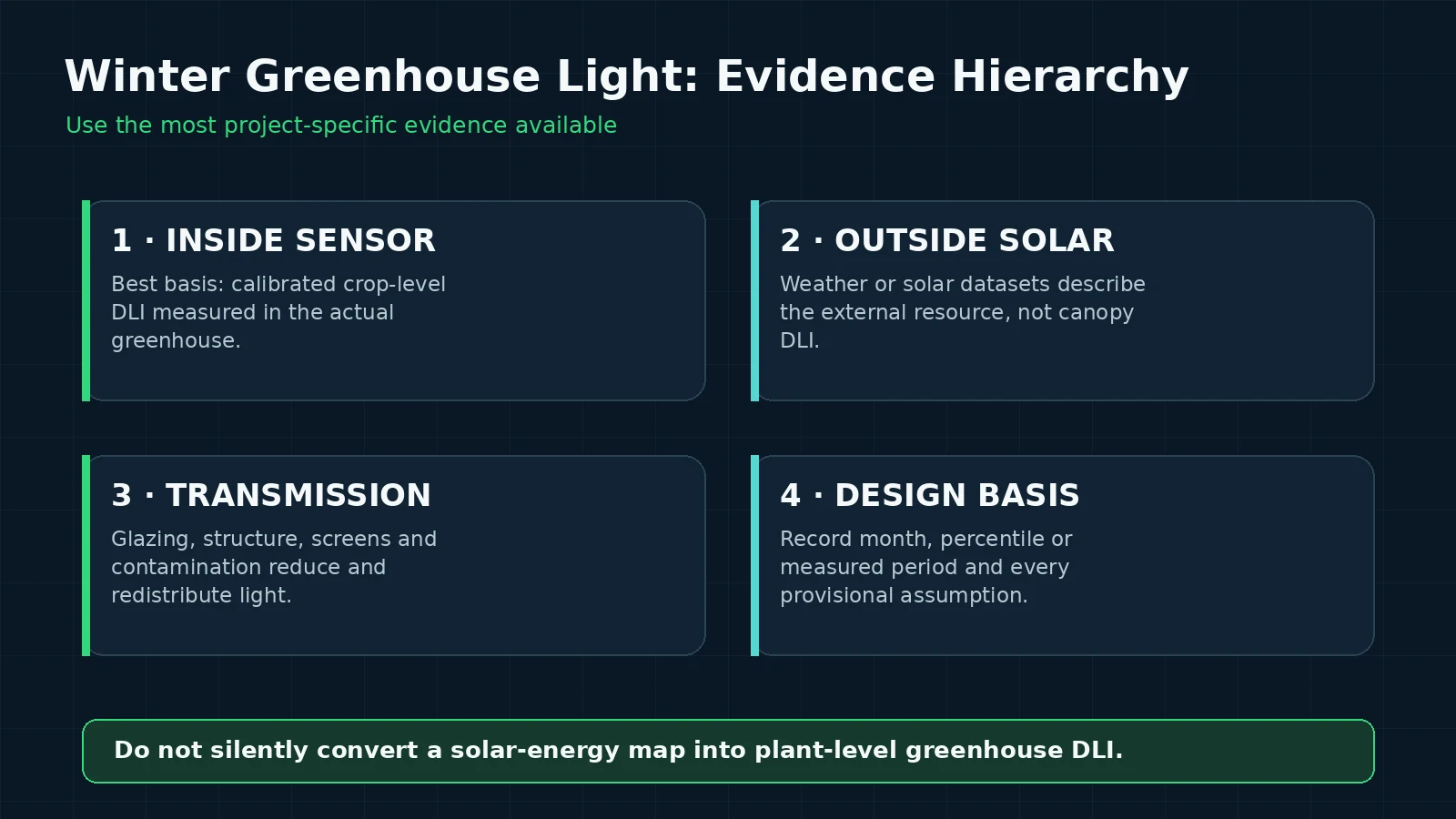
Prefer crop-level measurements inside the actual greenhouse
A calibrated PAR quantum sensor or logged array at representative canopy points captures the combined effects of glazing, structure, screens, dirt, crop position and local shading. Follow the sensor manufacturer’s orientation and cosine-response guidance, keep the sensor level, record the sampling interval, and document whether curtains or supplemental lights were operating. The greenhouse PAR sensor placement guide explains how position changes the result.
Use external solar data as a screening input, not a crop result
Natural Resources Canada publishes Canadian solar-resource maps derived from Environment and Climate Change Canada data. They are valuable for regional screening and comparing seasons, but the mapped quantity is solar energy for resource assessment. It is not automatically photosynthetic photon flux inside a greenhouse. If external data must be used, identify the dataset, time period and units, then apply a separately justified transmission method. Do not hide the conversion inside a fixture count.
Record transmission as a variable, not a universal percentage
Transmission changes with covering material, angle of incidence, framing, condensation, contamination, screens and aging. A single annual factor can miss the winter condition that governs the project. Measure inside and outside simultaneously where practical, or declare the source and uncertainty of every modeled factor. See greenhouse glazing light transmission for the optical boundary.
A Five-Step Method for Winter Supplemental-Light Planning
1. Define the crop and production objective
Use crop- and stage-specific evidence. A propagation target cannot be transferred automatically to finishing, and a published experiment does not become a universal commercial prescription. Record cultivar, density, harvest objective, acceptable morphology, photoperiod limits and any temperature or carbon-dioxide conditions that affect interpretation.
2. Select the winter design period
Choose the relevant months and whether the basis is a measured campaign, a multi-year monthly statistic or a conservative percentile. Preserve daylight-saving and local-time handling in the dataset. A clear design period makes later energy and production comparisons auditable.
3. Establish natural DLI at the canopy
Aggregate properly quality-checked PPFD samples over each day. Inspect missing intervals, sensor saturation, snow or condensation, unusual shading and curtain position. Keep daily values visible rather than reporting only an average; variability determines how much control flexibility is useful.
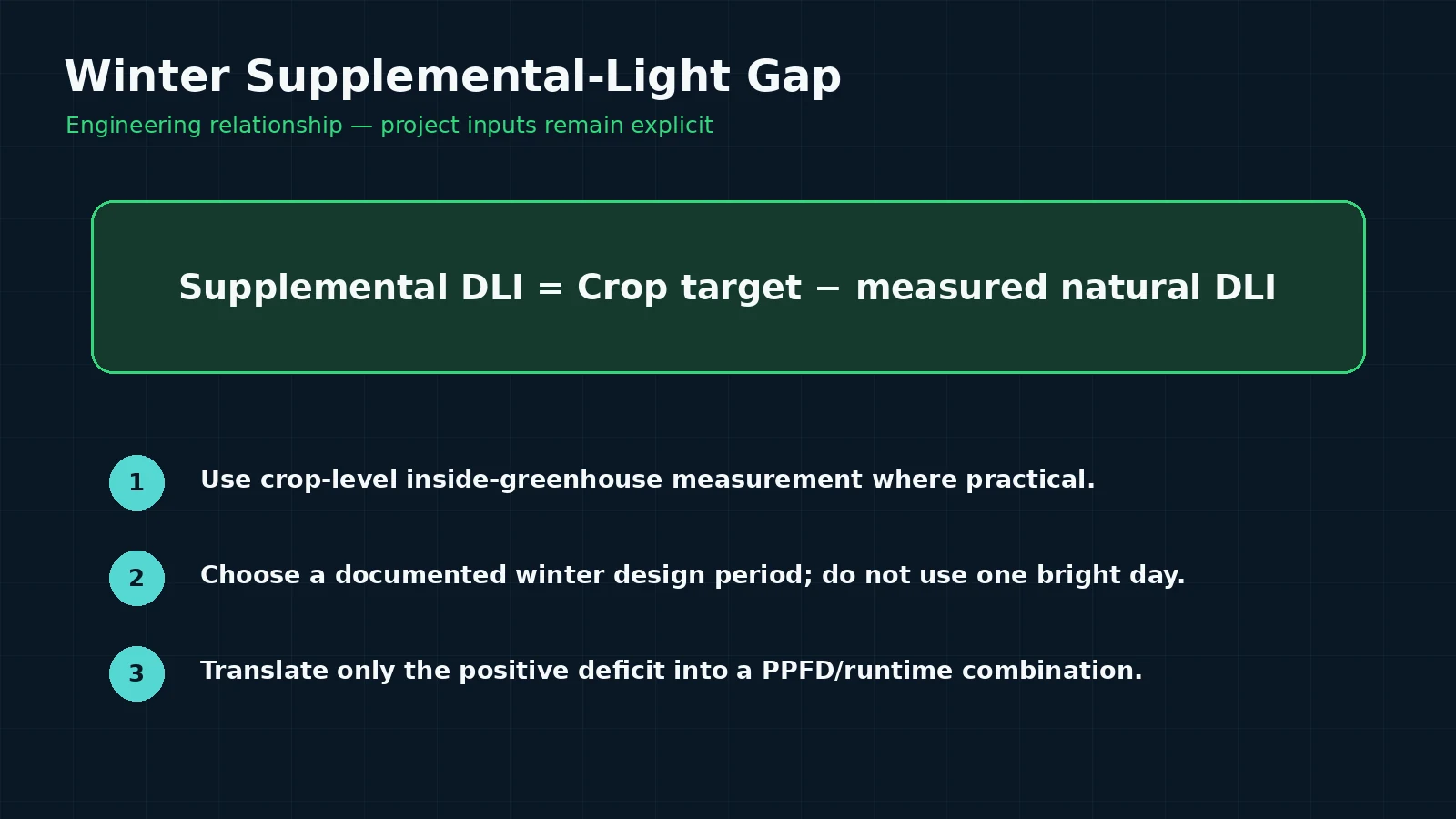
4. Calculate the positive light gap
Engineering relationship
Supplemental DLI = max(0, target crop DLI − expected natural crop-level DLI)
Both terms must describe the same plane, wavelength convention and 24-hour day. The max function prevents a negative ‘requirement’ on brighter days.
5. Test feasible PPFD and runtime combinations
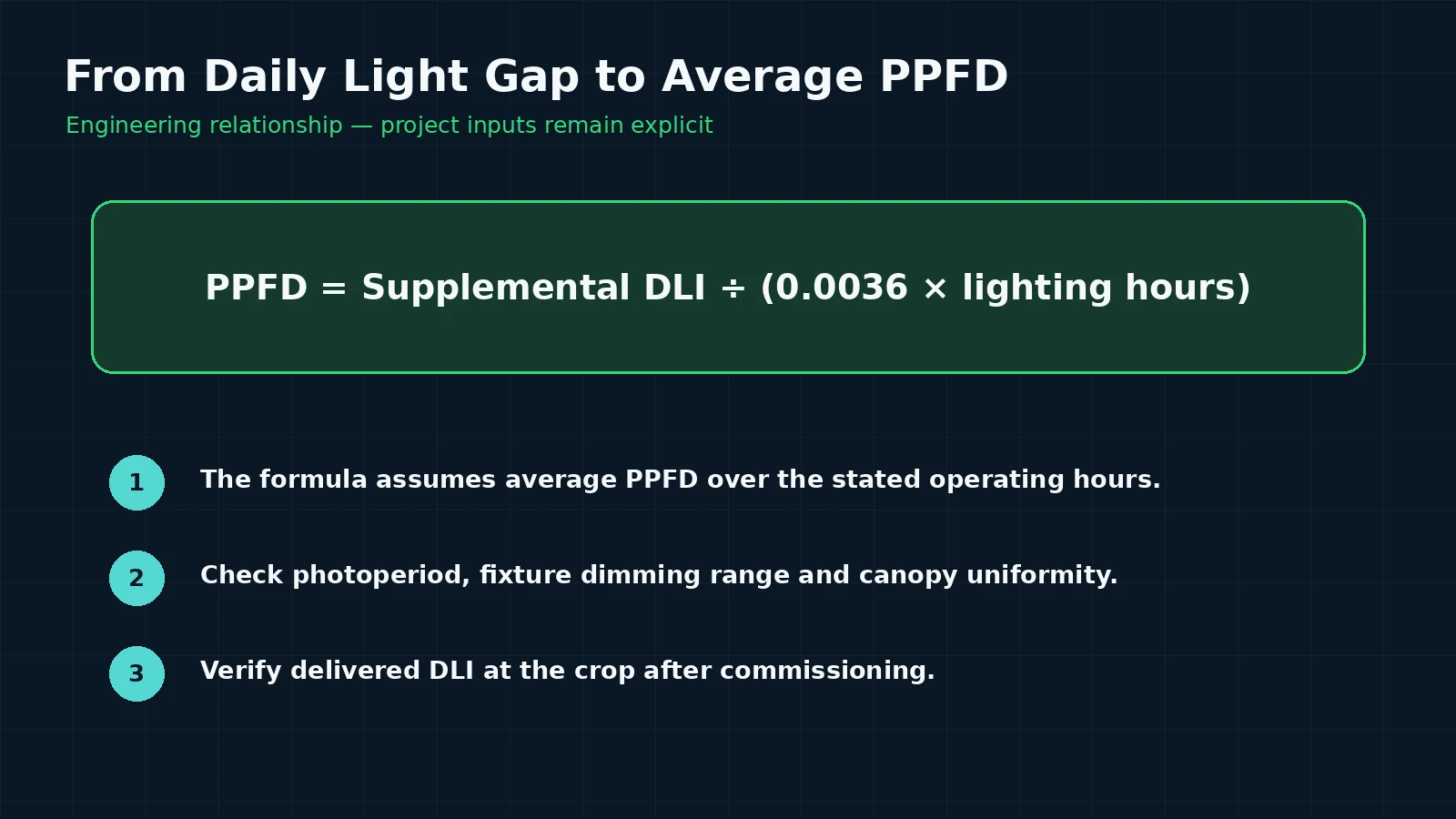
The daily gap can be delivered by different combinations of average canopy PPFD and operating hours. Longer operation at lower output may improve flexibility, while a shorter window may require higher intensity and electrical capacity. The crop’s allowable photoperiod, dark period, utility tariff, curtain rules, climate load and fixture dimming range constrain the choice.
Engineering relationship
Average supplemental PPFD (µmol·m⁻²·s⁻¹) = supplemental DLI (mol·m⁻²·d⁻¹) ÷ [0.0036 × lighting hours]
The 0.0036 factor converts micromoles per second and hours into moles per day. This is a photon-balance step, not a fixture-count formula.
A Transparent Winter Calculation Example
Assume a project team has already selected a crop target of 14 mol·m⁻²·d⁻¹ and, for an agreed winter design condition, measured 5 mol·m⁻²·d⁻¹ of natural light at the canopy. These are illustrative assumptions, not MarsEVOL product specifications or Canadian crop recommendations. The positive deficit is 9 mol·m⁻²·d⁻¹. If the allowed electric-light window is 16 hours, the average supplemental PPFD required by the photon balance is about 156 µmol·m⁻²·s⁻¹.
| Input | Illustrative value | Must be replaced with |
|---|---|---|
| Crop DLI target | 14 mol·m⁻²·d⁻¹ | Crop/stage evidence and production goal |
| Natural canopy DLI | 5 mol·m⁻²·d⁻¹ | Measured or documented winter basis |
| Supplemental gap | 9 mol·m⁻²·d⁻¹ | Target minus natural contribution |
| Lighting window | 16 h | Crop, tariff, curtain and climate limits |
| Average PPFD | ≈156 µmol·m⁻²·s⁻¹ | Layout and field-verified canopy average |
The result does not prove that 156 is uniform across the crop or that a particular fixture count will deliver it. A photometric model must use the planted area, fixture distribution, mounting height, edge conditions and obstructions. The greenhouse lighting layout guide and PPFD uniformity guide cover those next steps.
How Does the DLI Gap Become a Buildable System?
Translate the canopy requirement into a zone-based layout, electrical schedule and control sequence. Confirm voltage, available power, circuit loading and control interface before freezing fixture quantity. Model real mounting points and screens. Specify average and minimum PPFD or another agreed uniformity metric across the same crop boundary used in the DLI calculation.
Controls should accumulate measured light rather than rely only on a clock. A practical strategy can dim or pause lighting when sunlight contributes enough photons, while respecting minimum run states, ramping, photoperiod and local curtain rules. Read DLI lighting control and the greenhouse lighting control system guide before writing the sequence.
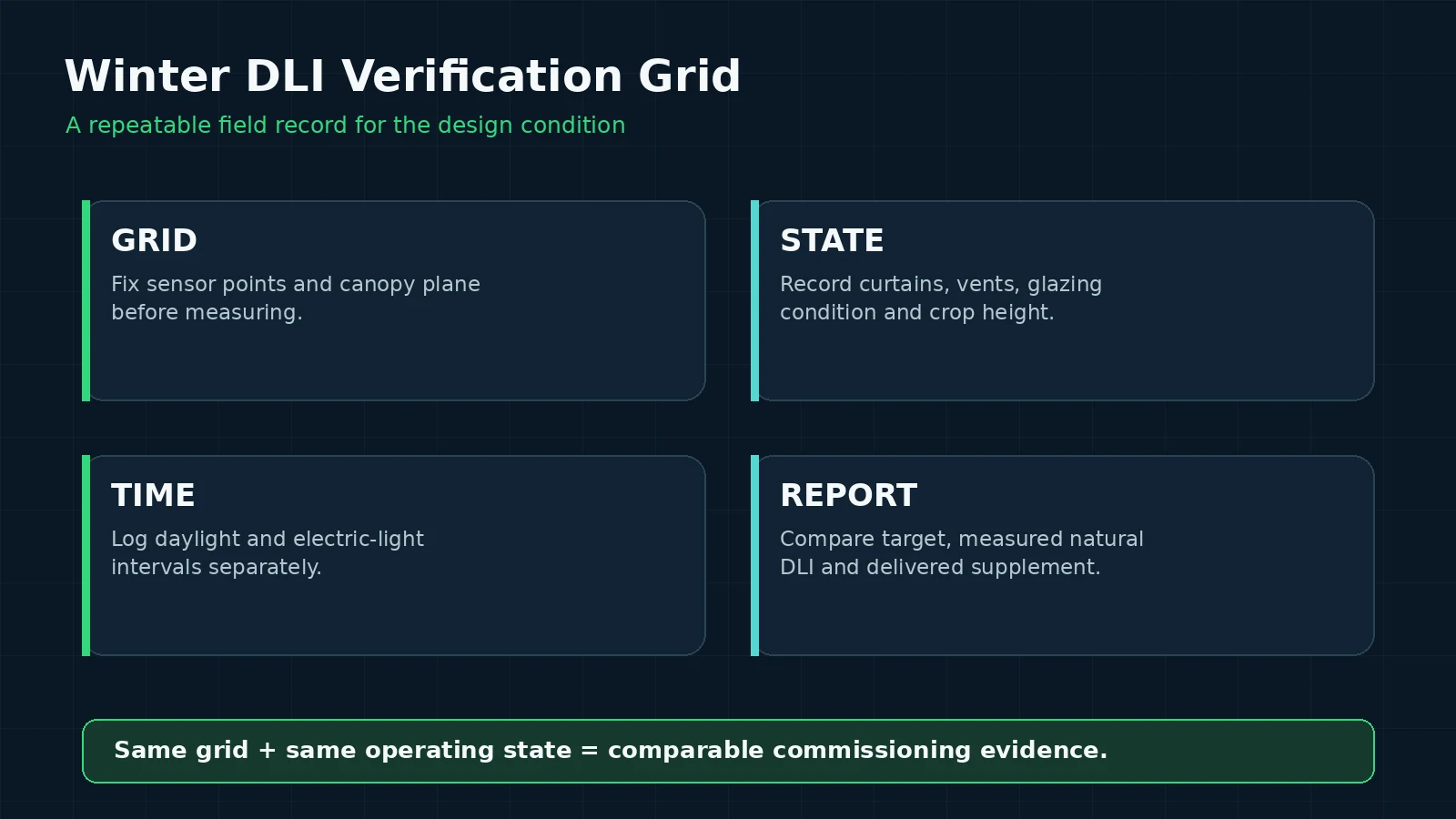
Commission at the agreed canopy plane with calibrated equipment. Record luminaire output setting, warm-up condition, grid coordinates, curtain position and ambient daylight. Separate an electric-only PPFD verification from a full-day DLI verification when possible. The design is not complete until its assumptions can be reconciled with field data.
Common Winter DLI Planning Mistakes
Calling an outdoor solar map “greenhouse DLI”
The units, spectrum and measurement boundary differ. Use the map to screen location and season, then document transmission or measure inside.
Designing from one day
One bright or dark day does not define an operating season. Preserve daily variability and state the design statistic.
Using gross floor area
Aisles and service zones distort photon balance and fixture economics. Use the planted canopy boundary.
Solving DLI while ignoring climate and curtains
Lighting adds heat and may only be permitted in certain curtain states or hours. Coordinate the schedule with environmental controls and applicable local requirements.
FAQ
What is a normal Canadian winter greenhouse DLI?
There is no single value that is defensible for every site. Latitude, weather, greenhouse transmission, screens and crop position all matter. Measure the crop plane or use a documented project-specific model.
Can I size lights from a monthly solar map?
Not directly. A solar map is an external resource layer. The design still needs a PAR/DLI method, greenhouse transmission, planted area, crop target and layout losses.
Should snow reflection be credited?
Only if it is represented in reliable measurements or a validated model for the site and geometry. Do not assume a fixed benefit.
Does the highest PPFD option reduce cost?
Not necessarily. Connected load, tariff, runtime, uniformity, climate and crop response all affect cost. Compare complete operating scenarios.
How often should the winter basis be checked?
Recheck after glazing cleaning or replacement, curtain changes, sensor relocation, major crop-height changes or a material control update. Seasonal trend reviews also reveal sensor drift.
Conclusion
A reliable winter greenhouse DLI plan for Canada separates external solar resource, greenhouse transmission, crop-level DLI, supplemental photon delivery and field verification. That separation prevents a regional map or product value from becoming an unsupported crop promise. Define the winter condition, measure what the crop receives, calculate the positive gap, test feasible PPFD/runtime combinations, then coordinate layout, electrical capacity, controls and commissioning.
Build a Project-Specific Lighting Plan
Send MarsEVOL the Canadian site, crop and stage, planted dimensions, canopy and mounting heights, glazing and curtain information, available power, control requirements and any crop-level winter DLI logs. We can turn those inputs into a reviewable preliminary plan.
Explore More MarsEVOL Resources
Keep instantaneous intensity and daily photon accumulation in the correct roles.
Review the measurement and integration method before setting a design target.
References
- Natural Resources Canada. Photovoltaic potential and solar resource maps of Canada. Regional solar-resource screening page; verified 11 October 2026.
- Torres, A. P., and Lopez, R. G. Measuring Daily Light Integral in a Greenhouse. Purdue Extension HO-238-W.
- ASABE. ANSI/ASABE S640: Quantities and Units of Electromagnetic Radiation for Plants.
- DesignLights Consortium. Horticultural Lighting Technical Requirements. Official program documentation; verified 11 October 2026.