
Greenhouse covering materials affect much more than weather protection.
Glass, polyethylene film, polycarbonate panels, acrylic sheets, diffuse films, shade screens, and specialty coatings all influence how much sunlight reaches the crop canopy and how that light is distributed.
This makes greenhouse covering materials light transmission an important part of crop lighting design.
A greenhouse may receive strong outdoor sunlight while delivering substantially less photosynthetically useful light to the crop because of glazing losses, structural shading, aging, dust, condensation, and internal screens.
Covering materials can also change the balance between direct and diffuse light, modify ultraviolet transmission, influence near-infrared heat gain, and affect crop-level Daily Light Integral.
This article explains how greenhouse covering materials affect PAR transmission, diffuse light, spectrum, seasonal DLI, crop uniformity, and supplemental lighting requirements.
Quick Answer
Greenhouse covering materials affect both the quantity and quality of sunlight reaching crops.
Growers should evaluate PAR transmission, light diffusion, spectral transmission, aging, contamination, condensation, structural shading, and seasonal performance rather than relying on nominal transparency alone.
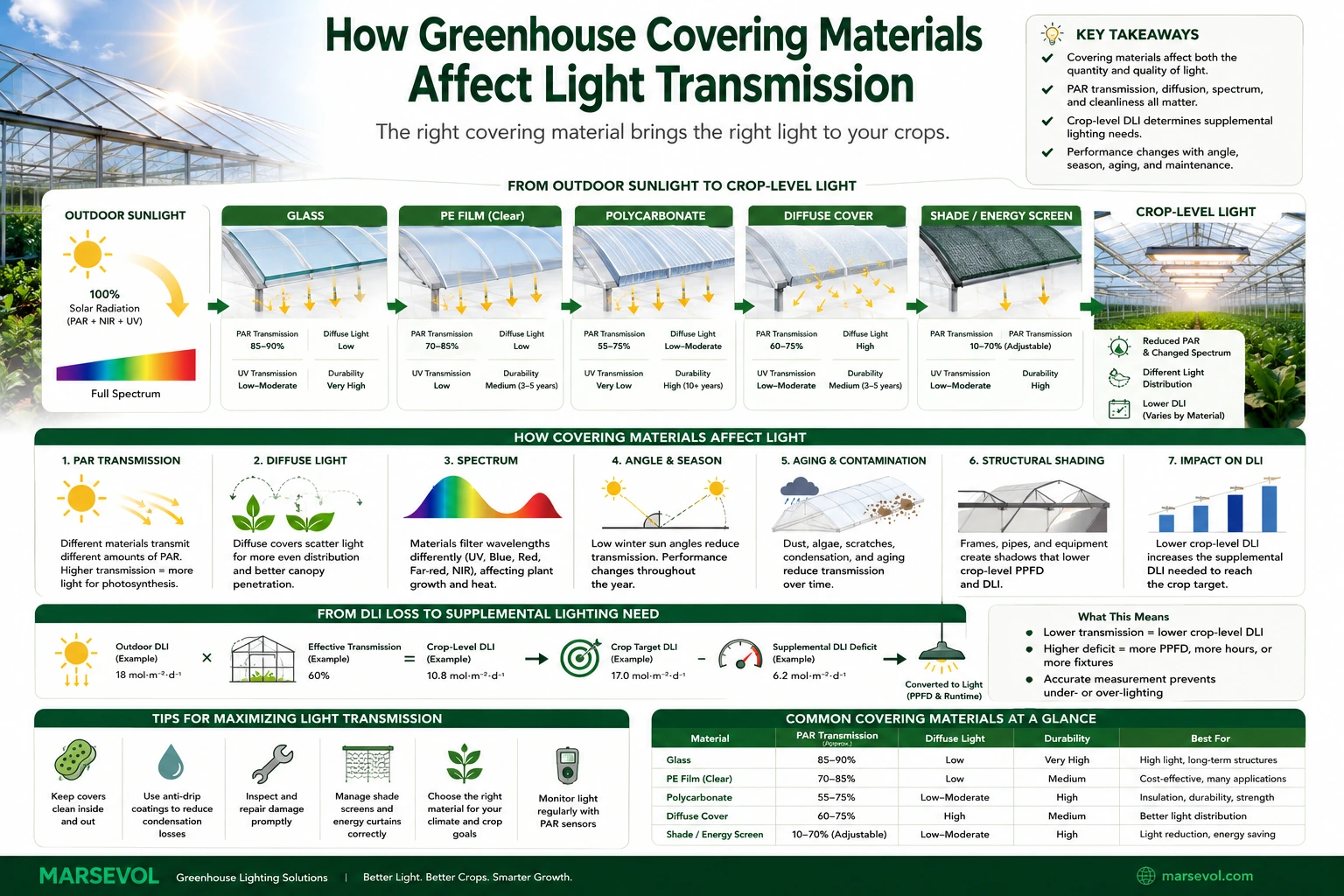
Key Takeaways
- Outdoor sunlight is not equal to crop-level greenhouse light. Covering materials and greenhouse structures reduce and redistribute incoming radiation.
- Total transmission is only one part of performance. Diffuse light, spectral transmission, incidence angle, aging, and condensation also matter.
- High transmission does not automatically mean the best crop environment. A material with good diffusion may improve canopy light distribution even if direct transmission is slightly lower.
- Transmission changes over time. Dust, algae, scratches, ultraviolet degradation, condensation, and aging can reduce actual performance.
- Covering materials affect supplemental lighting design. Lower crop-level DLI generally increases the supplemental DLI, PPFD, or runtime required.
1. What Is Greenhouse Light Transmission?
Greenhouse light transmission describes the fraction of outdoor radiation that passes through the greenhouse covering and reaches the interior.
For crop production, the most relevant portion is usually photosynthetically active radiation, or PAR, approximately within the 400–700 nm waveband.
A simplified transmission calculation is:
Transmission (%) = Indoor PAR ÷ Outdoor PAR × 100
If outdoor PPFD is 1,000 μmol·m⁻²·s⁻¹ and crop-level indoor PPFD is 650 μmol·m⁻²·s⁻¹, the measured transmission at that moment is:
650 ÷ 1,000 × 100 = 65%
However, one instantaneous measurement does not fully describe greenhouse performance.
Transmission changes with solar angle, time of day, season, cloud conditions, surface contamination, condensation, frame shadows, and sensor position.
2. Why Nominal Material Transmission Is Not the Same as Crop-Level Transmission
Manufacturers may provide a laboratory transmission value for a glazing material.
That value describes the material under defined test conditions, but the installed greenhouse normally performs differently.
Crop-level light can be reduced by:
- roof frames and trusses;
- gutters and support members;
- ventilation equipment;
- heating pipes and irrigation systems;
- shade or energy curtains;
- lighting fixtures and electrical infrastructure;
- dust, algae, mineral deposits, and condensation;
- covering material aging;
- crop canopy self-shading.
For this reason, greenhouse covering materials light transmission should be evaluated as part of the complete structure rather than as an isolated material property.
3. Direct Light and Diffuse Light
Sunlight entering a greenhouse may remain relatively direct or be scattered into diffuse light.
Direct light travels mainly in one direction and can create strong sunlit and shaded zones.
Diffuse light is scattered across a wider range of directions.
Diffuse greenhouse coverings can help distribute light deeper and more evenly through the crop canopy, especially in dense or tall crops.
Potential advantages include:
- reduced sharp shadows;
- better light penetration into lower canopy layers;
- more uniform leaf-level PPFD;
- reduced local hot spots;
- more consistent crop development across the greenhouse.
However, diffusion should not be evaluated alone.
A covering should ideally provide useful diffusion without an excessive reduction in total PAR transmission.
Transmission describes how much light enters.
Diffusion describes how that light is redistributed.
4. Common Greenhouse Covering Materials
The best covering material depends on climate, structure, crop, expected service life, energy strategy, maintenance capacity, and investment level.
Glass
Glass is widely used in permanent commercial greenhouse structures.
It can provide high light transmission, long service life, good weather resistance, and stable optical properties when properly maintained.
Its performance can still be reduced by frame density, contamination, condensation, coatings, and surface damage.
Modern greenhouse glass may also be treated to increase diffusion or reduce reflection.
Polyethylene Film
Polyethylene film is commonly used because it is lightweight, relatively economical, and suitable for many greenhouse structures.
Films may include additives for:
- ultraviolet stabilization;
- anti-drip performance;
- light diffusion;
- infrared retention;
- near-infrared reflection;
- spectral modification.
Film performance depends strongly on product formulation, number of layers, inflation system, aging, cleanliness, and installation quality.
Polycarbonate Panels
Polycarbonate is valued for impact resistance, structural strength, insulation potential, and long service life.
Multiwall polycarbonate can improve thermal insulation but may transmit less light than a thin, clean, single-layer material.
Panel geometry, wall thickness, internal ribs, surface coatings, yellowing, and contamination can all influence light transmission.
Acrylic Panels
Acrylic materials can provide high transparency and good resistance to long-term optical degradation.
They are commonly used where durability and stable light transmission are important, although cost and structural considerations may limit their application.
Diffuse and Spectral-Selective Covers
Specialized greenhouse covers may be designed to scatter light, reduce selected wavelengths, transmit ultraviolet radiation, reflect near-infrared radiation, or change the internal spectral environment.
These materials should be evaluated according to crop and climate objectives rather than selected solely by nominal PAR transmission.
5. How Coverings Affect PAR and PPFD
PPFD is the instantaneous density of photosynthetic photons reaching the crop canopy.
When a greenhouse cover reduces PAR transmission, crop-level PPFD is reduced accordingly, although the relationship can vary with solar angle and light distribution.
A simplified estimate is:
Indoor PPFD ≈ Outdoor PPFD × Effective Greenhouse Transmission
For example, if outdoor PPFD is 900 μmol·m⁻²·s⁻¹ and effective greenhouse transmission is 65%:
900 × 0.65 = 585 μmol·m⁻²·s⁻¹
This is a planning estimate, not a substitute for measurement.
Actual PPFD should be checked at crop canopy level using calibrated PAR sensors at representative locations.
6. How Coverings Affect Greenhouse DLI
Covering materials affect not only instantaneous PPFD but also the total Daily Light Integral received by the crop.
A simplified relationship is:
Greenhouse DLI ≈ Outdoor DLI × Effective Greenhouse Transmission
If outdoor DLI is 18 mol·m⁻²·d⁻¹ and effective greenhouse transmission is 60%:
18 × 0.60 = 10.8 mol·m⁻²·d⁻¹
If the crop target DLI is 17 mol·m⁻²·d⁻¹, the estimated supplemental DLI deficit is:
17 − 10.8 = 6.2 mol·m⁻²·d⁻¹
This example demonstrates why covering material performance directly affects supplemental lighting requirements.
A lower transmission value can increase the required lighting PPFD, runtime, fixture quantity, or electricity consumption.
7. Solar Angle and Seasonal Transmission
Greenhouse light transmission is not constant throughout the year.
When sunlight reaches a covering at a steep angle, more light may be reflected instead of transmitted.
This makes winter particularly important because:
- the sun is lower in the sky;
- day length is shorter;
- outdoor DLI is often lower;
- structural shadows may become longer;
- condensation may be more common;
- the crop may depend more heavily on supplemental lighting.
A material with a strong normal-incidence laboratory transmission value may perform differently under low winter sun angles.
Project-level design should therefore consider monthly or seasonal crop-level DLI rather than using one annual transmission percentage.
8. Condensation, Dust, and Aging
Condensation
Water droplets can alter reflection, scattering, and transmission.
Anti-drip films are designed to encourage water to form a continuous layer instead of individual droplets, although performance depends on material condition and greenhouse climate.
Dust and Surface Contamination
Dust, algae, chemical residues, mineral deposits, and external pollution can reduce transmission.
Regular cleaning can recover part of the lost light, but cleaning procedures must be compatible with the covering material and coatings.
Aging and Degradation
Ultraviolet exposure, temperature cycling, abrasion, chemicals, and mechanical stress can change material transparency and spectral properties over time.
Transmission values from a new sample should not automatically be assumed for an older installed greenhouse.
9. Spectral Transmission Matters
Two materials may have similar total visible transmission while transmitting different wavelength distributions.
Coverings can affect:
- ultraviolet radiation;
- blue light;
- green light;
- red light;
- far-red radiation;
- near-infrared radiation.
These differences can influence plant morphology, flowering responses, secondary metabolism, pest and disease interactions, and greenhouse heat gain.
For example, some polycarbonate and plastic materials strongly reduce ultraviolet transmission, while certain specialty covers are designed to remain UV-open.
Near-infrared-reflecting covers may help reduce solar heat gain while maintaining useful PAR, which can be valuable in warm climates.
However, any spectral-selective material should be evaluated for the specific crop, climate, and production objective.
10. Covering Materials and Supplemental LED Lighting
Electric lighting design should use the crop-level light environment inside the actual greenhouse.
The following approach is more reliable than designing from outdoor sunlight alone:
- Define the crop target DLI.
- Estimate monthly outdoor DLI.
- Measure or estimate effective greenhouse transmission.
- Calculate crop-level greenhouse DLI.
- Determine the supplemental DLI deficit.
- Convert the deficit into required supplemental PPFD and runtime.
- Verify fixture layout and PPFD uniformity.
A greenhouse with lower transmission may require:
- more fixtures;
- higher fixture output;
- longer lighting runtime;
- lower mounting heights;
- different optical distributions;
- more advanced zoning and dimming.
However, fixture quantity should not be increased until glazing cleanliness, curtain position, structural obstruction, and measurement accuracy have also been reviewed.
11. How to Measure Greenhouse Light Transmission
A practical measurement method uses two calibrated PAR sensors.
One sensor is placed outside the greenhouse in an unobstructed position. A second sensor is placed inside at crop canopy level.
Measurements should ideally be synchronized.
The transmission value can then be estimated as:
Effective Transmission = Indoor PPFD ÷ Outdoor PPFD
For better reliability:
- measure multiple crop zones;
- repeat measurements at different times of day;
- include clear and cloudy conditions;
- record shade-curtain position;
- repeat measurements in different seasons;
- document sensor calibration and mounting position;
- avoid direct fixture light when measuring sunlight transmission.
For long-term DLI evaluation, continuous sensor logging is more useful than a single spot measurement.
12. How to Select a Covering Material for Lighting Performance
Cover selection should balance optical, thermal, mechanical, operational, and economic requirements.
Important questions include:
- What is the PAR transmission when new?
- How does transmission change with solar angle?
- How much light is diffused?
- Which wavelengths are transmitted or blocked?
- How does condensation affect performance?
- How quickly does the material age?
- How easy is it to clean?
- What is the insulation value?
- How does it affect summer heat gain?
- What is the expected service life?
- How will it affect supplemental lighting demand?
The best material is not necessarily the one with the highest single transmission figure.
It is the material that provides an appropriate combination of PAR transmission, diffusion, spectral performance, thermal behavior, durability, and lifecycle cost for the specific greenhouse project.
13. Common Mistakes
Mistake 1: Using Only the Manufacturer’s New-Material Value
Installed transmission is normally affected by structure, contamination, condensation, aging, and solar angle.
Mistake 2: Treating Visible Brightness as PAR
The human eye and plants respond to light differently. Visual brightness does not replace PAR measurement.
Mistake 3: Ignoring Diffuse Light
Total transmission alone does not describe canopy distribution or shadow reduction.
Mistake 4: Using One Transmission Value for Every Season
Solar angle, day length, weather, contamination, and curtain use change throughout the year.
Mistake 5: Ignoring Covering Performance in LED Design
Supplemental lighting calculations that use outdoor DLI without transmission adjustment may underestimate the crop light deficit.
14. MarsEVOL Perspective: Covering Materials Are Part of the Lighting System
At MarsEVOL, the greenhouse cover is treated as part of the complete crop lighting system.
A practical greenhouse lighting analysis should connect:
- local outdoor DLI;
- covering material type;
- effective PAR transmission;
- light diffusion;
- seasonal solar angle;
- structural shading;
- shade and energy curtains;
- crop target DLI;
- supplemental PPFD;
- fixture layout and uniformity;
- dimming and control strategy.
The MarsEVOL SOLIFY Series supports commercial greenhouse projects where optical distribution, installation flexibility, durability, and control compatibility are important.
For advanced operation, HARVESTATION can support sunlight-aware dimming and DLI-oriented control so supplemental lighting responds to the light actually available inside the greenhouse.
The goal is not to compensate blindly for every transmission loss.
The goal is to understand the crop-level light environment and provide only the supplemental light needed to reach the production target.
FAQ: Greenhouse Covering Materials and Light Transmission
Which greenhouse covering material transmits the most light?
Transmission depends on the specific product, thickness, coatings, age, cleanliness, solar angle, and greenhouse structure. Glass and some acrylic or plastic products can provide high transmission, but installed crop-level performance should be measured rather than assumed from material type alone.
Does polycarbonate reduce greenhouse light?
Polycarbonate panels transmit useful crop light, but transmission varies with panel thickness, wall structure, coatings, aging, and contamination. Multiwall panels may trade some transmission for improved insulation.
Is diffuse light better for greenhouse crops?
Diffuse light can improve canopy distribution and reduce sharp shadows, especially in dense crops. Its value depends on maintaining adequate total PAR transmission.
How do I calculate greenhouse transmission?
Divide synchronized indoor crop-level PPFD by outdoor PPFD and multiply by 100. Multiple measurements across locations, times, and seasons provide a more representative value.
How does greenhouse transmission affect supplemental lighting?
Lower transmission reduces crop-level sunlight DLI. This generally increases the supplemental DLI, PPFD, runtime, or fixture capacity required to reach the crop target.
Should transmission be measured in lux?
PAR or PPFD measurements are more suitable for crop-lighting analysis because they quantify photons within the photosynthetically active waveband. Lux is weighted to human visual sensitivity.
How Transmission Losses Change the Lighting Layout
Covering-material transmission is an input to the lighting design, not a universal fixed property. Age, surface contamination, condensation, incidence angle, structure, screens and measurement method can all change the light reaching the crop.
For project work, record the material, age, surface condition, season, sensor position and whether the value represents hemispherical, PAR-band or another defined measurement. Use that documented transmission to estimate crop-level sunlight, then calculate the DLI deficit and verify the resulting fixture count and distribution with the greenhouse lighting layout guide.
Engineering note: Published material ranges are suitable for preliminary comparison. Final design should use project-specific measurements or a clearly documented conservative assumption.
Conclusion
Greenhouse covering materials affect the quantity, distribution, spectrum, and seasonal availability of crop light.
Nominal transparency alone is not enough to describe performance.
Growers and greenhouse designers should evaluate PAR transmission, light diffusion, spectral response, solar angle, contamination, condensation, aging, structural shading, and crop-level DLI.
Covering performance also directly affects supplemental lighting design.
A lower effective transmission value can increase the DLI deficit and require more supplemental PPFD or longer runtime.
The most reliable approach is to measure the actual greenhouse light environment, calculate the crop-level DLI, and design supplemental lighting around the remaining deficit.
Need Help Evaluating Your Greenhouse Light Environment?
MarsEVOL supports commercial growers, greenhouse designers, integrators, and research teams with greenhouse lighting analysis and system planning.
Our support can include:
- greenhouse transmission assessment;
- crop-level PPFD planning;
- DLI deficit calculation;
- fixture layout design;
- PPFD simulation;
- uniformity evaluation;
- sunlight-aware control recommendations.
Request a Free Greenhouse Lighting Plan →
Explore More MarsEVOL Greenhouse Lighting Resources
Read: What Is Greenhouse Supplemental Lighting? →
Learn how DLI, PPFD, seasonal sunlight, transmission, uniformity, and control work together in greenhouse lighting design.
Read: PPFD vs DLI in Greenhouse Lighting →
Understand the difference between instantaneous crop light intensity and total daily light accumulation.
Read: How to Calculate DLI for Greenhouse Crops →
Learn how to calculate greenhouse DLI and convert the remaining light deficit into supplemental PPFD.
Read: Estimate Supplemental Lighting Runtime →
Convert supplemental DLI requirements into practical daily lighting hours.
Learn About HARVESTATION Smart Control →
Explore sunlight-aware dimming, zone management, and DLI-oriented greenhouse lighting control.
References
Hemming, S., Mohammadkhani, V., & van Ruijven, J. P. M.
Material Technology of Diffuse Greenhouse Covering Materials: Influence on Light Transmission, Light Scattering and Light Spectrum
, Acta Horticulturae.
Maraveas, C.
Environmental Sustainability of Greenhouse Covering Materials
, Sustainability.
Kwon, J. K., et al.
Growth and Yield of Tomato and Cucumber Plants in Greenhouses Covered with Glass or Polycarbonate
.
Moreno-Teruel, M. A., et al.
The Effect of Diffuse Film Covers on Greenhouse Microclimate and Crop Performance
, Agronomy.
Abdel-Ghany, A. M., et al.
Covering Materials Incorporating Radiation-Preventing Techniques to Meet Greenhouse Cooling Challenges
.