
Quick Answer
A greenhouse lighting proposal should connect your crop targets and site conditions to a documented layout, verified fixture data, compatible controls, complete costs and measurable acceptance criteria. Request a revision-controlled package that separates assumptions from guarantees. Before ordering, confirm what light will reach the growing area, who supplies each interface, and how the installed system will be tested.
System context: For the complete design framework—from crop DLI and sunlight deficit through PPFD, runtime, layout, controls and commercial evaluation—use the greenhouse supplemental lighting guide.
Key Takeaways
- Give every supplier the same crop brief, growing-area boundary and daylight assumptions.
- Request a reproducible PPFD map with minimum values, not only an average.
- Match test evidence, controls and safety documentation to the exact quoted configuration.
- Close scope gaps and agree acceptance conditions before committing to equipment.
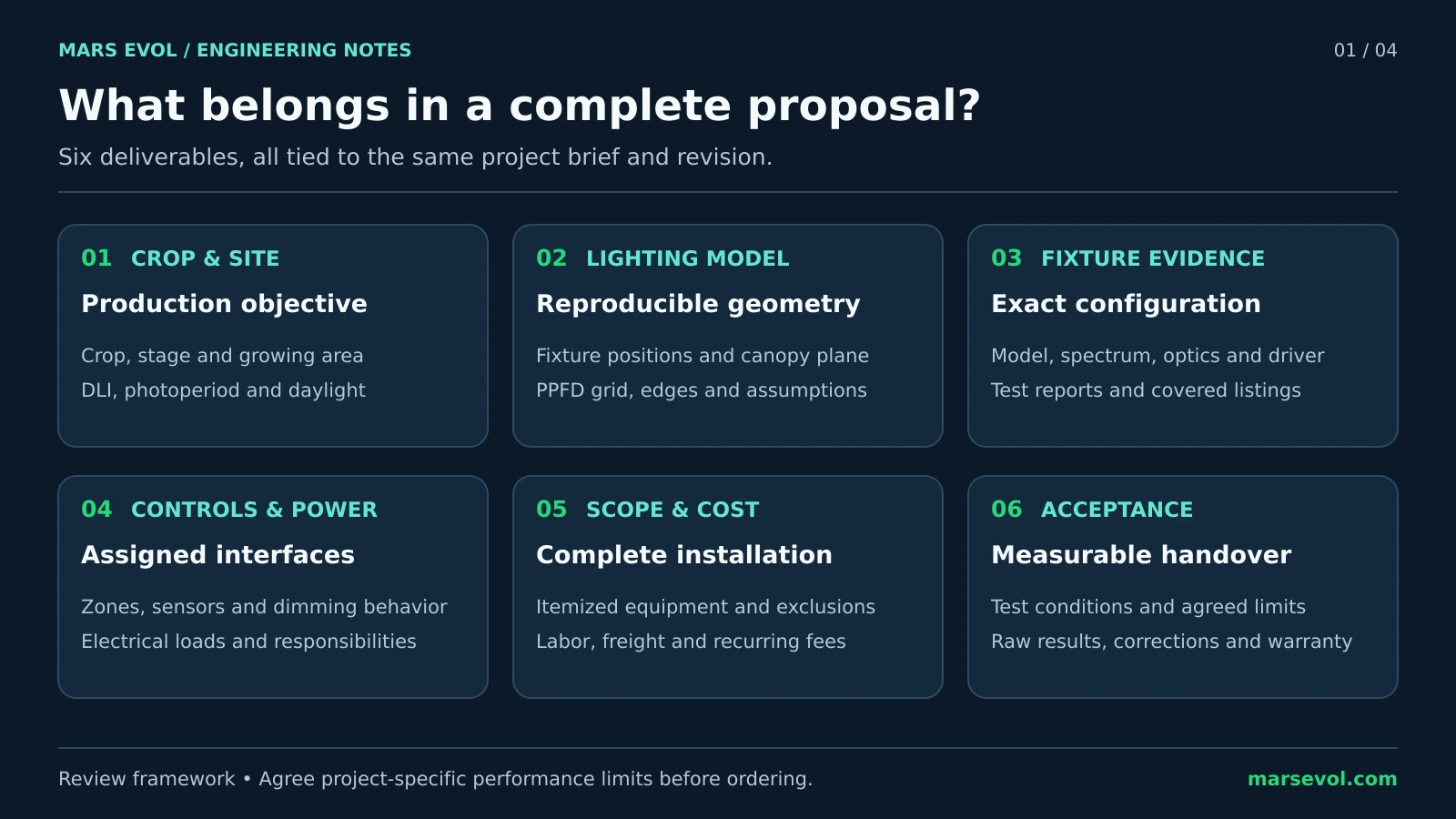
A greenhouse lighting proposal is useful when the grower, designer, installer and purchasing team can work from the same evidence. A fixture price and a colorful layout leave important questions unanswered. This checklist focuses on the documents needed to request and complete a proposal, before comparing suppliers or negotiating the final commercial offer.
What Should You Send Before Requesting a Greenhouse Lighting Proposal?
Send a dated project brief with drawings and operating targets. Identify an owner for missing information so estimates do not silently become design requirements.
| Project input | What to provide |
|---|---|
| Crop and purpose | Species, cultivar, growth stage, planting density, harvest objective or research treatment. |
| Geometry | Bay and bench dimensions, cropped area, aisles, canopy heights, mounting limits, screens and structural obstructions. |
| Light and operating window | Crop-approved DLI target, allowable photoperiod, existing lighting and seasonal daylight measurements. |
| Services and responsibilities | Location, supply voltage and phase, available electrical capacity, climate computer, installation owner and required completion date. |
Use daylight measured inside the greenhouse at crop level. Outdoor weather data needs a documented transmission model before it represents the crop. Purdue Extension explains why a single light reading cannot describe daily exposure. [1] Use the DLI calculation guide to prepare a transparent seasonal light budget.
For mixed crops, prepare separate requirements by zone. A single greenhouse-wide target can hide incompatible photoperiods or different growth stages.
Greenhouse Lighting Proposal Checklist: 10 Essential Checks
Use these ten checks to review a greenhouse lighting proposal. These are MarsEVOL review recommendations; project-specific performance limits must be agreed by the parties.
1. Is the crop requirement measurable?
State total DLI, the supplemental-light contribution, allowed operating hours and any instantaneous PPFD ceiling. Identify the season and production stage. Keep agronomic expectations, such as faster harvest, separate from equipment guarantees unless a defined crop trial supports them.
2. Can another reviewer reproduce the layout?
Request a dimensioned drawing with fixture coordinates, mounting height above the declared canopy plane, aiming, orientation and growing-area boundaries. Include aisle exclusions, screens, obstructions, reflectance assumptions, calculation grid and software revision. Ask for the input distribution file and its matching spectrum or validated photon conversion when a photometric file is used. A generic lux-to-PPFD factor is insufficient.
AHDB’s lighting-tool review illustrates why application geometry and installed cost belong in the assessment alongside fixture performance. [2] Treat the submitted model as a prediction to verify after installation.
3. Are average PPFD and uniformity defined together?
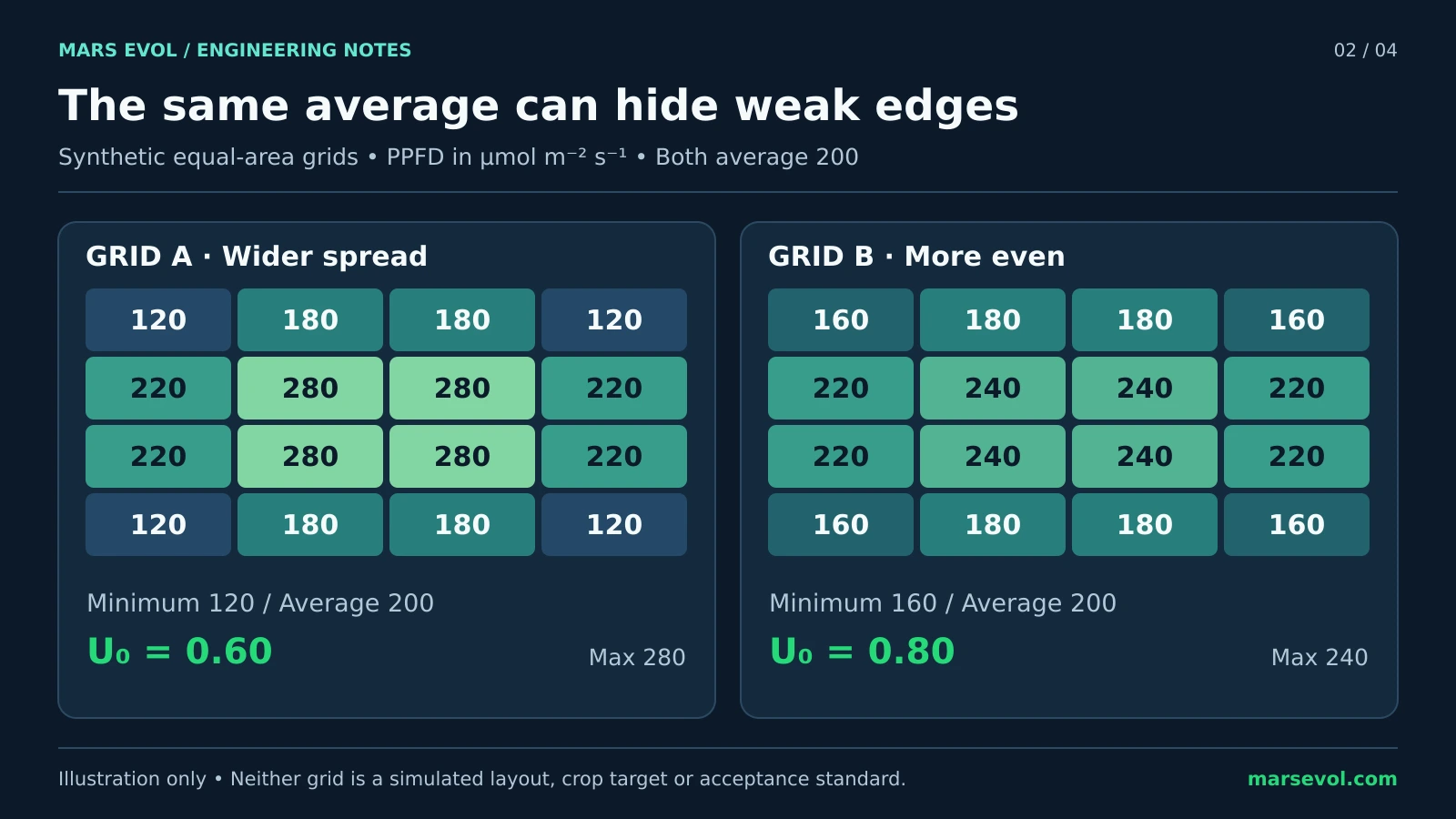
Ask for average, minimum and maximum PPFD, the raw grid, and the exact uniformity equation. Specify whether results cover crop surfaces, entire bays or selected interior cells. For irregular grids, explain area weighting. Report edge performance instead of removing inconvenient points after calculation.
Define the metric
U₀ = minimum PPFD ÷ average PPFD
Both values must use the same declared measurement plane, area and lighting state.
A minimum of 160 and average of 200 µmol m⁻² s⁻¹ gives U₀ of 0.80. This is an illustration, not a universal crop requirement. For practical bench layouts, see the greenhouse bench lighting guide.
4. Does the evidence match the quoted fixture?
Require the full model code, spectrum, optics, driver, voltage, rated input power and test conditions. Distinguish whole-fixture photon efficacy from LED-package efficacy. State the wavelength band for each photon metric; do not substitute an extended-band result for a 400–700 nm requirement.
ASABE S640 provides plant-radiation quantities and units. [3] The cited DLC horticultural V4.0 document addresses performance, controllability and safety evidence, including ANSI/UL 8800 certification. [4] Where qualification or certification is claimed, request the matching listing and covered configuration. A logo on a brochure is not model-specific evidence.
5. Are mounting and environmental conditions covered?
Document supports, fixture weight, clearances, cable routing, cleaning access and interference with moving screens. Match the proposed orientation and ambient conditions to manufacturer instructions. Ask which exposure conditions are covered, including condensation or cleaning chemicals where relevant. An ingress-protection rating alone does not answer every environmental question.
6. Is the control interface fully specified?
Identify zones, sensor locations, dimming limits, connectors, control ownership and the intended response to sensor or network failure. Request a tested compatibility statement for the proposed fixture and controller combination. “0–10 V” alone does not establish dim-to-off behavior, independent spectral channels or cloud-independent operation. The greenhouse dimming and zone-control guide explains the interface questions to resolve.
7. Are electrical responsibilities assigned?
Ask for connected load, driver input current, inrush data and the intended switching arrangement. Assign circuit design, protection, grounding, distribution equipment and local installation review to the responsible electrical professional. Confirm voltage and phase at the actual connection point. Keep this information in the proposal without treating a lighting estimate as a finished electrical design.
8. Does the price cover a working installation?
Make the greenhouse lighting proposal explicit with an itemized bill of materials and a responsibility table. Include fixtures, drivers, brackets, cabling, connectors, sensors, gateways, software, commissioning and training. Show freight, import responsibilities, taxes, installation labor, lifting equipment, spares and recurring fees separately. Identify every exclusion and the party responsible for pricing it.
9. Are operating costs and incentives conditional?
Require the runtime model, electricity tariff, dimming assumptions and separate treatment of heating, cooling and demand charges. Keep unapproved incentives outside the committed net price. Name the program, applicant, required documents and approval milestone.
For example, Ontario’s Save on Energy describes formal application pre-approval and lists a required worksheet for its vegetable top-lighting measure. [5] [6] Check the current program before committing; those documents do not establish eligibility for another location or any particular MarsEVOL model.
10. Are acceptance and after-sales obligations explicit?
Agree the measurement protocol, tolerances, correction process and final records before ordering. Confirm warranty start date, covered components, output-maintenance terms, labor, freight and claim procedures. Specify spare availability and support response. A stated service life is not automatically an equivalent warranty, and a successful power-on test does not verify canopy performance.
How Can You Check a Greenhouse Lighting Proposal’s Arithmetic?
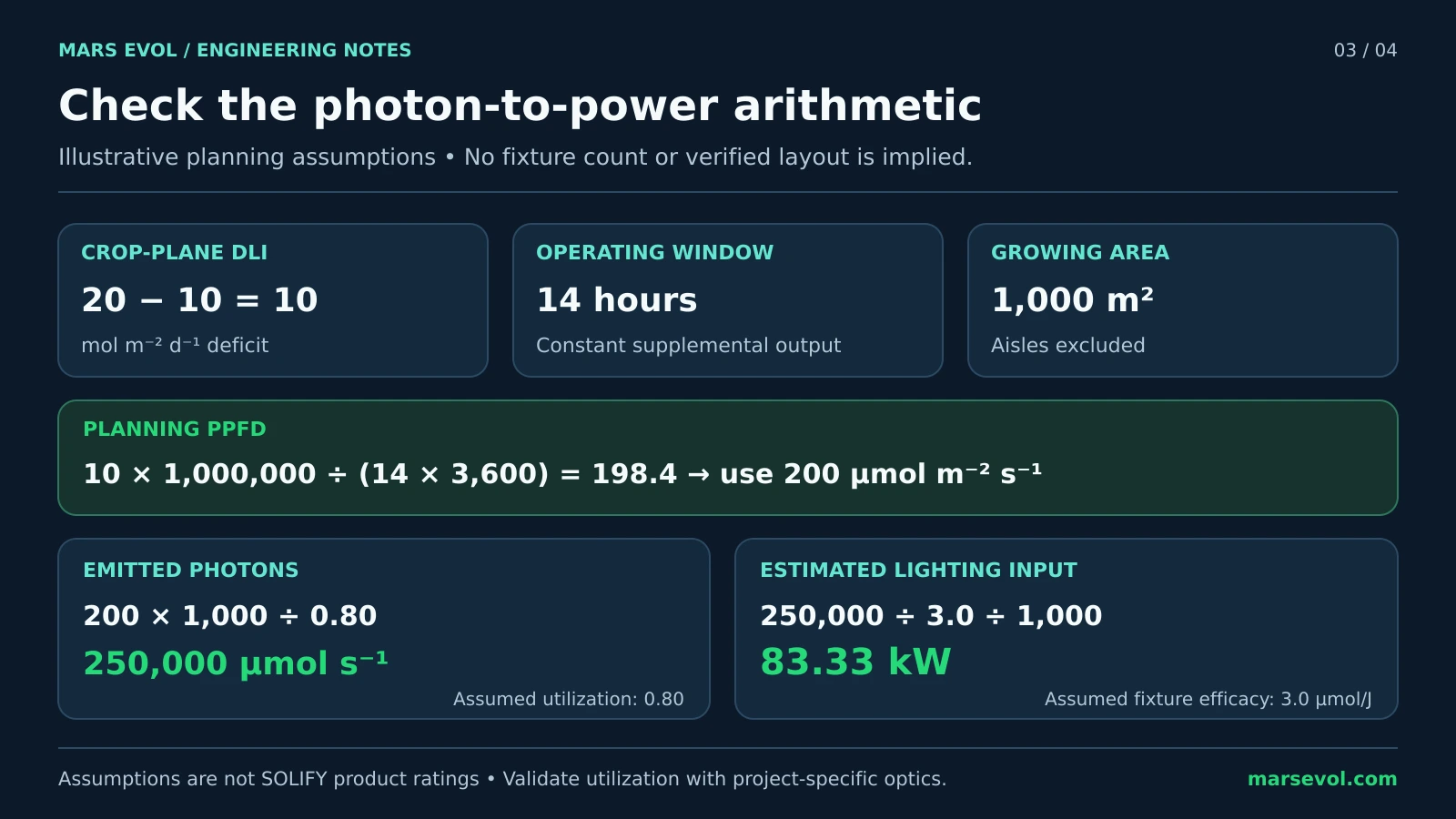
Trace one consistent set of assumptions from the crop target to estimated power. The following is an original planning example, not a product specification, crop prescription or validated layout.
| Illustrative input | Assumption |
|---|---|
| Growing area | 1,000 m², excluding aisles |
| Total target / daylight DLI | 20 / 10 mol m⁻² d⁻¹ at the crop plane |
| Supplemental-light window | 14 hours at constant output |
| Fixture photon efficacy | 3.0 µmol/J, including its driver |
| Utilization factor | 0.80 of emitted 400–700 nm photons reaches the defined growing plane |
Step 1 · Supplemental-light requirement
DLI deficit = 20 − 10 = 10 mol m⁻² d⁻¹
Required PPFD = 10 × 1,000,000 ÷ (14 × 3,600)
≈ 198.4 µmol m⁻² s⁻¹
Round to 200 µmol m⁻² s⁻¹ for the remaining planning calculation. At 14 hours, that supplies 10.08 mol m⁻² d⁻¹.
Step 2 · Emitted photons and input power
Required PPF = 200 × 1,000 ÷ 0.80
= 250,000 µmol s⁻¹
Lighting power = 250,000 ÷ 3.0 ÷ 1,000
≈ 83.33 kW
The 0.80 factor is an assumed delivery fraction, not a measured value, crop absorption fraction or standard design allowance.
This checks aggregate arithmetic only. Actual fixture count, edge coverage, mounting limits and distribution data can change the result. A supplier must justify utilization through the project model. Use the mounting-height and spacing guide to review the physical arrangement.
Step 3 · One operating scenario
Energy = 83.333… kW × 14 h/day × 180 days
= 210,000 kWh
Energy charge = 210,000 × US$0.12/kWh
= US$25,200
Illustrative energy-only charge. Uses unrounded power; excludes controls, upstream losses, demand charges, taxes, climate loads and maintenance.
The 180-day schedule is an assumed scenario, not an annual forecast. Daylight-responsive dimming changes runtime and power. Request seasonal logs or a documented operating model, then test sensitivity to daylight, tariffs and utilization. Do not attach a yield increase or payback claim to this arithmetic without additional evidence.
How Should Acceptance Be Written?
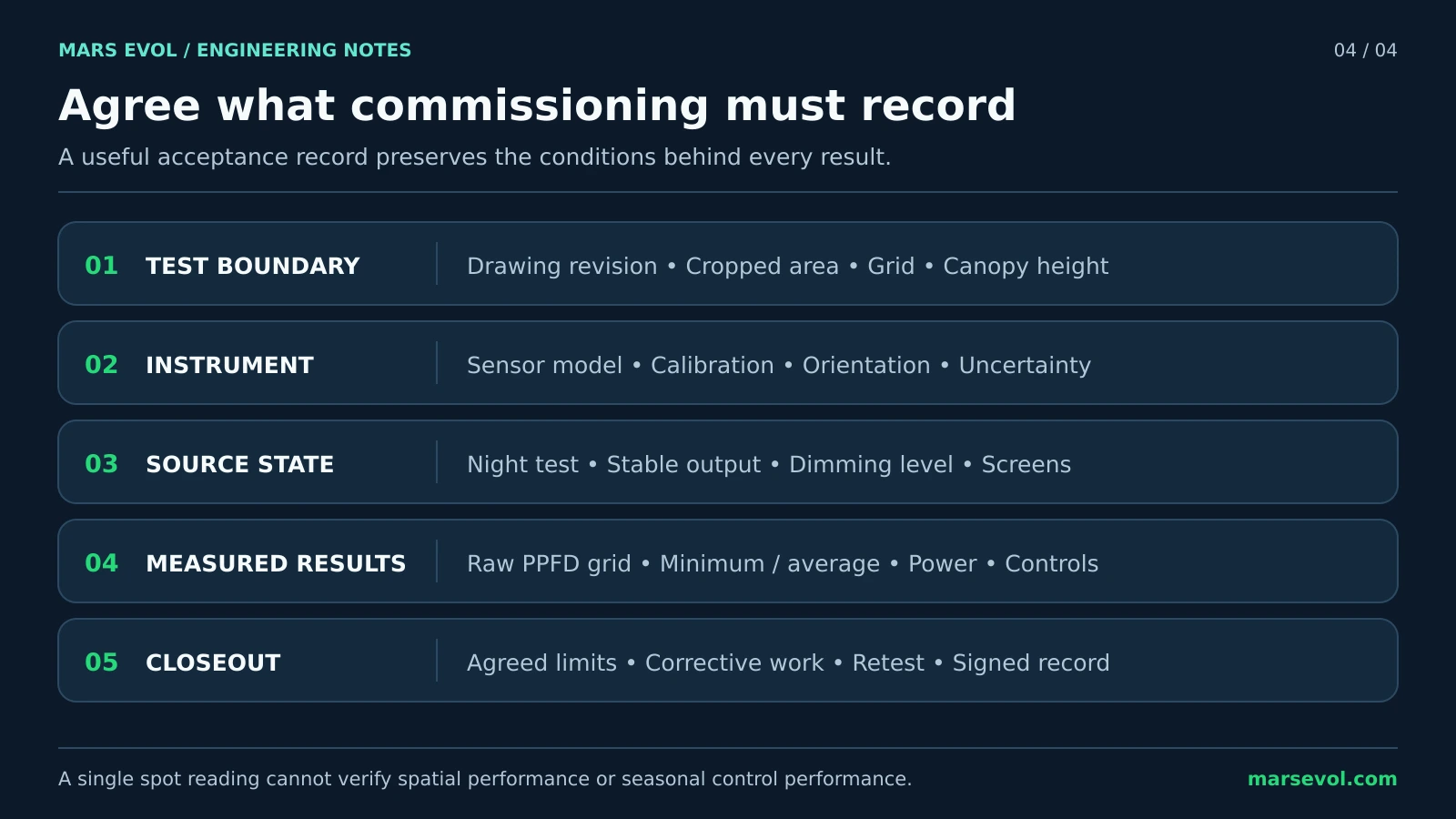
The greenhouse lighting proposal should define test conditions and pass criteria before installation. The same nominal PPFD means little if the supplier and customer use different planes, source states or grid boundaries.
| Acceptance record | Information to agree |
|---|---|
| Test boundary | Drawing revision, cropped polygon, canopy height, grid spacing and sensor orientation. |
| Measurement conditions | Calibrated sensor model, spectral suitability, stabilization, dimming level and screen position; use night conditions for electric-only mapping. |
| Results | Raw point readings, average/minimum/maximum, defined uniformity ratio, power and functional control checks. |
| Pass and correction | Negotiated limits, measurement uncertainty, responsible reviewer, corrective work, retest conditions and signed handover. |
Sensor response matters: LI-COR documents spectral response, cosine correction and calibration accuracy for its quantum sensor. [7] Record the instrument and uncertainty rather than assuming every handheld meter produces interchangeable results. Follow a fixed PPFD mapping protocol and retain the raw file.
If daytime measurement is unavoidable, document a method that separates electric light from changing daylight and quantify its uncertainty. A quick before-and-after reading under moving clouds can give a misleading result.
Research facilities should also require timestamped settings, repeatable treatment records and change control, as discussed in the research greenhouse lighting guide. Verify spatial delivery and daily control performance separately: a nighttime map does not validate a seasonal DLI strategy.
What If a Greenhouse Lighting Proposal Is Incomplete?
Issue a clarification list with owners and due dates. Keep the proposed configuration unchanged while questions are resolved; record substitutions as a new revision.
| Review status | Next action |
|---|---|
| Complete and traceable | Proceed to the agreed technical and commercial review. |
| Assumptions still open | Request evidence or revised calculations; retain a budgetary status. |
| Critical mismatch | Hold equipment commitment until crop targets, model identity, interfaces or acceptance conditions are corrected. |
For each gap, record the question, supplier response, evidence reference, decision owner and closure date. This prevents an unanswered email from becoming a hidden installation assumption.
Common Mistakes That Weaken a Proposal
- Changing the comparison area: excluding low-light crop edges makes results look better without improving the crop.
- Mixing photon metrics: fixture PPF does not equal PPFD at the canopy.
- Leaving interfaces unpriced: a sensor or gateway may be essential but excluded.
- Counting benefits twice: avoid overlapping dimming, runtime and replacement savings.
- Deferring acceptance: agree how results will be judged before equipment arrives.
FAQ
Is a fixture quotation a complete greenhouse lighting proposal?
No. It becomes actionable when it includes a project-specific layout, performance evidence, interfaces, scope and acceptance conditions. A product-only quotation can support early budgeting.
What if I have no measured daylight data?
Mark the daylight estimate as provisional. Request a measurement plan or a documented transmission model, and show how a lower-light scenario changes the design.
Should every proposal guarantee yield?
No. Lighting delivery can be specified and tested; yield depends on crop genetics, climate, nutrition and management. A yield commitment needs a separate agreed trial and comparison basis.
Is 0.80 uniformity always required?
No. Choose the metric and target for the crop and project. The example here uses minimum divided by average; another definition can produce a different number.
Does DLC listing guarantee an incentive?
No. Confirm the exact model, project, applicant and current program requirements. Obtain the required approvals rather than treating a qualification listing as a promised payment.
Can commissioning be accepted with one meter reading?
One reading cannot establish spatial distribution. Use the agreed grid and operating state, and include functional controls and electrical records in the handover.
MarsEVOL Perspective: Make the Deliverable Clear
MarsEVOL treats a greenhouse lighting proposal as a coordinated design package. Discuss the appropriate SOLIFY fixture and HARVESTATION control configuration against your actual crop and site brief. The official SOLIFY PRO product page identifies a compact greenhouse fixture with 0–10 V dimming; confirm the exact offered model and its supporting documentation.
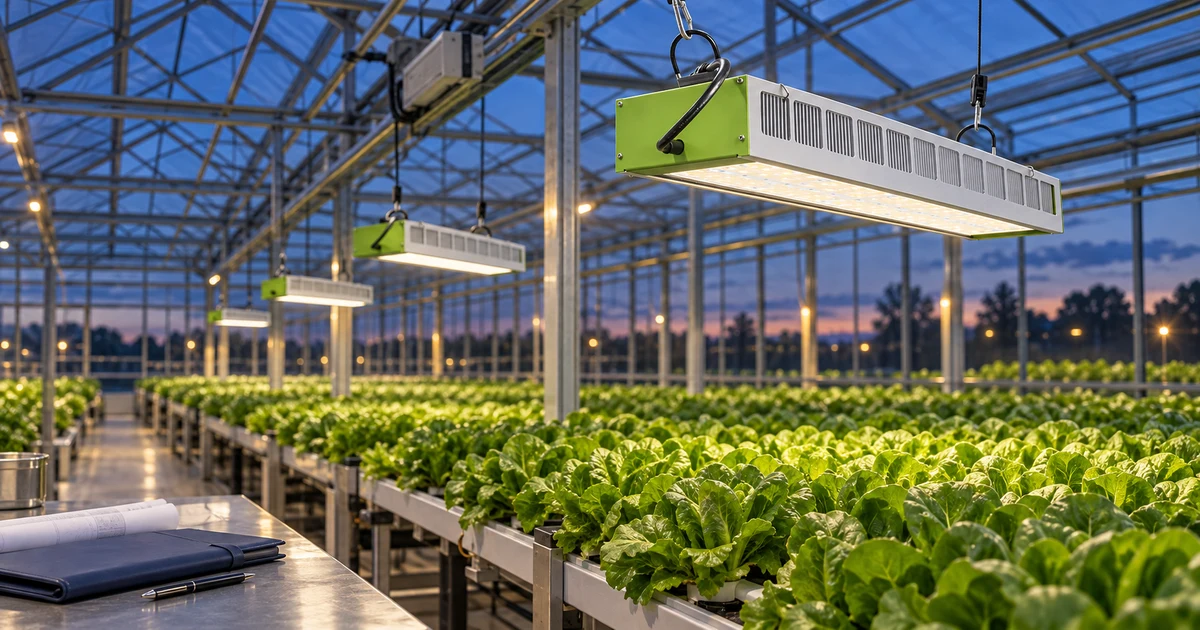
The illustrative 3.0 µmol/J efficacy in this article is not a SOLIFY PRO rating. The AI-generated cover uses official product imagery as a shape reference and does not document a customer installation.
Conclusion
A useful greenhouse lighting proposal leaves a clear path from crop requirements to installed-system acceptance. Start with a shared brief, request reproducible evidence, assign interfaces and complete the cost scope. Resolve material assumptions before ordering so commissioning checks an agreed result.
Preparing a Greenhouse Lighting Request?
Send your crop, location, greenhouse drawing, growing area, canopy height, target light conditions and available power. Include your control requirements and installation timetable.
Explore More MarsEVOL Resources
Connect growing-area boundaries, mounting and optical distribution.
Discuss zones, DLI operating logic and verified fixture interfaces.
References
- Torres, A. P., and Lopez, R. G.. Measuring Daily Light Integral in a Greenhouse. Purdue Extension, HO-238-W (2010).
- Agriculture and Horticulture Development Board (AHDB). LED Lighting Calculators. GrowSave technical review. Accessed September 12, 2026.
- American Society of Agricultural and Biological Engineers. Quantities and Units of Electromagnetic Radiation for Plants (Photosynthetic Organisms). ANSI/ASABE S640, July 2017; official scope and terminology reference.
- DesignLights Consortium. Technical Requirements for LED-based Horticultural Lighting V4.0. Released March 11, 2025; revised October 1, 2025. Cited edition; verify the applicable version for a new application.
- Independent Electricity System Operator, Save on Energy. Frequently Asked Retrofit Questions. Official program guidance, including application pre-approval. Accessed September 12, 2026.
- Independent Electricity System Operator, Save on Energy. Application Documents for the Retrofit Program. Official horticultural worksheet requirements. Accessed September 12, 2026.
- LI-COR Environmental. LI-190R Quantum Sensor. Official measurement principles and specifications. Accessed September 12, 2026.