
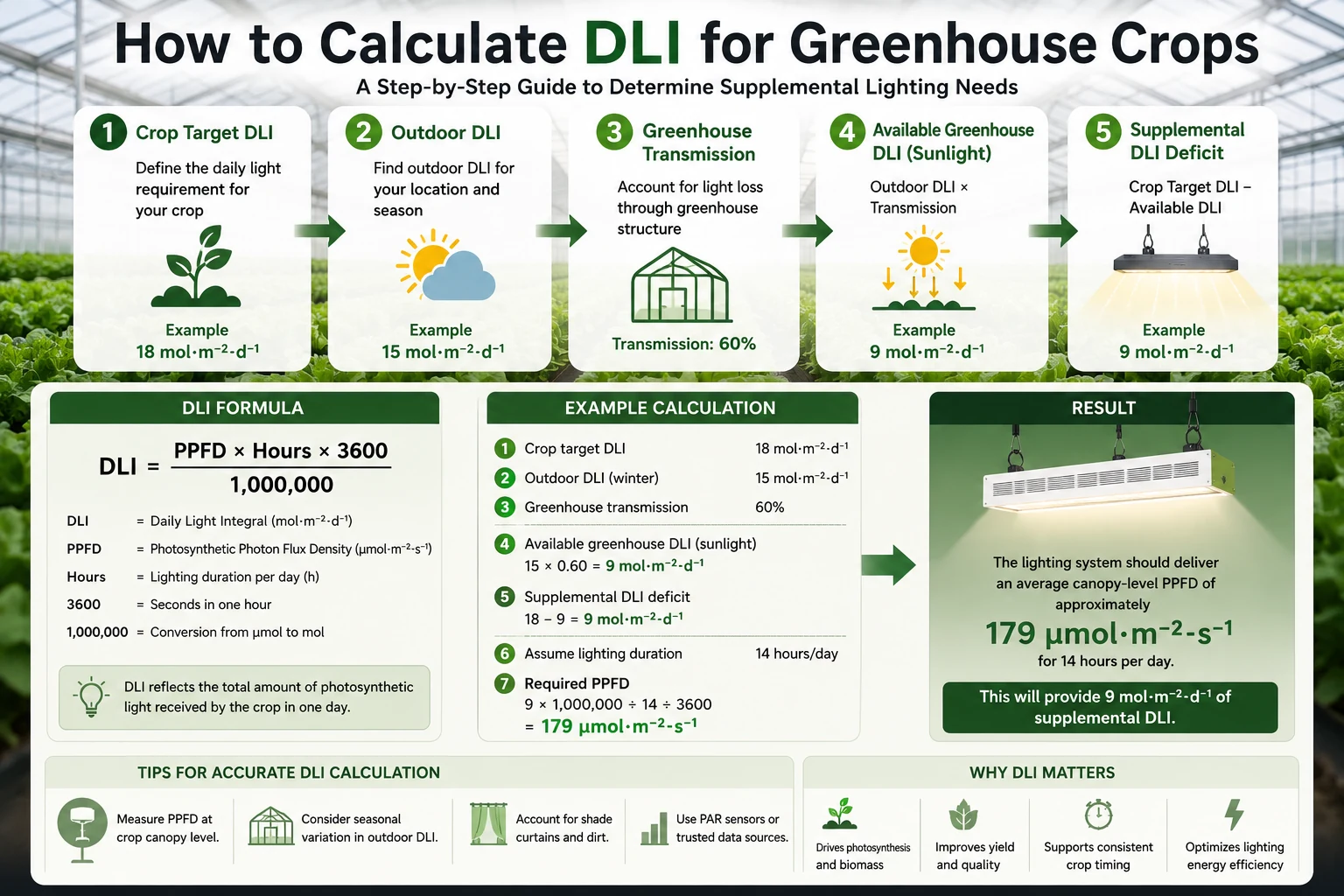
Calculate DLI by multiplying average canopy-level PPFD by the number of lighting hours and by 0.0036. For example, 250 μmol·m⁻²·s⁻¹ delivered for 12 hours contributes 10.8 mol·m⁻²·d⁻¹. For a greenhouse project, first estimate or measure the sunlight DLI reaching the crop, subtract it from the crop target DLI, and then convert the remaining deficit into required electric-light PPFD or runtime.
Last reviewed: August 2, 2026 · Technical topic: greenhouse DLI calculation and supplemental-light sizing
Key Takeaways
- DLI is the total photosynthetic light received during a day; PPFD is the light intensity at a specific moment.
- For constant PPFD, DLI = PPFD × hours × 0.0036.
- Use average PPFD at the crop canopy—not fixture wattage, fixture PPF, or a single hot-spot reading.
- Outdoor DLI must be adjusted for greenhouse transmission, or replaced with measured crop-level DLI.
- Supplemental-light demand equals crop target DLI minus available greenhouse sunlight DLI.
- The final PPFD target must be translated into a verified fixture layout, uniformity plan, operating schedule, and control strategy.
Daily Light Integral, or DLI, is one of the most useful planning metrics in greenhouse crop lighting because it connects crop requirements, changing sunlight, electric-light intensity, and operating time. A grower may know that a luminaire is powerful, but that information alone does not show how much useful light reaches the crop during an entire day. DLI provides that daily total.
This guide explains how to calculate DLI for greenhouse crops and how to use the result when sizing supplemental lighting. It focuses on the engineering workflow: define the crop target, estimate or measure sunlight at canopy level, calculate the remaining deficit, convert that deficit into electric-light PPFD or runtime, and then verify the design through layout simulation and field measurements.
For a direct comparison of the two main metrics, review PPFD vs DLI in greenhouse lighting. PPFD is needed to describe the instantaneous intensity reaching the canopy; DLI is needed to describe the accumulated daily dose.
1. What Does DLI Measure?
DLI measures the total number of photosynthetically active photons received by one square meter during one day. It is normally expressed as mol·m⁻²·d⁻¹.
A useful analogy is rainfall. PPFD is similar to the rain rate at one moment, while DLI is similar to the total amount collected in a rain gauge over the day. A brief period of high PPFD and a longer period of moderate PPFD can sometimes deliver the same DLI, although crop response can still be influenced by photoperiod, temperature, CO₂, spectrum, and the timing of the light.
| Metric | What it describes | Typical unit | Design use |
|---|---|---|---|
| PPFD | Instantaneous photon flux reaching the crop canopy | μmol·m⁻²·s⁻¹ | Intensity, distribution, uniformity, and measurement |
| DLI | Total photosynthetic photon exposure accumulated during a day | mol·m⁻²·d⁻¹ | Daily crop target, sunlight deficit, and operating strategy |
| PPF | Total photosynthetic photon output from a fixture | μmol·s⁻¹ | Fixture output comparison; not a direct crop-level DLI value |
DLI targets are not universal. They vary by crop, cultivar, growth stage, production objective, season, temperature, CO₂ concentration, and management strategy. Use crop research and production experience to define the target before selecting fixtures or setting runtime.
2. The Basic DLI Formula
When PPFD is reasonably constant during the selected lighting period, DLI can be calculated from average canopy-level PPFD and time:
The factor 3600 converts hours to seconds, and division by 1,000,000 converts micromoles to moles. The PPFD value should represent the average electric-light intensity at the crop canopy over the stated calculation area—not the value directly below one luminaire.
Example: 250 μmol·m⁻²·s⁻¹ for 12 hours
The electric-light system contributes approximately 10.8 mol·m⁻²·d⁻¹. The crop’s total DLI will also include sunlight that reaches the canopy during the same day.
DLI contribution at several constant PPFD levels
| Average canopy PPFD | Operating time | Electric-light DLI |
|---|---|---|
| 150 μmol·m⁻²·s⁻¹ | 10 h | 5.4 mol·m⁻²·d⁻¹ |
| 200 μmol·m⁻²·s⁻¹ | 12 h | 8.64 mol·m⁻²·d⁻¹ |
| 250 μmol·m⁻²·s⁻¹ | 12 h | 10.8 mol·m⁻²·d⁻¹ |
| 300 μmol·m⁻²·s⁻¹ | 14 h | 15.12 mol·m⁻²·d⁻¹ |
| 400 μmol·m⁻²·s⁻¹ | 12 h | 17.28 mol·m⁻²·d⁻¹ |
Real sunlight is not constant. When PPFD changes throughout the day, DLI should be calculated by integrating the sensor readings over time. A data logger or environmental-control platform can perform this accumulation automatically. A single midday PPFD reading should not be multiplied by the full day length and treated as the daily sunlight DLI.
3. How Do You Estimate Greenhouse Sunlight DLI?
Start with the amount of sunlight that actually reaches the crop canopy. Outdoor DLI maps and weather data are useful for early planning, but the greenhouse structure reduces and redistributes incoming light. Glazing, frame members, gutters, trusses, shade or energy curtains, dust, condensation, equipment, crop geometry, solar angle, and maintenance condition can all affect transmission.
A simplified planning estimate is:
If outdoor DLI is 20 mol·m⁻²·d⁻¹ and the effective transmission assumption is 60%, the estimated crop-level sunlight DLI is:
20 × 0.60 = 12 mol·m⁻²·d⁻¹
For better accuracy, measure PPFD or accumulated DLI inside the greenhouse at representative canopy locations. Document the sensor type, calibration, measurement interval, crop stage, curtain position, glazing condition, weather, and measurement plane. The MarsEVOL guide to greenhouse covering materials and light transmission explains why nominal material transmission and installed crop-level transmission are not always the same.
4. How Do You Calculate the Supplemental DLI Deficit?
Once the crop target and available sunlight contribution are defined, calculate the daily deficit:
For example, if the crop target is 17 mol·m⁻²·d⁻¹ and the measured or estimated greenhouse sunlight contribution is 12 mol·m⁻²·d⁻¹:
17 − 12 = 5 mol·m⁻²·d⁻¹
The electric-light system must contribute approximately 5 mol·m⁻²·d⁻¹ to close the daily gap. On a brighter day, the deficit may be smaller; on a cloudy winter day, it may be larger. This is why a single fixed annual runtime is often less efficient than sunlight-aware operation.
5. How Do You Convert Supplemental DLI into PPFD or Runtime?
Convert DLI deficit into required PPFD
When the available operating window is known, calculate the required average electric-light PPFD:
For a deficit of 5 mol·m⁻²·d⁻¹ delivered over 10 hours:
5 ÷ (10 × 0.0036) ≈ 139 μmol·m⁻²·s⁻¹
Convert DLI deficit into runtime
When the installed or modeled average electric-light PPFD is known, calculate the approximate runtime:
For a deficit of 8 mol·m⁻²·d⁻¹ and an average electric-light PPFD of 200 μmol·m⁻²·s⁻¹:
8 ÷ (200 × 0.0036) ≈ 11.1 hours
For a more detailed explanation of runtime assumptions and variable sunlight, see how to calculate greenhouse supplemental-lighting runtime.
6. Complete Worked Example for a Greenhouse Crop
Consider a crop with a target DLI of 18 mol·m⁻²·d⁻¹ during a winter production stage. The estimated outdoor DLI for the design condition is 15 mol·m⁻²·d⁻¹, and the documented effective greenhouse transmission is 60%. The planned electric-light operating window is 14 hours.
| Step | Input or calculation | Result |
|---|---|---|
| 1. Crop target | Defined from crop and production objective | 18 mol·m⁻²·d⁻¹ |
| 2. Outdoor DLI | Representative winter planning value | 15 mol·m⁻²·d⁻¹ |
| 3. Greenhouse sunlight | 15 × 0.60 | 9 mol·m⁻²·d⁻¹ |
| 4. Supplemental deficit | 18 − 9 | 9 mol·m⁻²·d⁻¹ |
| 5. Required PPFD | 9 ÷ (14 × 0.0036) | ≈179 μmol·m⁻²·s⁻¹ |
The lighting system should therefore be designed to provide approximately 179 μmol·m⁻²·s⁻¹ of average supplemental PPFD at the crop canopy during the selected operating period. This is a design target—not yet a fixture count.
The next step is to translate the target into fixture selection, mounting height, spacing, optical overlap, edge treatment, electrical zones, and dimming capacity. Use the MarsEVOL greenhouse lighting layout design guide to develop and verify that geometry. A model should report at least average, minimum, and maximum PPFD, the full PPFD map, uniformity, boundary losses, canopy-height assumptions, and connected load.
7. Common Mistakes When Calculating DLI
Mistake 1: Using outdoor DLI as crop-level DLI
Outdoor data does not include greenhouse transmission losses. Apply a documented transmission assumption during concept design and replace it with measured crop-level data when practical.
Mistake 2: Using fixture wattage or PPF as canopy PPFD
Wattage describes electrical input, while PPF describes total photon output. Neither shows how photons are distributed across the crop. Use simulated or measured average canopy PPFD over a defined area.
Mistake 3: Multiplying one midday PPFD reading by the whole day
Sunlight changes continuously. Accumulate time-series readings or use a sensor and data logger that calculates DLI.
Mistake 4: Ignoring uniformity
Two layouts can have the same average PPFD but very different minimum values and spatial patterns. Poor uniformity can produce uneven crop response and reduce research repeatability.
Mistake 5: Treating transmission as a fixed material constant
Installed transmission depends on more than the covering product. Structure, angle of incidence, dirt, condensation, curtains, aging, and internal equipment also matter.
Mistake 6: Using one crop target for every stage and season
Targets should reflect crop type, cultivar, stage, production objective, environmental setpoints, and economic priorities. Recalculate representative seasonal cases rather than designing from one convenient month.
Mistake 7: Ignoring photoperiod and operational constraints
A mathematical runtime may conflict with crop dark-period requirements, electricity tariffs, labor schedules, temperature management, or utility demand limits. Coordinate the lighting calculation with the complete production strategy.
8. From DLI Calculation to Greenhouse Lighting Design
A DLI calculation is the beginning of the design process, not the end. A professional greenhouse supplemental-lighting workflow should connect the following items:
- crop, cultivar, stage, and production objective;
- target DLI and acceptable operating window;
- representative outdoor sunlight data;
- effective greenhouse transmission or measured canopy-level DLI;
- supplemental DLI deficit;
- required electric-light PPFD and runtime range;
- fixture distribution, layout, mounting height, and uniformity;
- electrical capacity, control zones, dimming, and sensing;
- commissioning measurements and seasonal operating adjustments.
The MarsEVOL overview of greenhouse supplemental lighting explains how these elements fit together. After the system is installed, sunlight-aware dimming and daily accumulation can reduce unnecessary operation while maintaining the crop target. The guide to DLI lighting control describes how sensors, control zones, and end-of-day targets can support that strategy.
Need a Project-Level DLI and PPFD Plan?
MarsEVOL supports commercial growers, greenhouse designers, integrators, and research teams with crop-light requirement review, greenhouse transmission assumptions, supplemental DLI calculations, canopy-level PPFD planning, fixture layout, and control recommendations.
FAQ: How to Calculate DLI for Greenhouse Crops
What is the formula for DLI?
For a constant average PPFD, DLI = PPFD × lighting hours × 0.0036. The result is expressed in mol·m⁻²·d⁻¹.
What PPFD value should be used?
Use the average PPFD reaching the crop canopy over the defined production area and operating condition. Do not substitute fixture wattage, total PPF, or the maximum PPFD directly beneath a fixture.
How is sunlight DLI measured in a greenhouse?
Use a calibrated quantum sensor at a representative canopy plane and accumulate readings over time with a data logger or environmental-control system. Multiple locations may be needed where greenhouse geometry or shading creates different light zones.
How do you calculate supplemental DLI?
Subtract the available greenhouse sunlight DLI from the crop target DLI. When the result is below zero, supplemental photosynthetic lighting is not required to close a DLI deficit for that day, although other production objectives may still affect operation.
How do you convert DLI to required PPFD?
Required PPFD = supplemental DLI ÷ (lighting hours × 0.0036). Verify that the resulting average PPFD can be delivered with acceptable uniformity and without violating crop or operational constraints.
Can the same lighting schedule be used every day?
A fixed schedule is simple but may over-light bright days and under-light cloudy days. Sunlight-aware dimming or DLI-based control can adjust electric-light contribution according to accumulated daily sunlight and the remaining target.
References
- Torres, A. P., and Lopez, R. G. Measuring Daily Light Integral in a Greenhouse. Purdue University Extension.
- Virginia Cooperative Extension. Calculating and Using Daily Light Integral: An Introductory Guide.
- Faust, J. E., and Logan, J. Daily Light Integral: A Research Review and High-Resolution Maps of the United States. HortScience.
- Michigan State University Extension. Daily Light Integral Defined.
- Apogee Instruments. Daily Light Integral: Measuring Light for Plants.