
Winter and cloudy seasons create one of the most common lighting challenges in greenhouse production: crops may receive enough protection from the greenhouse structure, but not enough daily photosynthetic light.
This is why greenhouse supplemental lighting in winter is not simply a productivity upgrade. For many crops and regions, it can become an important part of maintaining crop quality, production timing, and predictable growth.
Greenhouse crops depend on sunlight, but sunlight is not constant. It changes with season, latitude, cloud cover, day length, solar angle, greenhouse glazing, structural shading, shade curtains, and local weather patterns.
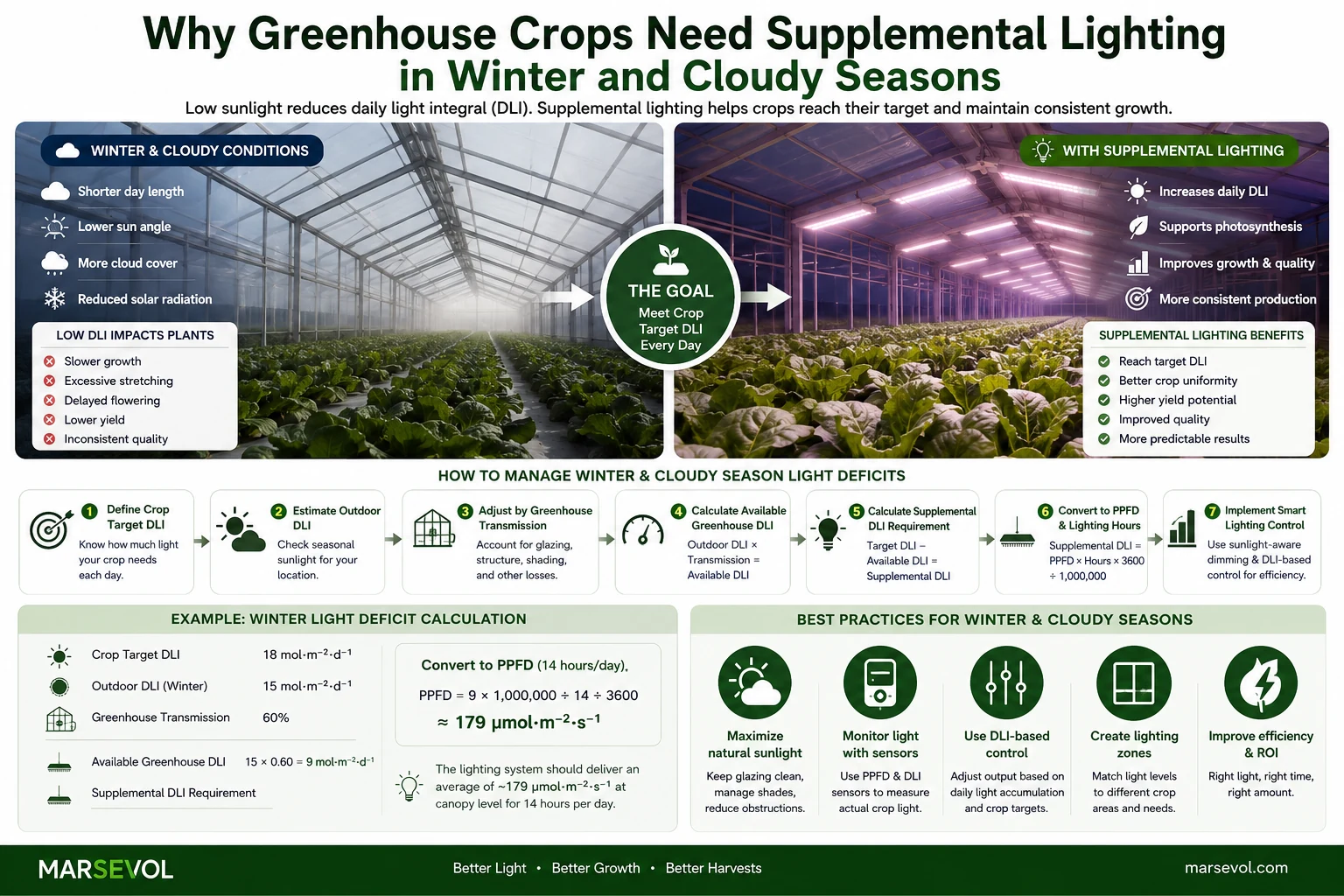
During winter and extended cloudy periods, the available Daily Light Integral, or DLI, may fall below the crop’s target light requirement. When this happens, crops can grow more slowly, stretch excessively, produce less biomass, flower later, or show inconsistent quality.
This article explains why greenhouse crops need supplemental lighting in winter and cloudy seasons, how low DLI affects crop performance, and how growers can design a more practical light management strategy using DLI, PPFD, runtime, and smart control.
Quick Answer
Greenhouse crops need supplemental lighting in winter and cloudy seasons because natural sunlight often cannot provide enough daily photosynthetic light to meet crop target DLI.
Supplemental lighting helps close the gap between available greenhouse sunlight and the crop’s daily light requirement.
Key Takeaways
- Winter reduces daily light availability. Shorter days and lower solar angles reduce the amount of sunlight reaching greenhouse crops.
- Cloudy weather can sharply reduce DLI. Even during the growing season, extended cloudy periods can create temporary light deficits.
- Low DLI affects crop performance. Crops may grow more slowly, stretch, flower later, or show inconsistent quality when daily light is insufficient.
- Supplemental lighting should be based on DLI deficit. Growers should estimate crop target DLI, available greenhouse DLI, and the required supplemental DLI contribution.
- Smart lighting control improves efficiency. Sunlight-aware dimming and DLI-based control can reduce unnecessary lighting while maintaining crop light targets.
Winter-Specific Design Conditions to Check Before Setting a Schedule
A winter lighting plan should be based on the actual seasonal operating envelope, not a single annual-average sunlight value. The same greenhouse can require very different electric-light contributions on a clear cold day, a fully overcast day and a multi-day low-light sequence.
| Winter condition | What changes | Recommended operating response |
|---|---|---|
| Clear, short winter day | Strong midday sunlight but limited morning and evening contribution | Use dimming or scheduled shoulder-period lighting and avoid unnecessary midday output. |
| Overcast day | Low crop-level PPFD for most of the permitted photoperiod | Track accumulated DLI and increase electric contribution within the crop and equipment limits. |
| Several dark days in sequence | Repeated DLI shortfall can disrupt crop timing and consistency | Review the daily deficit trend, available fixture capacity and whether the target can be recovered without violating the dark period. |
Before commissioning a winter schedule, document crop target DLI, crop-level sunlight, greenhouse transmission under winter conditions, the allowed photoperiod, commissioned electric PPFD by zone and the response at each dimming level. Use the DLI calculation guide for the deficit, the runtime guide for operating hours, and the covering-material guide when glazing losses are uncertain.
1. Why Winter Is a Low-Light Season for Greenhouses
In winter, greenhouse crops face several light limitations at the same time.
Day length becomes shorter. The sun is lower in the sky. Solar radiation is weaker. Weather is often cloudier in many regions. Snow, condensation, dust, and greenhouse covering conditions can further reduce light transmission.
Even when the greenhouse temperature is controlled, the crop may still receive insufficient photosynthetic light.
This is especially important because plants respond not only to temperature and water, but also to the total amount of photosynthetic light received each day.
That daily total is described by DLI.
If winter sunlight cannot provide enough DLI, the crop may not reach its normal production potential.
2. Cloudy Seasons Can Create the Same Problem
Winter is not the only low-light condition.
Cloudy seasons, rainy periods, storms, fog, smoke, or long periods of overcast weather can reduce greenhouse light availability even outside winter.
For growers with tight production schedules, this creates an important challenge.
The greenhouse may still look bright to the human eye, but the crop may not receive enough photosynthetically active light to maintain target growth.
This is why professional greenhouse lighting should not rely on visual brightness alone.
The better approach is to evaluate crop-level PPFD and daily DLI.
3. The Key Problem: Low DLI
The main reason crops need supplemental lighting in winter and cloudy seasons is low DLI.
DLI stands for Daily Light Integral.
It describes the total amount of photosynthetically active light received by one square meter of crop area during one day.
DLI is commonly expressed as:
mol·m⁻²·d⁻¹
DLI answers this question:
How much photosynthetic light did the crop receive today?
When DLI is too low, the crop may not accumulate enough light energy to support the desired level of photosynthesis and growth.
4. What Happens When Greenhouse Crops Receive Too Little Light?
Low daily light can affect crop growth in several ways.
The specific response depends on crop type, cultivar, growth stage, temperature, CO₂ concentration, nutrition, and production objective.
Common effects of insufficient light include:
- slower growth rate;
- lower biomass accumulation;
- weaker root and shoot development;
- excessive stem elongation;
- delayed flowering;
- reduced flower number or fruit development;
- inconsistent crop timing;
- lower uniformity across the growing area;
- reduced crop quality and marketability.
For commercial growers, these effects can influence production scheduling, harvest timing, labor planning, and economic return.
For research greenhouses, low or inconsistent light can also reduce experimental repeatability.
5. Supplemental Lighting Is Not the Same as Photoperiod Lighting
One common mistake is confusing supplemental lighting with photoperiod lighting.
Photoperiod lighting is usually low-intensity lighting used to influence day length or flowering response.
Supplemental lighting is higher-intensity lighting used to increase the amount of photosynthetic light available to the crop.
In winter and cloudy seasons, the primary goal of greenhouse supplemental lighting is usually to increase DLI, not simply to extend perceived day length.
This distinction matters because a low-intensity photoperiod lamp may affect flowering response, but it may not provide enough photosynthetic light to meaningfully increase DLI.
6. How to Estimate the Winter Light Deficit
A practical greenhouse lighting strategy starts with the light deficit.
The basic workflow is:
- define the crop target DLI;
- estimate outdoor DLI for the location and season;
- adjust outdoor DLI by greenhouse transmission;
- calculate available greenhouse DLI;
- calculate supplemental DLI requirement;
- convert supplemental DLI into required PPFD and runtime.
The supplemental DLI requirement can be calculated as:
Supplemental DLI = Crop Target DLI − Available Greenhouse DLI
For example:
- Crop target DLI: 18 mol·m⁻²·d⁻¹
- Available greenhouse DLI in winter: 9 mol·m⁻²·d⁻¹
The supplemental DLI requirement is:
18 − 9 = 9 mol·m⁻²·d⁻¹
This means the supplemental lighting system should provide approximately 9 mol·m⁻²·d⁻¹ to close the winter light deficit.
7. Outdoor DLI Is Not the Same as Greenhouse DLI
When evaluating winter lighting needs, growers should not use outdoor DLI directly as crop-level DLI.
Light is reduced before it reaches the crop canopy.
Greenhouse light transmission can be reduced by:
- glazing material;
- roof structure;
- trusses and frame shadows;
- shade curtains;
- dust and condensation;
- hanging equipment;
- lighting fixtures themselves;
- crop canopy overlap.
A simplified estimate is:
Greenhouse DLI = Outdoor DLI × Greenhouse Transmission
For example, if outdoor DLI is 15 mol·m⁻²·d⁻¹ and greenhouse transmission is 60%:
15 × 0.60 = 9 mol·m⁻²·d⁻¹
The crop may receive only about 9 mol·m⁻²·d⁻¹ before supplemental lighting is added.
8. How to Convert Winter DLI Deficit into Required PPFD
After calculating the supplemental DLI requirement, growers can convert it into the required average PPFD.
The formula is:
Required PPFD = Supplemental DLI × 1,000,000 ÷ Lighting Hours ÷ 3600
For example, if the supplemental DLI requirement is 9 mol·m⁻²·d⁻¹ and the lighting system operates for 14 hours:
Required PPFD = 9 × 1,000,000 ÷ 14 ÷ 3600
Required PPFD ≈ 179 μmol·m⁻²·s⁻¹
This means the lighting system should deliver approximately 179 μmol·m⁻²·s⁻¹ of average supplemental PPFD at crop canopy level for 14 hours.
The final fixture layout should then be verified by PPFD simulation and field measurement.
9. Why Fixed Lighting Schedules Are Often Inefficient
Many greenhouse lighting systems use fixed on/off schedules.
For example, lights may run from morning to evening regardless of actual sunlight conditions.
This approach is simple, but it may not be efficient.
On bright winter days, natural sunlight may already contribute a significant portion of the crop’s DLI requirement.
On dark, cloudy days, the crop may need additional supplemental light.
A fixed schedule may therefore over-light crops on bright days and under-light them on dark days.
A better strategy is to use sunlight-aware or DLI-based lighting control.
10. DLI-Based Control: Using Sunlight Instead of Fighting It
DLI-based control manages lighting based on the crop’s daily light target and the sunlight already received.
Instead of asking:
Should the lights be on at this time?
A DLI-based strategy asks:
How much light has the crop already received today, and how much more is needed to reach the target DLI?
This approach can support:
- better use of natural sunlight;
- more consistent crop light exposure;
- reduced unnecessary lighting hours;
- zone-based crop management;
- more efficient supplemental lighting operation;
- better production planning during variable weather.
For winter and cloudy seasons, DLI-based control is especially valuable because sunlight changes frequently and unpredictably.
11. Practical Strategies Before Adding More Light
Supplemental lighting is important, but growers should also maximize available natural sunlight before increasing electric lighting.
Practical steps include:
- clean greenhouse glazing;
- reduce unnecessary shading;
- open shade curtains when appropriate;
- minimize overhead obstructions;
- avoid excessive hanging baskets above crop zones;
- maintain fixture placement to reduce structural shading;
- measure actual crop-level PPFD and DLI.
These actions can increase the amount of free sunlight reaching the crop and reduce the required supplemental lighting load.
12. MarsEVOL Perspective: Designing for Winter and Cloudy Seasons
At MarsEVOL, greenhouse supplemental lighting in winter is treated as a system design problem, not just a fixture selection problem.
A practical winter lighting strategy should connect:
- crop target DLI;
- regional and seasonal sunlight availability;
- greenhouse transmission;
- winter DLI deficit;
- required supplemental PPFD;
- fixture layout and mounting height;
- PPFD uniformity;
- spectrum strategy;
- dimming and zone control;
- DLI-based operation.
The MarsEVOL SOLIFY Series is designed for greenhouse supplemental lighting projects where output, optical distribution, durability, installation flexibility, and control compatibility all matter.
For advanced greenhouse management, HARVESTATION supports sunlight-aware operation, zone-based dimming, and DLI-oriented control strategies that help growers respond to changing sunlight conditions.
The goal is not simply to run lights longer in winter.
The goal is to deliver the right amount of supplemental photosynthetic light when natural sunlight is insufficient.
FAQ: Greenhouse Supplemental Lighting in Winter and Cloudy Seasons
Why do greenhouse crops need supplemental lighting in winter?
Greenhouse crops need supplemental lighting in winter because shorter days, lower solar angles, and cloudy weather often reduce daily light availability below the crop’s target DLI.
Do cloudy days reduce greenhouse DLI?
Yes. Cloudy days can significantly reduce the amount of photosynthetically active light reaching the crop canopy, lowering daily light accumulation.
Is supplemental lighting only needed in winter?
No. Winter is a common low-light season, but extended cloudy periods, rainy seasons, or high-latitude locations may also require supplemental lighting at other times of the year.
Should supplemental lighting be based on PPFD or DLI?
Both are needed. DLI defines the crop’s daily light target, while PPFD helps determine the required fixture output, layout, and runtime.
How can growers reduce lighting energy waste?
Growers can reduce unnecessary lighting by measuring sunlight contribution, using dimming, creating lighting zones, and applying DLI-based control strategies.
Conclusion
Greenhouse crops need supplemental lighting in winter and cloudy seasons because natural sunlight may not provide enough daily photosynthetic light.
The main challenge is not simply low brightness. The main challenge is low DLI.
When DLI is insufficient, crop growth, uniformity, flowering, biomass accumulation, and production timing can be affected.
A professional supplemental lighting strategy should start with crop target DLI, estimate available greenhouse sunlight, calculate the winter or cloudy-season DLI deficit, and convert that deficit into required canopy-level PPFD and runtime.
For modern greenhouse production, the most effective lighting systems are not simply those that run longer.
They are systems that use sunlight intelligently, provide supplemental light when needed, and help crops reach their target DLI with better consistency and efficiency.
Need Help Planning Supplemental Lighting for Winter Production?
MarsEVOL supports commercial growers, greenhouse designers, integrators, and research teams with greenhouse lighting analysis and system planning.
Our support can include:
- winter DLI analysis;
- cloudy-season light deficit estimation;
- canopy-level PPFD planning;
- fixture layout design;
- PPFD simulation;
- DLI-based control recommendations;
- greenhouse supplemental lighting proposal support.
Request a Free Greenhouse Lighting Plan →
Explore More MarsEVOL Greenhouse Lighting Resources
Read: What Is Greenhouse Supplemental Lighting →
Learn the full greenhouse supplemental lighting framework, including DLI, PPFD, seasonal sunlight, greenhouse transmission, and system design.
Read: PPFD vs DLI in Greenhouse Lighting →
Understand the difference between instant light intensity and total daily light accumulation.
Read: How to Calculate DLI for Greenhouse Crops →
Learn how to calculate DLI, estimate greenhouse transmission, and convert supplemental DLI into required PPFD.
Explore SOLIFY Greenhouse Lighting Series →
Discover greenhouse supplemental lighting fixtures designed for commercial applications, uniformity optimization, and flexible installation.
Learn About HARVESTATION Smart Control →
Explore sunlight-aware greenhouse lighting control strategies based on DLI targets and dynamic dimming.
References
Michigan State University Extension.
Strategies for Supplemental Lighting.
Runkle, E.
Daily Light Integral Defined, Michigan State University Extension.
Torres, A. P., & Lopez, R. G.
Measuring Daily Light Integral in a Greenhouse, Purdue University Extension.
Faust, J. E., & Logan, J.
Daily Light Integral: A Research Review and High-Resolution Maps of the United States, HortScience.
University of Wisconsin Extension.
Evaluating Supplemental Light for Your Greenhouse.