

Tomato greenhouse lighting for high-wire fruiting crops should be sized from the canopy DLI gap—not from fixture wattage alone. Measure the sunlight that reaches the active canopy, choose a project DLI target, then use electric light to close the remaining daily deficit within a crop-appropriate light schedule. A published 25–30 mol·m⁻²·d⁻¹ range is a useful screening reference, not a universal setpoint; final PPFD, photoperiod and control limits must reflect cultivar, stage, fruit load, CO₂, temperature, greenhouse transmission and economics.
Key Takeaways
- Measure or model sunlight at the active tomato canopy, then close only the DLI deficit.
- Treat 25–30 mol·m⁻²·d⁻¹ as a published high-wire reference—not a universal guarantee or fixed recipe.
- Convert the deficit into average supplemental PPFD using a documented lighting window.
- Preserve a crop-appropriate dark period unless a validated dynamic-lighting protocol supports another strategy.
- Verify average, minimum and spatial distribution at the canopy and coordinate lighting with climate control.
Tomato is a high-light fruiting crop with a tall, changing canopy and a production response that cannot be separated from temperature, CO₂, irrigation and fruit load. This makes tomato greenhouse lighting a system-design problem. A useful plan connects the crop target to measured sunlight, a supplemental-light budget, a verified layout and a daily control strategy. The general framework is explained in the MarsEVOL guide to greenhouse supplemental lighting; this article applies it specifically to tomatoes.
What DLI Should Tomato Greenhouse Lighting Target?
A published screening reference for high-wire tomato and cucumber production is at least 25–30 mol·m⁻²·d⁻¹, but a grower should not treat that range as a universal setpoint. Michigan State University Extension presents it as a target for high-wire fruiting vegetables. The project target still depends on cultivar, stage, planting density, fruit load, climate, CO₂ strategy and marginal energy economics.
DLI is the total photosynthetic photon exposure received per square metre each day. It combines sunlight and electric light. The important boundary is the crop canopy inside the greenhouse—not an outdoor weather station and not fixture output. Virginia Tech Extension likewise emphasizes that fruiting crops such as tomato need substantially more DLI than many leafy or ornamental crops.
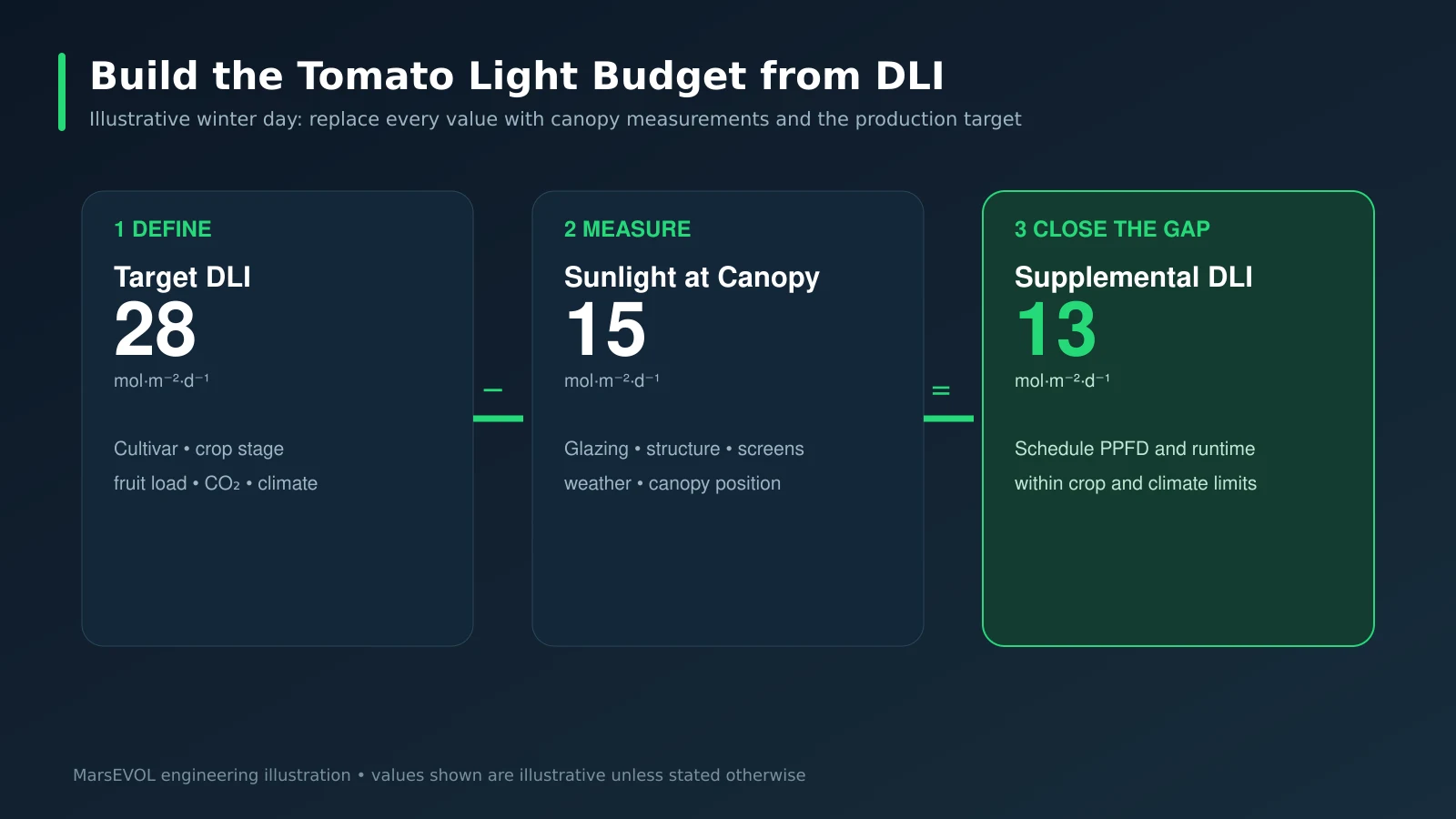
For a deeper explanation of the two quantities, see PPFD versus DLI in greenhouse design. PPFD describes the instantaneous photon rate; DLI describes the accumulated day.
How Should the Tomato Crop Stage Change the Lighting Plan?
The crop stage changes the objective, measurement plane and acceptable operating conditions even when the same greenhouse is used. Young plants need compact, uniform establishment; a rapidly developing canopy requires repeated height and distribution checks; fruiting high-wire plants require a larger daily light budget and attention to vertical shading.
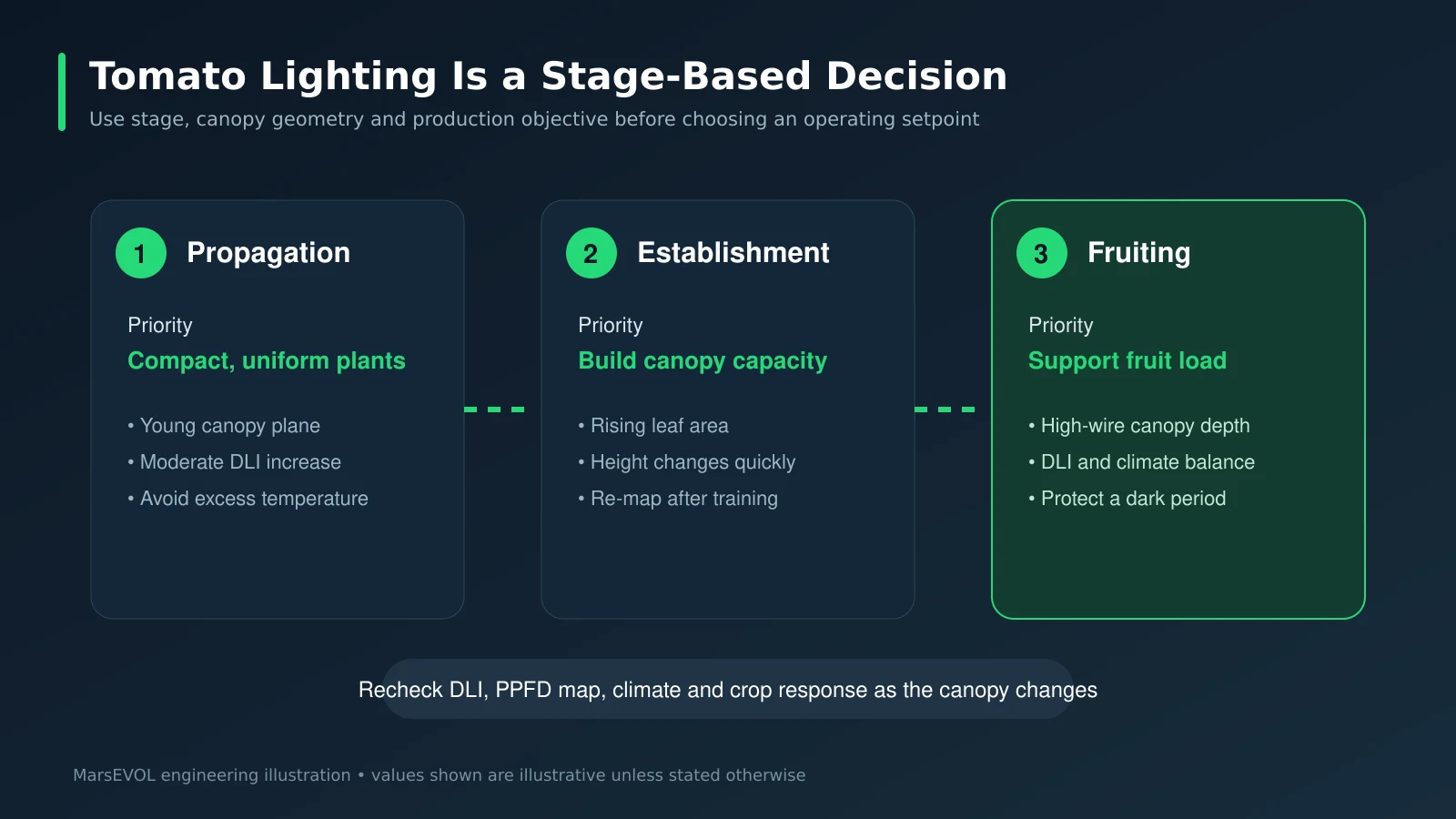
| Crop phase | Main lighting question | Measurement focus | Decision risk |
|---|---|---|---|
| Propagation | Is light sufficient for compact, uniform transplants? | PPFD and DLI at the young canopy | Excess heat or uneven trays |
| Establishment | Does the layout remain uniform as plants grow? | Changing canopy height and edge zones | Using the seedling plane after training |
| Fruiting high-wire crop | Does total light support the production target? | Top canopy plus vertical distribution | Ignoring lower-canopy shading and climate load |
Do not transfer results from compact indoor tomato research directly to commercial high-wire production. Cultivar, canopy architecture, sunlight, root volume and environmental control are materially different. Use research values as evidence about mechanisms and treatment boundaries, then validate the commercial crop response.
How Do You Convert a Tomato DLI Deficit into PPFD?
Divide the required supplemental DLI by the number of electric-light seconds available in the planned operating window. This produces the average canopy-level supplemental PPFD needed for screening. It does not by itself determine fixture count or guarantee uniformity.
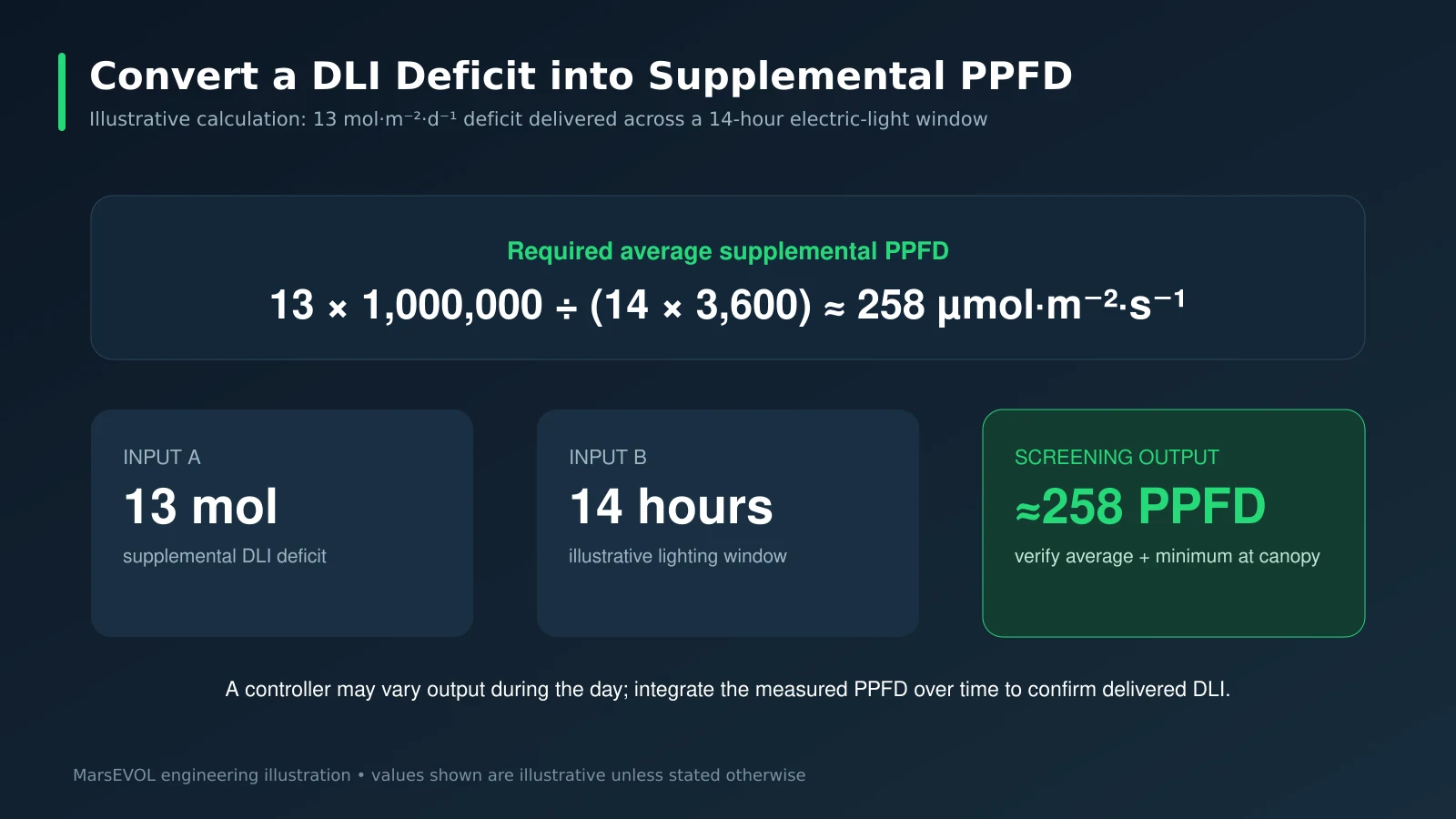
Target DLI: 28 mol·m⁻²·d⁻¹. Measured canopy sunlight: 15 mol·m⁻²·d⁻¹. Supplemental deficit: 13 mol·m⁻²·d⁻¹. Across a 14-hour electric-light window, the screening average is approximately 258 µmol·m⁻²·s⁻¹. A shorter available window requires higher PPFD; more sunlight reduces the deficit. The supplemental-light runtime guide explains the same relationship from the operating-hours side.
Engineering Design Snapshot: Winter High-Wire Tomato Zone
This illustrative zone turns the DLI calculation into a design handoff. It keeps the same 28 mol·m⁻²·d⁻¹ target, 15 mol·m⁻²·d⁻¹ measured canopy sunlight and 14-hour electric-light window used above, then identifies what the lighting designer and controls engineer still need to verify.
| Design parameter | Illustrative value | Engineering implication |
|---|---|---|
| Target crop DLI | 28 mol·m⁻²·d⁻¹ | Screening target only; confirm cultivar, stage, climate and economics |
| Measured canopy sunlight | 15 mol·m⁻²·d⁻¹ | Use greenhouse canopy data rather than outdoor DLI |
| Supplemental DLI deficit | 13 mol·m⁻²·d⁻¹ | Daily electric-light contribution to be closed dynamically |
| Available electric-light window | 14 h | Must fit the crop light schedule and protected dark period |
| Screening supplemental PPFD | ≈258 µmol·m⁻²·s⁻¹ | Convert to fixture count only after spatial modeling |
| Acceptance check | Mature-canopy PPFD map + DLI log | Verify edges, row geometry, shading and control response after installation |
Next, translate the 258 µmol·m⁻²·s⁻¹ screening requirement into a greenhouse lighting layout, check PPFD uniformity, and use DLI-responsive control so bright days reduce unnecessary output. A fixture such as SOLIFY PRO should be selected only after the project geometry and target map are defined. For a project-specific calculation, use the MarsEVOL greenhouse solution process.
Design input to prepare: greenhouse zone dimensions, row spacing, mature canopy height, winter canopy DLI, target DLI, operating window, electrical limits and control-zone boundaries.
What Photoperiod Should Greenhouse Tomatoes Use?
A conventional tomato program should protect a daily dark period and should not assume that 24-hour static lighting is safe. A 16-hour treatment is commonly used as a research control, while continuous-light responses vary with cultivar, DLI, spectrum, temperature and dynamic scheduling.
Recent peer-reviewed work compared dynamic and static 24-hour treatments with a conventional 16-hour control because prolonged lighting can cause photoperiodic injury in tomato. An ISHS greenhouse study also evaluated 24-hour treatments at defined DLIs and red-light intensities. These studies are valuable research, but they do not justify changing a commercial greenhouse to continuous lighting without crop-specific validation, climate safeguards and an economic case.
Define the total light-on interval—including sunlight and electric extensions—and the protected dark period. Then state whether electric light operates before dawn, after sunset, during low-radiation periods, or dynamically across the day. Never use “14 hours of supplemental light” as if it were automatically equivalent to a 14-hour photoperiod when daylight overlaps.
Why Does Canopy Distribution Matter for Tomatoes?
A high-wire tomato canopy can receive adequate light at the top while middle and lower leaves remain shaded. The design therefore needs both horizontal uniformity at the active canopy plane and a reasoned view of vertical light distribution.
A 2021 meta-analysis of 31 papers and 100 observations found an overall positive tendency from supplemental LEDs, but it also reported inconsistencies among trials. A 2016 single-truss experiment showed that inter-lighting improved mid-canopy distribution and produced season-specific responses; daytime summer lighting was not automatically beneficial. These are treatment results under defined conditions, not MarsEVOL performance claims.
For top lighting, model the planted boundary, roof structure, trusses, gutters, crop rows and mature canopy height. Review the complete PPFD map rather than the average alone. The MarsEVOL greenhouse lighting layout method connects the target to mounting, spacing and field verification, while the PPFD uniformity guide explains minimum-to-average and variability metrics.
How Should Tomato Lighting Respond to Sunlight and Climate?
Use zone-level dimming to close the daily light gap while respecting temperature, humidity, electrical and photoperiod limits. A fixed timer cannot respond to bright days, glazing differences, shade curtains or crop-zone variation.
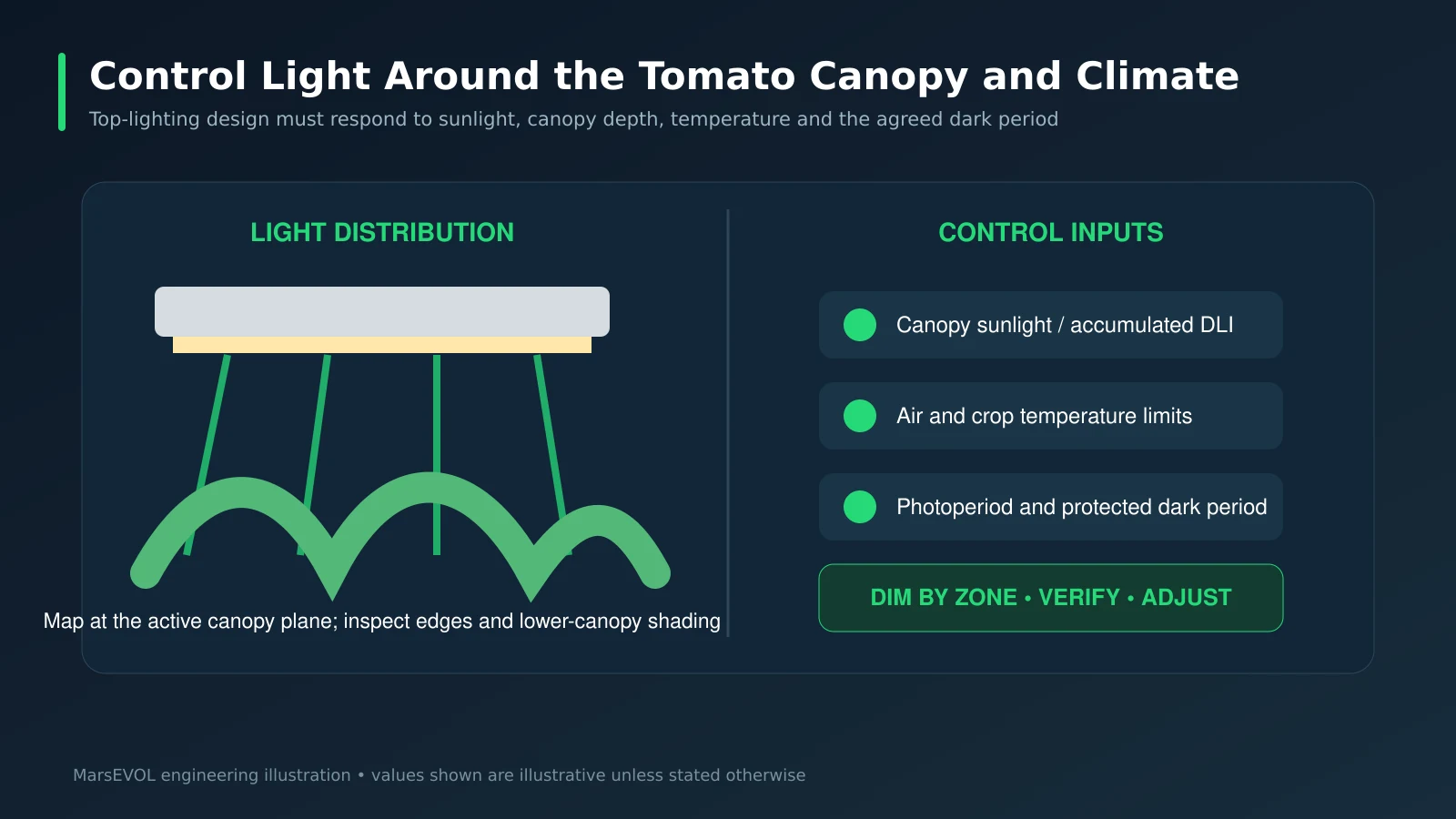
- Measure or estimate accumulated sunlight at a representative canopy location.
- Calculate the remaining DLI requirement using the agreed target.
- Check remaining operating time and maximum permissible supplemental PPFD.
- Apply temperature, humidity, electrical-demand and dark-period limits.
- Dim appropriate zones and continue integrating delivered light.
- Log the final daily DLI and exceptions for crop review.
The detailed DLI lighting control guide explains why a controller needs feedback, limits and a failure state rather than a single target number.
How Should a Tomato Lighting Design Be Verified?
Verify the electric-light system at the actual canopy plane with a documented quantum-sensor grid, then confirm the operating strategy using daily DLI and crop records. Separate electric-light acceptance from combined sunlight operation so the result can be repeated.
| Verification layer | What to record | When to repeat |
|---|---|---|
| Fixture and controls | Model, output setting, zones, command response | Commissioning and after changes |
| Canopy PPFD map | Grid, height, average, minimum, maximum, uniformity | Installation and major canopy-height change |
| Daily light delivery | Sunlight DLI, electric DLI, total DLI, exceptions | Continuous logging; periodic audit |
| Crop and climate | Temperature, humidity, CO₂, irrigation, fruit load and response | By production review interval |
Before approval, state sensor calibration, measurement orientation, grid boundary, time, shade-screen position and whether sunlight was negligible. A crop response that changes after lighting is introduced may also reflect irrigation or climate interactions, so the production review should not isolate light from the rest of the greenhouse.
Common Tomato Greenhouse Lighting Mistakes
Using one universal tomato PPFD
A single value hides DLI, photoperiod, sunlight, stage and climate. Define the full daily boundary.
Applying an outdoor DLI directly indoors
Glazing, structure and screens reduce transmission. Use canopy-level greenhouse data.
Confusing supplemental-light hours with photoperiod
Electric lighting can overlap daylight. Report the total light-on interval and dark period separately.
Designing only for the young canopy
High-wire tomatoes change height and density. Revisit the calculation plane and vertical distribution.
Treating research yield percentages as a guarantee
Published treatments have specific cultivars, climates, controls and baselines. Use them to inform trials, not sales promises.
Ignoring summer heat and diminishing value
Extra photons can have low or negative marginal value when sunlight and canopy temperature are already high.
FAQ: Tomato Greenhouse Lighting
What DLI do greenhouse tomatoes need?
MSU Extension gives at least 25–30 mol·m⁻²·d⁻¹ as a high-wire fruiting-vegetable reference. Confirm the final target for the cultivar, stage, fruit load, climate and economics.
What PPFD is best for tomatoes?
There is no universal PPFD. Calculate supplemental PPFD from the DLI deficit and available lighting window, then verify distribution at the canopy.
Can tomato lights run 24 hours?
Continuous-light strategies are an active research area and can cause photoperiodic injury. Do not use 24-hour static lighting as a default commercial program.
Should sunlight count toward tomato DLI?
Yes. Measure or estimate the sunlight that reaches the crop canopy inside the greenhouse and add only the required electric-light contribution.
Are top lights enough for high-wire tomatoes?
They may be, but the answer depends on canopy depth, row geometry and distribution. Review horizontal and vertical light conditions before deciding.
When should tomato lighting dim or switch off?
Reduce output when accumulated sunlight closes the DLI gap or when climate, electrical-demand, photoperiod or safety limits require it.
MarsEVOL Perspective: Design Around the Crop-Light Budget
MarsEVOL approaches tomato greenhouse lighting as a connected chain: production target → canopy sunlight → DLI deficit → supplemental PPFD and window → layout and uniformity → zones and climate limits → commissioning → crop review. SOLIFY fixture selection should follow the project boundary and photometric model; the product name alone does not determine tomato performance.
Conclusion
A defensible tomato lighting plan starts with a daily crop-light budget. Use a published DLI range only as a screening reference, quantify sunlight at the real canopy, convert the remaining deficit into average supplemental PPFD, protect an appropriate dark period, model the mature greenhouse geometry and verify the installed system. Then adjust operation with climate and crop data rather than relying on a fixed recipe.
Need a Tomato Greenhouse Lighting Plan?
Share the greenhouse dimensions, location, tomato type, canopy-height range, production stage, available DLI data, lighting window and control requirements.
Explore More MarsEVOL Resources
Connect crop targets, layout simulation, fixture selection and controls in one project workflow.
Review the official fixture form and published product data before project-specific photometric design.
References
- Runkle, E. Investment Considerations for Greenhouse Lighting. Michigan State University Extension.
- Virginia Cooperative Extension. Calculating and Using Daily Light Integral (DLI): An Introductory Guide. Virginia Tech, 2025.
- Appolloni, E., et al. Supplemental LED Lighting Effectively Enhances the Yield and Quality of Greenhouse Truss Tomato Production: Results of a Meta-Analysis. Frontiers in Plant Science 12, 2021. DOI: 10.3389/fpls.2021.596927.
- Tewolde, F. T., et al. Nighttime Supplemental LED Inter-lighting Improves Growth and Yield of Single-Truss Tomatoes. Frontiers in Plant Science 7, 2016. DOI: 10.3389/fpls.2016.00448.
- Lanoue, J., et al. Dynamic Lighting Mitigates Photoperiodic Injury in Greenhouse Tomatoes. Frontiers in Plant Science, 2026. DOI: 10.3389/fpls.2026.1731972.
- Hao, X., et al. Response of Greenhouse Tomato to a Long Photoperiod of Lighting Varies with Daily Light Integral. Acta Horticulturae 1423, 2025. DOI: 10.17660/ActaHortic.2025.1423.37.